Books
George Kemp
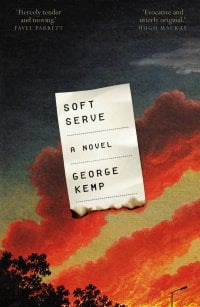
Soft Serve
Small towns can be both the most joyful places to grow up in – and the most stifling. George Kemp deftly captures this paradox early in Soft Serve when he describes the novel’s setting as “a place where one felt the excitement of a new set of traffic lights going up in town, as well as the sadness about the excitement of a new set of traffic lights going up in town”.
Pathos and bathos coexist in Soft Serve right from the first page, in which a priest rushes through a funeral so as not to miss a lawn bowls tournament. The community is grieving the sudden and senseless loss of one of its most beloved young men. Taz was a boy who did what some of his friends dreamt of and what others, for reasons they could barely articulate, found terrifying – he escaped the town’s “gravitational force” to move to Sydney. After the funeral and the wake, his three closest friends, Fern, Jacob and Ethan, convene in the town’s Macca’s for a three-cone salute of soft-serve ice-cream to their friend’s memory. This will become their annual ritual of remembrance.
Now it’s the second anniversary of Taz’s death. His mother, Pat, formerly a high-school career counsellor, became the manager of the Macca’s after her “sandcastle marriage” was wiped out by the rogue wave of Taz’s passing. If tragedy set Pat adrift, the work at Macca’s keeps her anchored. The innocuous, predictable food and decor lend the fast-food outlet a comforting if illusory air of stability, even permanence. It serves as a shiny plastic buttress against change and despair as well as a wee connection to the broader world outside. For all these reasons, it is one of the centres of town life – a fact that has to be at least as sad as excitement over new traffic lights.
The day dawns with an ominous, smoky light. Raging bushfires are fast approaching the town. Pat’s young staff all text in their excuses. On this day, when she is already struggling to keep it together, she’ll be on her own. Pat knows she’ll be seeing Fern, Jacob and Ethan, and expects to be feeding hungry crews of firefighters as well. At least she’ll keep busy.
The narrative of Soft Serve alternates between an account of the day and its rapidly building tensions and flashbacks that peel back the layers of sexual desire, hurt, love and friendship that have brought three young people to the point of ignition. If this is a novel about dealing with grief, which Kemp likens to trying to “fill in a sinkhole with a trowel”, it is also about bravery.
There are different types of bravery. There’s that of Taz, who left to pursue his dreams, and of Pat, who carries on. Then there’s the kind of courage displayed by Lotte, a Māori woman and the can-do leader of the local volunteer firefighters, who works tirelessly to save the lives and the houses of others even as her own home succumbs to the inferno. Another type of valour entirely is that of a young man about to reveal a fraught secret about himself. If this is the kind of town that takes perverse pride in its pub being named one of the five most dangerous in the state, it is not the sort of place where it has ever been safe to come out as gay.
One of the most affecting portrayals of character is that of Jacob, Fern’s brother, an inarticulate, messy lad just out of his teens, rough around the edges but with “something bright and sad clanging about in there”. Kemp tells us Jacob sorts his thoughts much like his mum sorts her playing cards after a round of Bundy and cokes – “slowly and incorrectly”.
This is a masterful and compelling first novel, infused with psychological insight, social observation and compassion. A small book, it is full of big themes like the climate crisis, the importance of community and the need to respect difference. The only outsiders we meet are a pair of grey nomads who have wandered into Macca’s on this of all days and very consciously set up an invisible wall between themselves and the townspeople with their brusqueness and his I WORKED MY WHOLE LIFE AND ALL I GOT WAS THIS LOUSY T-SHIRT T-shirt. It’s only with this unsympathetic pair that you feel the novel veering towards banality or at least stereotype, though there’s a shocking twist in their tale that gives it a genuine place in the narrative.
Kemp’s background as an actor and playwright informs the sharp dialogue and tight, almost theatrical setting of Soft Serve. Apart from the flashbacks, such as a party scene at Pat’s house when Taz was still alive that’s all tiki torches and sweetened cocktails, most of the action takes place inside the McDonald’s.
Soft Serve is an exquisitely touching coming-of-age and coming-out novel that is also about the ordinariness of life and the suddenness of death. A narrative of hot, risky emotions that unfolds against the menace of an encroaching bushfire, its central metaphor smoulders and sparks. In the hands of a lesser writer, it could easily have ignited a flaming wall of cliché, but Soft Serve is a feat of controlled burning. All the feels, none of them cheap.
UQP, 208pp, $29.99
This article was first published in the print edition of The Saturday Paper on January 31, 2026 as "Soft Serve".
For almost a decade, The Saturday Paper has published Australia’s leading writers and thinkers. We have pursued stories that are ignored elsewhere, covering them with sensitivity and depth. We have done this on refugee policy, on government integrity, on robo-debt, on aged care, on climate change, on the pandemic.
All our journalism is fiercely independent. It relies on the support of readers. By subscribing to The Saturday Paper, you are ensuring that we can continue to produce essential, issue-defining coverage, to dig out stories that take time, to doggedly hold to account politicians and the political class.
There are very few titles that have the freedom and the space to produce journalism like this. In a country with a concentration of media ownership unlike anything else in the world, it is vitally important. Your subscription helps make it possible.
Purchase this book
Soft Serve
BUY NOW
When you purchase a book through this link, Schwartz Media earns a commission. This commission does not influence our criticism, which is entirely independent.
Subscriber exclusive
Send this article to a friend for free.
Share this subscriber exclusive article with a friend or family member using share credits.