Visual Art
Awakening Histories challenges colonial narratives with an exhibition of artworks that explores centuries-old trade relationships with South-East Asia. By Carolyn Barnes.
Awakening Histories challenges narratives that erase Indigenous presence
The accepted colonial history is that Britain “discovered” Australia, an unhistoried terra nullius, in 1788. Of course, the real story is much more complex.
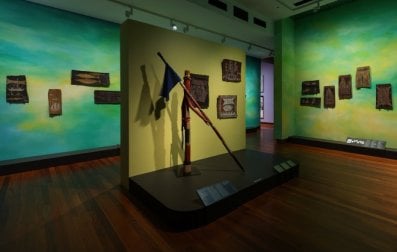
Awakening Histories, now showing at the Perth Institute of Contemporary Arts (PICA) after its debut at Monash University Museum of Art, explores the connections between First Nations peoples of Arnhem Land (Marege) and the Kimberley (Kayu Djawa) and South-East Asian seafarers, tracing how these relationships formed and endure.
Archaeological, historical and oral evidence shows that First Nations people across northern Australia had sustained contact with Macassan seafarers from South Sulawesi from at least the early 1700s. Macassans sailed seasonally to harvest trepang, trochus and turtle shell for trade with Manila and southern China.
The works in Awakening Histories, by artists from Australia, China, Indonesia and the Philippines, challenge dominant narratives that normalise colonial possession and erase Indigenous presence. By foregrounding the enduring connections between northern Australia and South Sulawesi, and showing how these relationships continue to shape the cultural practices and political consciousness of the artists and their communities, the exhibition contests the notion that settler colonialism is a completed historical event. Through various artistic strategies, the works expose the limits of Western historical frameworks, which continue to distort how Indigenous and regional pasts and presents are understood.
Rather than presenting history as a single path towards Western modernity, Awakening Histories reveals multiple, coexisting trajectories. Key works highlight alternative modernities, suggesting the peoples of the region were developing their own modern project through a complex system of trade and exchange, a history overshadowed by Eurocentric narratives focused on the Silk Road or spice routes. The trepang industry was an advanced supply chain involving navigation, seasonal labour, middlemen and logistics. Guan Wei’s porcelain vessels make this sophistication tangible, elegantly conveying the cultural, culinary and medicinal significance of the trepang trade.
Karrabing Film Collective’s Night Fishing with Ancestors (2023) offers an Indigenous analysis of colonisation. Across six episodes, it moves from pre-colonial times, marked by reciprocal relations with Macassan traders, through to Captain Cook’s arrival and the violent consequences of settler colonialism. It then turns to the impact of the gold and diamond rushes and later extractive mining, concluding with the current climate crisis.
The film represents white settlers as zombies who wage war on Indigenous peoples and ecosystems. It makes clear that just as ancestors remain present, colonialism and its consequences are ongoing for Aboriginal people. It imagines what ecological and historical paths might have unfolded if the British had never arrived, how the largely collaborative and peaceful relations between First Nations and Macassan people might have continued, rather than being disrupted in the late 19th century by the imposition of import duties and licensing fees on Macassan ships. The trepang trade was banned in 1906 under the White Australia policy.
By highlighting a pre-colonial history shaped by seasonal trade winds, Awakening Histories reveals a region organised through fluid, oceanic networks. In foregrounding maritime connections, it contests land-based notions of political order established under British settlement, placing northern Australia in a regional history defined by mobility, interconnectedness and relational sovereignty rather than fixed borders, nation-states or racialised difference.
The trepang trade is recorded in oral traditions, Austronesian loan words, rock art depicting proa (Macassan sailing vessels), and knowledge exchange, such as dugout canoe manufacture – forms of evidence often dismissed as anecdotal within Eurocentric historiography. The artists in the exhibition actively resist these interpretations, insisting their histories be told on their own terms.
Awakening Histories reflects this critique by marshalling a group of works that materialise alternative historical registers. It brings together ceramics, bark paintings, textiles, performance works, paintings and sculpture that embody place-based memory, intergenerational storytelling and the material traces of the trepang trade. Taken together, these works address historical oversights by holding multiple ways of knowing at once, conveying history through material, sensory and relational forms that exceed the limits of conventional historiography.
Darrell Sibosado’s Niman Aarl (Many Fish) (2021–25) is created from ebony, pearl, and trochus and turtle shell – materials traded, worked and lived with for generations – and links his Bard Country to Macassan trade. A “school” of 500 hand-carved fish arranged in a circle on the gallery wall invites reflection on the connections between human activity, ocean life and trade histories. Produced collaboratively across generations of Sibosado’s family, the work enacts history as a living process, where knowledge is sustained through kinship, place and practice rather than abstract narrative.
Although the trepang trade between northern Australia and South Sulawesi officially ended more than a century ago, the relationship endures in people’s knowledge of their origins. Abdul-Rahman Abdullah explores this continuity through hybridity and entanglement. Drawing on his maternal lineage to the old Luwu Kingdom in South Sulawesi, he traces ancestral movements across South-East Asia to Binjerup Nyungar Country in south-west Western Australia, echoing longer regional histories.
In his group of recent drawings, past and present converge in depictions of his children in their contemporary landscape alongside ancestral graves, Macassan proa, water buffalo and fighting cocks. Through interwoven motifs of culture, family and place, Abdullah presents history as an ongoing, lived inheritance that connects distant geographies and generations.
Macassan voyaging relied on advanced knowledge of astronomy, monsoon winds, sea currents and seafaring technologies. They exchanged goods such as cloth, tobacco, rice, metal tools and pottery with Aboriginal communities in return for assistance harvesting trepang. Macassan culture was incorporated into Indigenous technologies, totemic systems and cultural practices, and references to these influences recur throughout the works in the exhibition.
Bulthirrirri Wunuŋmurra paints triangle motifs on ceramic vessels crafted by South Sulawesi artisans Daeng Tommi and Daeng Siama to remember the sails of Macassan proa on the horizon. Other works in the exhibition adopt the form of sails or represent seafaring and boat-building practices drawn from oral histories.
Gunybi Ganambarr’s Djirrit (2021) depicts how knowledge of Macassan sail construction and thunderhead clouds – as indicators of shifting winds – enabled him and a group of companions to avoid being stranded during a turtle-hunting expedition.
For Macassan sailors, tamarind was an essential food source for long sea journeys. Aziziah Diah Aprilya’s Under the Tamarind Tree (2025) highlights the tree as a site of social life in South Sulawesi, while recognising the trees that took root along northern Australian coasts from seeds discarded by Macassan sailors.
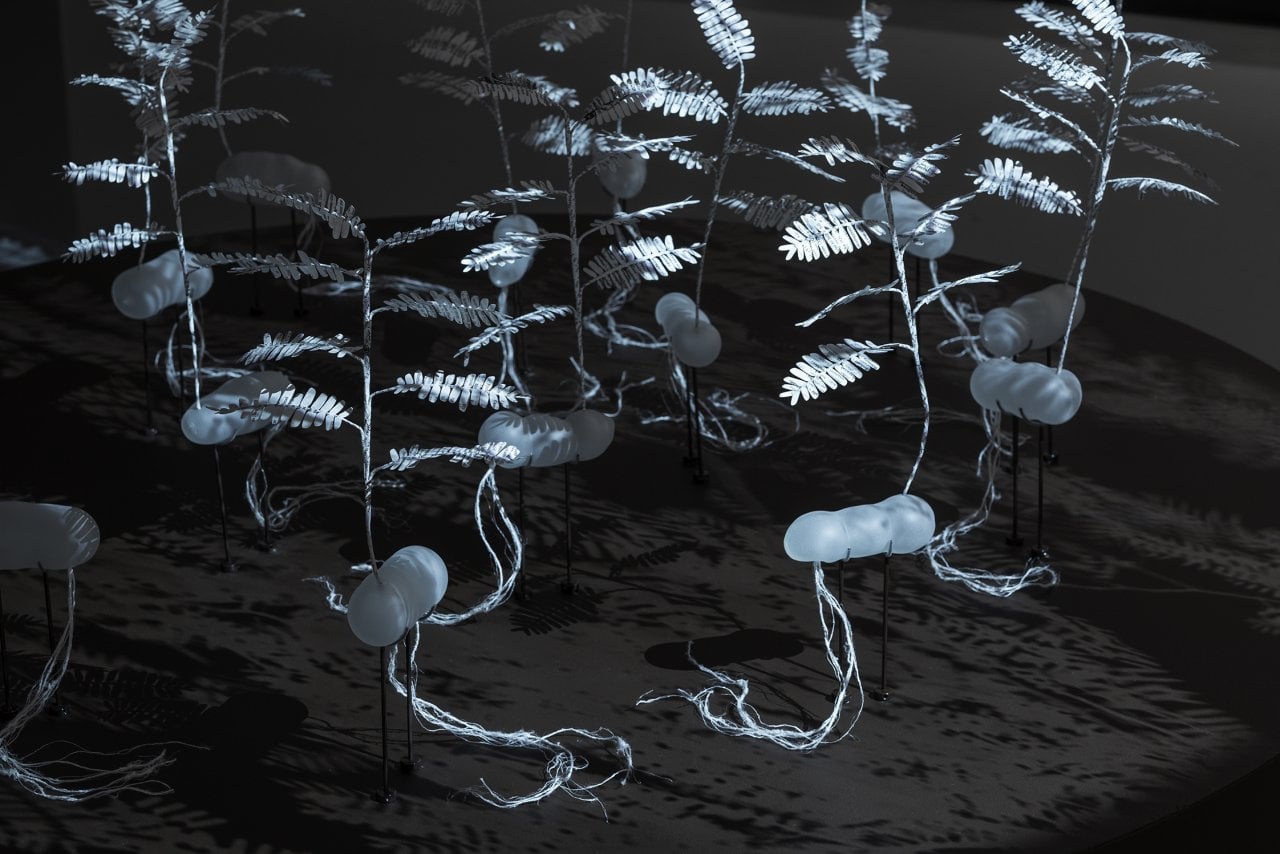
In Category of Significance: Ancestral (Tamarindus indica) (2025), Jenna Lee, an artist of Gulumerridjin, Wardaman, KarraJarri Saltwater, Japanese, Chinese, Filipino and Anglo-Australian ancestry, sculpts 15 tamarind seedlings in paper. Each represents a significant Darwin tamarind tree, marking a burial site where Indigenous people gather under the shady canopy to honour those who have died.
The works in Awakening Histories counter colonial narratives by bringing into view local languages, cosmologies and lived experience. This exhibition presents history as a plurality of trajectories, accessible through ancestral knowledge and cultural practice. It demonstrates art’s power to preserve memory, transmit culture and help future generations understand who they are and where they come from.
ARTS DIARY
EXHIBITION Searchers: graffiti and contemporary art
National Art School Gallery, Gadigal Country/Sydney, until April 11
CINEMA AACTA Festival
Home of the Arts, Yugambeh Country/Gold Coast, February 4–8
THEATRE Lacrima
Heath Ledger Theatre, Whadjuk Noongar Country/Perth, February 6–10
CIRCUS The Mirror
Theatre Royal Hobart, nipaluna, February 5–7
MULTIMEDIA Tourmaline: Transcendent
Australian Centre for Contemporary Art, Naarm/Melbourne, until March 15
Last Chance
VISUAL ART Art on the Murray
Arnold Gallery, Nganguraku Country/Mannum, South Australia, until January 31
This article was first published in the print edition of The Saturday Paper on January 31, 2026 as "Seas of memory".
For almost a decade, The Saturday Paper has published Australia’s leading writers and thinkers. We have pursued stories that are ignored elsewhere, covering them with sensitivity and depth. We have done this on refugee policy, on government integrity, on robo-debt, on aged care, on climate change, on the pandemic.
All our journalism is fiercely independent. It relies on the support of readers. By subscribing to The Saturday Paper, you are ensuring that we can continue to produce essential, issue-defining coverage, to dig out stories that take time, to doggedly hold to account politicians and the political class.
There are very few titles that have the freedom and the space to produce journalism like this. In a country with a concentration of media ownership unlike anything else in the world, it is vitally important. Your subscription helps make it possible.
Subscriber exclusive
Send this article to a friend for free.
Share this subscriber exclusive article with a friend or family member using share credits.