Visual Art
Tina Stefanou’s exhibition You Can’t See Speed draws on her Greek heritage to present a richly layered symbolic exploration of the urban fringe. By Carolyn Barnes.
Tina Stefanou’s You Can’t See Speed
In Australian life post-colonisation, the bush and the suburbs have at times represented competing zones of cultural significance. The bush was long more than a landscape, symbolising national identity, mythology and cultural expression. Once romanticised as the authentic Australia, the bush gradually gave way to suburbia as the embodiment of everyday Australian life – both critiqued for its lack of character and celebrated for shaping a distinctive Australian experience and identity.
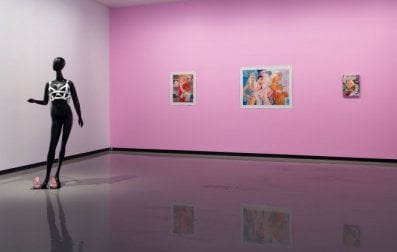
Tina Stefanou’s exhibition You Can’t See Speed at the Australian Centre for Contemporary Art (ACCA) explores the mysteries of an interstitial zone on Melbourne’s urban fringe that is neither suburb nor bush. Centred on Doreen, a fast-growing outer suburb in Melbourne’s north that mixes new housing developments with pockets of rural landscape, Stefanou reveals it to be a battleground of mythological proportions where the complex forces shaping 21st century Australia play out.
On Australia’s urban fringe – the site of rapid population growth and residential expansion – development pressures clash with existing rural land uses. This is a space where wealthy tree changers seeking semirural lifestyles are reshaping place identity, as shifting demographics and economics push out long-term residents. It is equally a zone of socio-spatial inequality characterised by infrastructure lag, limited public services and transport disadvantage. Australia’s urban fringe often hosts biodiversity hotspots, water catchments and fire-prone areas, creating tensions between urban expansion and conservation goals, especially in the absence of sustainable planning practices that might balance ecological protection with human settlement.
Stefanou’s exhibition captures all of this, representing Australia’s urban fringe as a space of transition and negotiation, where diverse interests – rural, urban, ecological, economic, cultural – intersect.
Despite the strong element of critique in Stefanou’s work, she is an artist, not a social geographer. In You Can’t See Speed, she draws on her Greek heritage to present a richly layered symbolic exploration of this in-between zone. Nothing is didactic; the enthralling quality of the works draw you into a temporal, sensory experience where meaning unfolds through contingency, immersion and presence.
Across the four exhibition spaces at ACCA, an interconnected series of works combining installation, sculpture, sound-music and video culminates in the vast installation Grief Ramp (2025). This takes the form of a motorbike stunt ramp built from scaffolding that curves around and up into the heights of the gallery space, painted black for the exhibition and dimly lit. At the threshold of the installation plays a collaborative film, made with the blind motorcycle mechanic and rider Matthew Cassar.
Blindness in Greek mythology is not simply a loss but a gateway to different kinds of understanding, often tied to the divine, the tragic and the transformative. Befittingly, Cassar speeds effortlessly around a scrubby paddock on his motorbike, guided by voice instructions, only occasionally losing his balance, before picking up his bike and zooming off again. The camera view lurches around, capturing fleeting images of a scattering mob of kangaroos, patches of remnant eucalypts and makeshift buildings and fencing.
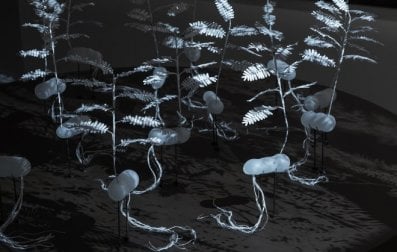
Through the installation, Stefanou arouses intense, subjective reactions, mostly bypassing rational thought, to connect the viewer to the work. On the film’s soundtrack, the noise of the bike’s motor grows in intensity. Hanging from the scaffolding are enigmatic elements – large glass eyes encrusted with threads of bright, white salt crystals, looking like strange octopuses; a glowing, cascading cloth, also salt-encrusted, dropping from the highest point of the ramp to the gallery floor.
With its range of elements and dialogical nature, You Can’t See Speed needs to be experienced, but there are some constants across the works in the exhibition. Taking its lead from Greek mythology, You Can’t See Speed explores dualities and tensions, creating space for cultural and philosophical reflection. As in myth, for Stefanou meaning emerges not from fixed truths but from the dynamic interplay of characters, choices and consequences. Her works don’t offer clear resolutions but rather invite interpretation.
A gender convention the exhibition investigates is the trope that boys ride motorcycles and girls ride horses. The psychosocial appeal of motorbikes to boys and men can be explained by the opportunity to display toughness and mastery over machines. Girls’ psychosocial attraction to horses in late childhood and early adolescence is linked to a desire for autonomy, emotional connection and a sense of capability. Horses also carry symbolic weight, embodying grace, wildness and ties to the divine and heroic in myth.
The exhibition includes Stefanou’s haunting video work Hym(e)nals (2022), in which a group of equine and teenage human performers appear as apparitions, moving in and out of the shadows to a hypnotic soundtrack of melismatic singing. Hym(e)nals plays on the symbolism of the horse, renegotiated through the lens of socially delineated female traits. While horses represent freedom, strength and beauty in culture, they also require care and empathy. Across Australia’s urban fringe, pony clubs and riding lessons offer a structured, socially acceptable space for girls to find friendship and express competitiveness and physicality, often more freely than in other gendered spaces.
Stefanou’s video suggests the existence of a mystery cult of veiled teenage equestrians, yet their pastel tracksuits and the undeniable ordinariness of the horses drags you back to the actuality of the urban fringe. The exhibition challenges traditional notions of the mythic. Much like the American artist Robert Smithson’s reflections on the city of Passaic, particularly in his 1967 photo essay A Tour of the Monuments of Passaic, New Jersey, Stefanou suggests that the mix of urban sprawl and rural and natural remnants on Australia’s urban fringe are as revealing of our culture as classical ruins.
Stefanou approaches what might be seen as marginal and mundane as worthy of artistic and philosophical reflection, without ignoring the despoliation of the countryside as urban development spreads into formerly agricultural or natural areas. For Stefanou, fringe suburbs such as Doreen might be compromised and overlooked, but they possess their own kind of meaning and significance.
The eight-channel video installation Field of Triggers: Agri-temple (2025), a compilation of sections of Stefanou’s filmed performances, explores the profound and lasting contribution of Greek migrants to Australian society, culture and economy. Arriving in significant waves from the early 20th century, Greek migrants in the Australian suburbs re-created aspects of the daily life of the agrarian communities they left behind. A significant number brought less expensive land just beyond the urban fringe, in areas such as Doreen, to more fully maintain an agricultural lifestyle.
The rich traditions of community, language, food, music and celebration that Greek migrants brought with them to Australia resonate through Field of Triggers. Greek Australians were early advocates for multiculturalism, pushing back against assimilationist policies in the 1960s and ’70s. Their success helped shift Australian identity from a British-centred model to a more pluralistic, inclusive one.
Stefanou’s work explores such themes indirectly, through oblique combinations of images, sounds and material that allow unexpected connections to emerge, inviting open-ended interpretation. The application of artistic media is an integral part of this. Wax and plaster casts of horses’ legs and hoofs emerging from the gallery ceiling and walls appear at random in the exhibition. Their artistic index is classical Greek sculpture but, as disconnected body parts, they also suggest the fate of the many uncared-for horses on the Australian urban fringe, which can face neglect or abandonment as owners struggle with the costs and space required to care properly for them amid expanding suburban development.
In several video works, the sequence of images is determined by an algorithmic program, creating a nonlinear, generative experience that changes over time or in response to specific inputs. In challenging conventional storytelling by emphasising variability, unpredictability and process over fixed narrative, Stefanou mirrors the evolving nature of her subject matter – life on the urban fringe – where a complicated mix of economic, ecological and human factors drive unpredictable change.
As an example of participatory media, algorithmic video emphasises audience collaboration in the production of meaning. Such participation is equally central to Stefanou’s practice. Each work in You Can’t See Speed reflects the contribution of many creative and technical collaborators, animal and human. This includes members of the communities Stefanou documents in exploring the urban fringe as a site of contradiction and wonder.
Tina Stefanou: You Can’t See Speed is showing at ACCA until June 9.
ARTS DIARY
VISUAL ART Blak In-Justice: Incarceration and Resilience
Heide Museum of Modern Art, Wurundjeri Country/Bulleen, until July 20
SCULPTURE Undercurrents
Top Gallery, nipaluna/Hobart, until April 26
COMEDY Brisbane Comedy Festival
Venues throughout Meanjin/Brisbane, until May 25
LITERATURE Sorrento Writers Festival
Venues throughout Boon Wurrung Country/Sorrento, April 24-27
EXHIBITION Morris & Co | An Adelaide Obsession
Art Gallery of South Australia, Kaurna Yarta/Adelaide, until June 29
LAST CHANCE
MULTIMEDIA Here, Somewhere
Fremantle Arts Centre, Whadjuk Noongar Country, until April 20
EXHIBITION Yayoi Kusama
National Gallery of Victoria, Naarm/Melbourne, until April 21
This article was first published in the print edition of The Saturday Paper on April 19, 2025 as "Suburban myths".
For almost a decade, The Saturday Paper has published Australia’s leading writers and thinkers. We have pursued stories that are ignored elsewhere, covering them with sensitivity and depth. We have done this on refugee policy, on government integrity, on robo-debt, on aged care, on climate change, on the pandemic.
All our journalism is fiercely independent. It relies on the support of readers. By subscribing to The Saturday Paper, you are ensuring that we can continue to produce essential, issue-defining coverage, to dig out stories that take time, to doggedly hold to account politicians and the political class.
There are very few titles that have the freedom and the space to produce journalism like this. In a country with a concentration of media ownership unlike anything else in the world, it is vitally important. Your subscription helps make it possible.
Subscriber exclusive
Send this article to a friend for free.
Share this subscriber exclusive article with a friend or family member using share credits.