Visual Art
Image Economies at the Monash University Museum of Art shows how technology changes our relationship to representation – and to ourselves. By Carolyn Barnes.
Image Economies and how technology transforms
Monash University Museum of Art launches into its 50th year with the exhibition Image Economies. Featuring works from the Monash University Collection and new commissions, it showcases several generations of artists who have explored the role of images in shaping identities, subjectivities and social norms.
Curators Stephanie Berlangieri, Melanie Oliver and Francis E. Parker fulfil the assignment of a university art museum by challenging their audience with complex, multifaceted ideas. Many works employ video and digital installations that require extended engagement from the viewer.
Image Economies emphasises the deep connection between representation and technology, and how technology amplifies and transforms our experience of images. For example, Ian Burn’s Systematically Altered Photographs (1968), the exhibition’s earliest work, is basic compared with other works. Yet photocopying transformed how we reproduce and share ideas, while its convenience increased our dependence on technology to disseminate information. Challenging assumptions about photographic truth, Burn repeatedly photocopied images from a government brochure celebrating Australia’s development until only traces of the originals remained. The work is complemented by a theoretical text on the linguistic construction of visual experience. Here Burn deploys the photocopy to prioritise concept and process over the idealisation of the original artwork.
Conceptual artists such as Burn addressed fundamental issues within representation through cool philosophical analysis. Artists active from the late 1970s extended this to scrutinise whole systems of representation across the high/low cultural divide. Jeff Gibson’s series disPOSTERS (1986) exemplifies how artists appropriated and recontextualised mass cultural imagery to question the control of the production of meaning in industries such as advertising, media and entertainment. The paired images in Gibson’s work are visual tropes, formulaic elements found in multiple contexts to convey normative ideas and attitudes, which question the pervasive influence of mass media on society.
A pivotal stream of critique featured in Image Economies looks at traditional depictions of women. Victoria Todorov’s appropriated images of celebrities, such as the politician and former porn star Cicciolina, Anna Nicole Smith and Toni Holt Kramer (leader of the Trumpettes), play on and subvert gendered stereotypes. The selected images of each woman emphasise femininity and sexuality in the performance of gender, especially in celebrity culture. Yet Todorov’s subjects have some agency in crafting their public image, simultaneously challenging and reinforcing societal expectations. In Heaven (1997), Tracey Moffatt films male surfers changing out of their wetsuits in beach-side car parks. By positioning the audience to view the surfers through a voyeuristic lens, Moffatt flips the male gaze, making the surfers the subjects of visual pleasure.
The most arresting works are by artists who use digital media to explore issues obliquely through emotions, sensations and mood. Ashley Perry’s Precipitation 2021 (2021) addresses the complexities of colonialism, cultural heritage and ownership in the vast collections of Indigenous artefacts held in museums. The main activity in Precipitation 2021 occurs on a palm-sized screen. It’s attached to a small, single-board computer placed in one of three suspended cable trays that comprise the installation. The computer runs an imaging program created by Perry, a Goenpul artist from Quandamooka Country. At first, little seems to be happening on the screen. Occasionally – you could walk by and miss it – a faint geometric object streaks across the monochromatic blue field, vanishing as quickly as it appears. Only the circular wave pattern left behind confirms that something happened.
Precipitation 2021 addresses the fate of Indigenous artefacts locked away in museum collection vaults, far from their origins and disconnected from the cultural practices that make them meaningful. They exist mainly as entries in digital collection management systems yet often lack accurate identifying information. These artefacts are mostly inaccessible to the public, displayed only intermittently, if at all. Their journey through time and space is uncertain. They might be repatriated to restore some respect to their communities but will more likely be retained in the belief that museums can best preserve and interpret world heritage. Precipitation 2021 creates an affective experience of the evanescence of cultural heritage and traditional knowledge in a digital age.
Ana Iti’s video Howling out at a safe distance (2021) equally hinges on the difficult, protracted process of reclaiming language. In the video, a pair of hands hesitantly moves a sheet of paper punched with several holes over a historic Māori language newspaper. The text has been processed through several digital translation tools, suggesting how technology, while offering potential for accessibility, can also complicate efforts to maintain the integrity of cultural heritage. The gaps in the paper eventually settle on words and phrases that hint at how language, culture and community become diminished over time, despite the efforts of the Māori people to maintain the connection.
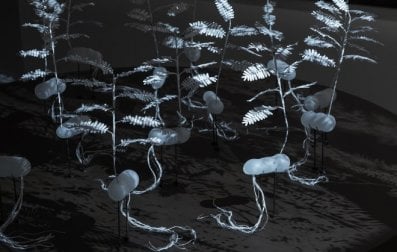
Many critics argue that technology transforms how we relate to the material world, turning it into something to be manipulated and used, rather than to be experienced with meaning. The Sun Is Not To Be Believed (2022–23) is a collaboration between Juliet Carpenter and Róisín Berg, who wrote an algorithm that manipulates the playback of the black-and-white footage of a woman working in a garden. The program randomly repeats and overwrites the recording, progressively corrupting the image to suggest the friction between human agency and technological determinism in our disturbed relationship with nature, our dwindling connection shown in the increasing fragmentation of the video image.
The four-channel video work #C (2025) by Machine Listening (Sean Dockray, James Parker and Joel Stern) immerses its audience in a confusing sound and image scape in which disembodied voices describe mundane actions in meticulous detail. The video content comes from Meta’s Ego4D research project, which aimed to create advanced wearable devices that scan the wearer’s immediate environment from their perspective to anticipate actions that can provide assistance. During its research phase, the project collected a vast body of video data from this “first-person” perspective, ostensibly to make technology more intuitive and responsive to users’ needs.
Whatever its utilitarian benefits, the technological appropriation of the individual’s visual field suggests a representational system that runs counter to human autonomy and control. In exploring the effects of representations, Image Economies, without explicitly providing a history, loosely charts the shift from the time when images existed outside the viewer, even while they influenced their subjectivities, to their growing absorption of the human.
Image Economies is showing at Monash University Museum of Art until April 17.
This article was first published in the print edition of The Saturday Paper on March 8, 2025 as "Treason of images".
For almost a decade, The Saturday Paper has published Australia’s leading writers and thinkers. We have pursued stories that are ignored elsewhere, covering them with sensitivity and depth. We have done this on refugee policy, on government integrity, on robo-debt, on aged care, on climate change, on the pandemic.
All our journalism is fiercely independent. It relies on the support of readers. By subscribing to The Saturday Paper, you are ensuring that we can continue to produce essential, issue-defining coverage, to dig out stories that take time, to doggedly hold to account politicians and the political class.
There are very few titles that have the freedom and the space to produce journalism like this. In a country with a concentration of media ownership unlike anything else in the world, it is vitally important. Your subscription helps make it possible.
Subscriber exclusive
Send this article to a friend for free.
Share this subscriber exclusive article with a friend or family member using share credits.