Back
Back



News
In an exclusive interview with The Saturday Paper, the prime minister says he is campaigning on three elements: his record, his promise and the risk of the alternative. By Karen Barlow.
Your subscription makes these exclusive articles possible
Subscriptions make these exclusives possible SUBSCRIBE NOW
On the plane with Albanese: ‘In turbulent seas, we’ve kept our eye on the horizon’
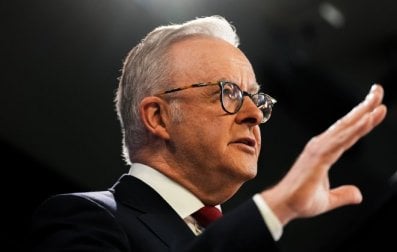
Anthony Albanese looks at his turkey baguette. He considers the sandwich for a moment, then cuts it in half. It’s the beginning of the third week of the campaign and the Labor leader is hungry.
Sitting on an RAAF-operated flight between Hobart and Melbourne, Albanese is upbeat about his chances. There are no signs of campaign fatigue. He uses every minute – of the flight and in the towns he visits too.
“One of the things that I’ve done in this campaign, unlike my opponent, is I do unscripted stuff,” the prime minister tells The Saturday Paper. “I went out to dinner in Hobart. It was great. Talking to people walking down the street, talking to people in the restaurant, talking to people afterwards.
“Day one, on the way to the urgent care clinic in Dickson [Peter Dutton’s Queensland seat], we stopped before and I went into that gym, 30 people there, talked with them.
“I went for a walk in Adelaide with [fiancée] Jodie [Haydon] and [son] Nathan. We went around the street, went through the mall in Adelaide, the Rundle Street mall. People stopped and had a chat. They’re engaged. So, sometimes without the media, but a lot of time with the media as well.”
The Saturday Paper spent this week travelling with the Labor leader as he launched his party’s official campaign again in Perth and then spun around Adelaide, Hobart and Melbourne.
It was a flurry of activity to bed down Labor messaging, particularly on health and housing.
Albanese says he is drawing on a “wide circle of trusted confidants” as the campaign progresses. He says his power circle consists of Katy Gallagher, Mark Butler, Richard Marles, Jim Chalmers and Don Farrell, as well as Labor national secretary Paul Erickson.
“I have others that I speak to as well, of experience,” the Labor leader says. “I am someone who reaches out to people. I speak to people, including some people who might come as some surprise, people in the business community, in the community, in the union movement.
“You always listen to people’s different perspectives. One of the things about being in a campaign is I’m not watching the TV news every night and reading all the papers and doing all of that because you’re too busy. So getting that input is helpful.”
Albanese had been in parliament for five years when Peter Dutton was elected in 2001. He says his opponent has not changed in that time.
“He’s always been someone who has sought to promote division and send Australians against each other,” he says.
“He’s the person who walked out on the Apology for the Stolen Generations. That was an uplifting moment for the nation. There’s never been a moment too big for Peter Dutton to show how small his vision for Australia is.”
Asked about his second-term agenda, Albanese insists “ambition has been there from day one” in areas such as climate and childcare, while he continues to acknowledge that progressives are impatient for reform.
The National Anti-Corruption Commission is a proud first-term achievement, he says, but he won’t address the calls for more open hearings, as he respects the commission’s independence. “It’s doing its job,” he says.
Global events, war, natural disasters and Trump weigh heavily and have led to agenda adjustments.
“We’re in uncertain times,” he says in a now very familiar refrain. “You of course always have to respond to immediate events, but we’ve responded to immediate events with action like cost-of-living relief. But in turbulent seas, we’ve kept our eye on the horizon. Where do we want to get to? How do we build a stronger Australian future?”
As the days run down, the prime minister is now on the offensive in Labor target seats such as the LNP-held Brisbane marginal seat of Bonner and the inner-city Greens territory in the Queensland capital.
“Campaigns are about competing clarities and I think that he has been clearer, and he’s been more composed,” a senior Albanese colleague tells The Saturday Paper.
“We have a more battle-hardened story to tell, and the other guys are kind of a bit feeling their way and recalibrating and recalibrating, whereas we’ve got a pretty good story about what we’ve done, what we want to do, and what the risk is.
“Peter Dutton has been kind of knocking around this right-wing echo chamber, and that did him a disservice.”
The revolving door of prime ministers in the Rudd–Gillard–Rudd years was painful for Albanese. This week, he reflected on his famous, tearful line from the time – “I like fighting Tories; that’s what I do.” The sentiment crystallised Albanese’s position as a Labor warrior but has more recently been used to question whether he still has the same drive.
“The context was Labor was fighting itself,” he tells The Saturday Paper. “When a political party is looking inward, that’s a recipe for negative outcomes.
“I firmly believe that Labor should be united. It has been since I’ve been leader, and before, to be fair, as well, because that’s how you can focus on what the needs of Australians are, and also, I firmly believe that the country would go backwards if Peter Dutton was elected.”
Dutton has kept the Coalition united over the Albanese term but campaign problems are weighing down his side. One source tells The Saturday Paper that it’s “tough out there”. Another says shadow treasurer Angus Taylor is circling his leader and has been shoring up right-faction support throughout the term, particularly in New South Wales.
“I think if the answer is Angus Taylor, it’s a stupid fucking question, and I can only imagine how Peter Dutton feels about it,” a senior Labor insider says of the destabilisation talk. “Angus Taylor is at least as responsible for the policy and coherence in the Coalition as anyone.”
https://www.youtube.com/watch?v=viod_ZODrsA&ab_channel=TheSaturdayPaper
Both Labor and the Liberals are fighting voter distrust, disengagement, anger over the cost-of-living crisis and now deepening concern over Donald Trump’s tariffs.
The Coalition is floating indexation of personal income tax scales to end bracket creep. Chalmers insists Labor has not looked into similar policy.
While the campaign has been criticised for a lack of ambition and inspiration, MPs say local retail issues are hitting home.
“People do pick up on the Temu Trump in Peter Dutton, and people, as we’re knocking on their doors, have been watching their super balances tank, and that really worries them,” the Labor member for Swan, Zaneta Mascarenhas, tells The Saturday Paper.
“They don’t know what Peter Dutton stands for, and they don’t see the certainty that they need.”
Asked what the same voters are saying about Albanese, Mascarenhas says, “They see someone who genuinely cares about WA and their future.”
Another MP says, “Medicare is really resonating. It is a Labor issue that opens a door to wider conversation.”
This week Dutton decided to bring his son Harry out to help sell Liberal housing policies and soften his hard Queensland cop image – a tactic described as “bizarre” and “scatterbrain” by Liberal colleagues.
It’s a door that has been opened for a notoriously private politician when it comes to family and family finances. It took the Liberal leader an extra day to concede he will one day help Harry buy a home.
Labor insiders say there is no way Albanese would bring out his son at media events, although Nathan was with him at the Labor launch and is expected to be with him on election night.
Asked if he is winning or his opponent is losing at this point in the campaign, Albanese is not getting in Dutton’s way.
“I’m focused on what our agenda is, and we have been focused on three elements,” he says. “One, what we’ve done, our record. Secondly, the offer going forward. And thirdly, the risk on what we’ve done, inflation down, wages up, interest rates starting to fall, a million jobs created, real wages growing, climate action occurring and transitioning the economy.”
On the campaign trail, Albanese looks as if he is enjoying himself. In Brisbane, asked about an issue he has not been briefed on, he quips: “I don’t shoot from the hip. You’re thinking of the other bloke.”
At press conferences, Albanese does what he calls a “gender thing”, alternating questions between male and female journalists.
“Been doing it for three years. I go boy, girl, boy, girl,” he says. “Because otherwise what happens? What happens, you might have noticed, is that it’s the blokes who yell out first.”
Asked in Perth how badly he wants to be prime minister, he responded: “What do you reckon?”
Like Dutton, Albanese tends not to allow follow-up questions, but the press pack has been working together to ensure important points are not let go. It is happening on the Dutton side as well.
After a strong start to the campaign, Labor is bracing for the final two weeks. No one on the team is underestimating the Liberals.
“It’ll be misinformation and disinformation on social media, amplified by News Corp, to be clear,” the senior Labor insider says.
“There will be campaigns about things like death taxes, which will be completely and utterly wrong. But people should expect misinformation and disinformation to be a feature of the Coalition campaign, especially if they get even more desperate.”
A “secret plan” tax attack is under way. The Liberals are pushing Labor hard over negative gearing and other tax breaks known to drive up house prices.
It is a reform the ALP has tried and failed to get up before, and there is Treasury modelling from last September, so a clear explanation is needed.
Just days before pre-polling begins, there’s optimism, too. “We can’t get ahead of ourselves,” a party insider tells The Saturday Paper. “It is trending our way, but we are not out of the woods yet.”
The block of public holidays between now and the election represents a risk, particularly if it allows people to tune out of news coverage and campaign messages.
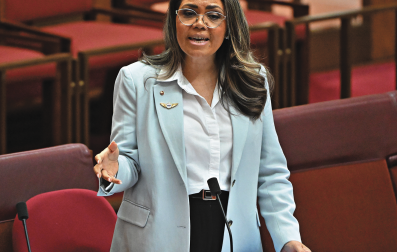
Anne Aly, a Labor frontbencher and member for Cowan, expects the cost of living will keep people focused on the importance of their vote.
“I don’t think that breaks the momentum of what people are concerned about in their everyday lives. I think they’ll still have those issues at front of mind,” she tells The Saturday Paper. “In terms of us as candidates and campaigners, there is no switch-off period from the day we were elected. We have not wasted a single day, and we will never waste a single day.”
Albanese notes it could all sink in a quick minute, but he says the hard work within the ALP has been done.
“It’s a long way to go, but we’ve got a really positive agenda to sell to the Australian people. I’m determined to do that. We have fantastic candidates,” he says, before resuming his aeroplane lunch.
“I’ve taken time over the three years as well. I said this before 2022: work from election day back. What’s the agenda we want to take to the next election? How are we getting the best candidates?
“For the opposition, I think they showed they are simply not ready for government.”
For almost a decade, The Saturday Paper has published Australia’s leading writers and thinkers. We have pursued stories that are ignored elsewhere, covering them with sensitivity and depth. We have done this on refugee policy, on government integrity, on robo-debt, on aged care, on climate change, on the pandemic.
All our journalism is fiercely independent. It relies on the support of readers. By subscribing to The Saturday Paper, you are ensuring that we can continue to produce essential, issue-defining coverage, to dig out stories that take time, to doggedly hold to account politicians and the political class.
There are very few titles that have the freedom and the space to produce journalism like this. In a country with a concentration of media ownership unlike anything else in the world, it is vitally important. Your subscription helps make it possible.
Subscriber exclusive
Send this article to a friend for free.
Share this subscriber exclusive article with a friend or family member using share credits.