News
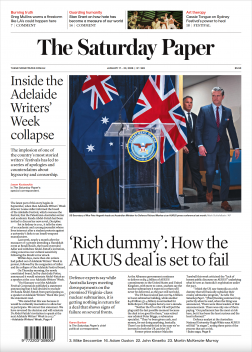
Defence experts say while Australia keeps meeting downpayments on the promised Virginia-class nuclear submarines, it is getting nothing in return for a deal that shows signs of failure on several fronts. By Karen Barlow.
‘Rich dummy’: How the AUKUS deal is set to fail
As the Albanese government continues to deliver on $9.4 billion of AUKUS commitments to the United States and United Kingdom, with more to come, analysts say the nuclear submarines it expects in return will never be delivered, as the pact will not hold.
The US has received just over $4.6 billion to boost submarine building, while another $4.8 billion (£2.4 billion) is earmarked for Rolls-Royce’s UK engine factory over a decade.
“Neither the US or the UK will pull the plug until the last possible moment because the deal is too good for them,” says retired rear admiral Peter Briggs, a submarine specialist. “They’ve been given cash, real money, for not doing anything, basically. There’s no deliverable tied to the sum we’ve invested in both the UK and the US.”
Former prime minister Malcolm Turnbull this week criticised the “lack of honest public discourse on AUKUS” underlying what he sees as Australia’s exploitation under the pact.
“I think the UK saw Australia as a rich dummy that will basically subsidise their creaky submarine program,” he tells The Saturday Paper. “[Paul] Keating summed it up perfectly when he said, when the thing was announced, ‘There were three leaders of that announcement. There was only one of them paying.’ Our parliament has the most at risk here, but it has been the least curious and the least informed.”
Defence analyst at the Australian National University Hugh White says AUKUS will fail “in stages”, noting three parts of the process that are at risk.
“The first is we have to get the Life of Type Extension of the Collins [class submarine] right, because if we don’t, then we won’t have enough submarines of our own at sea in the years between now and when the Virginia-class are meant to appear.
“Then there’s the very high likelihood that the Virginia-class won’t be available because the Americans won’t have enough.
“And then there’s a very high likelihood that the SSN-AUKUS will never appear because the British lack the industrial design, technological and, I think, also financial base to take on a project of that scale and complexity.”
White predicts it will become “absolutely blindingly obvious” that the schedule can’t be met “within a few years”. Politically, he notes, that is likely in the parliament after this one, “or at least so they hope”.
“What our Australian political leaders on both sides are betting on is that neither of our supposed partners are going to pull the plug, and so the problems will emerge after the present generation of political leaders has left parliament, at which point, of course, Australia’s submarine capability will have collapsed. We won’t have any submarines,” he says.
The Australian Submarine Agency is managing the submarine part of the $368 billion deal announced in 2021 by then prime minister Scott Morrison. A spokesperson tells The Saturday Paper that payments to the UK have started, as part of “an agreed schedule of contributions up to £2.4 billion over 10 years, with approximately half to be made by the end of financial year 2027/28 and the remainder over the rest of the decade to 2032/33. The exact timing of payments is at the mutual agreement of Australia and the UK.”
As for the progress on the pact: “We are meeting key milestones and AUKUS remains full steam ahead.
“We remain confident in the ability of all three nations to work collectively to deliver this program,” the spokesperson says.
Despite that reassurance from US President Donald Trump during Prime Minister Anthony Albanese’s visit last October that the AUKUS deal is moving “full steam ahead”, the full details of a Pentagon review into the provision of the promised Virginia-class submarines are still to be released. And now Kevin Rudd, widely regarded as a “tireless” Australian ambassador to Washington, is stepping down a year early to resume the leadership of the Asia Society global think tank.
US congressman Joe Courtney has described the former prime minister as a “force of nature” who pursued key AUKUS approvals by congress in December 2023 with “relentless interaction and presence on the Hill, with the White House and the Department of Defense”.
Whoever Albanese chooses will serve for the remainder of Trump’s term. The secretary of the Department of Defence, and chief of staff to then prime minister Turnbull, Greg Moriarty, is considered a frontrunner. As a senior bureaucrat and former ambassador, he has a rare unblemished record on public assessments of the US president.
Moriarty is currently in the US for high-level meetings at the Pentagon. The Saturday Paper approached the secretary for comment, but was told through a Defence spokesperson, “We are working closely with the Trump Administration to advance our shared interests and expand our cooperation.”
Peter Briggs notes “in the US case, they’re very anxious, very keen, to get a submarine base in Western Australia, which is part of this deal as well. I have no doubt that they’ll delay as much as they can, and when the decision comes there’ll be some sort of a compromise – but it will not be the sale of sovereign submarine capability to Australia, I can guarantee that.”
The US has to deliver first under the AUKUS agreement, and the concern about whether its military can spare Virginia-class submarines remains. The US has a backlog of 12 Virginia-class submarines, in addition to three Columbia-class ballistic submarines. Hugh White, a long-time critic of AUKUS, expects the “fragility” of US shipbuilding out of Connecticut means the Virginia-class subs will never arrive in Australia – despite the approval from the as-yet-unpublished Pentagon review.
Days before announcing his resignation as US ambassador, Rudd posted a picture on social media of himself with the head of that review, Department of War under secretary for policy Elbridge Colby, and their wives at a dinner event, stating: “The Australia–US alliance has never been stronger.”
Colby, the Pentagon’s top policy official, has been one of the strongest US critics of AUKUS, based on his concerns about lagging submarine production as well as ambiguity over support for the US in future conflicts.
“I think that was to send the message that Bridge Colby and the Australians were on talking terms,” former Australian ambassador to the US Arthur Sinodinos tells The Saturday Paper. “And that was useful, given that Bridge Colby was one of the people who clearly expressed scepticism about AUKUS, particularly in the context of the US pivoting more to the Indo-Pacific and who could be relied on in that context.”
Political support for AUKUS on the British side has seemed less in doubt. The UK government’s Strategic Defence Review last June expressed an intent to “double down on both pillars of the AUKUS agreement”, but the country’s submarine capability – reduced since the 1980s – has been described as “shambolic” and “parlous” by a former nuclear submarine commanding officer, retired British rear admiral Philip Mathias.
“There is a high probability that the UK element of AUKUS will fail, making the international row in 2021 over the cancellation of the plan for Australia to build French-designed submarines look like a non-event,” the former director of nuclear policy with the UK Ministry of Defence warned in an interview last week with The Sydney Morning Herald.
Mathias made similar comments to the UK Sunday Telegraph in December about the fleet being “no longer fit for purpose”, and that being a cause to withdraw from AUKUS.
While one uniformed source says Mathias’s knowledge is “very dated”, his view is not singular in defence circles. Briggs, a past president of the Submarine Institute of Australia, has tracked the publicised problems with the Royal Navy’s Astute-class nuclear submarine fleet. Of the six commissioned boats, one has not been to sea in three years, another for two years. The operational status, Briggs says, of any of the boats is “problematic”, while the newest Astute, HMS Agamemnon commissioned by King Charles in September, won’t be ready to join the fleet until another year of sea trials has been completed.
“I can only surmise that it was commissioned by the king – which is highly unusual as well – to impress the visiting President Trump and the visiting Prime Minister Albanese,” Briggs says. “I think that’s a pretty fair pointer to the state of the Royal Navy submarine capability.
“Their infrastructure is under-capitalised, has not been kept up to date and repaired, and so the submarines can’t get to the dock. The ship lift in Faslane on Clyde [Scotland] has been out of commission for quite a long time. It’s back working now, I understand.”
The docking backlog has pushed the length of patrols of available subs, including the Vanguard-class ballistic missile submarines, as a deterrent in the North Atlantic, up from 70 days to more than 200.
In a direct response to delays, cost overruns and the increasing patrol lengths, the UK’s First Sea Lord, General Sir Gwyn Jenkins, launched an urgent “100-day challenge” in October to come up with a new submarine maintenance recovery plan.
A lack of sea time impacts adversely on personnel. Briggs says new candidates can’t rotate through the “brutal” submarine command course known as “the Perisher”.
“The Royal Navy has started accepting ‘re-scrubs’ on the Perisher,” he says. “Previously, if you were assessed not to meet the standard you failed, you … went back to the surface navy or found yourself a new career entirely.”
There was also trouble recruiting submarine leadership positions from inside the service, and Briggs says the new SSN-AUKUS nuclear submarines are being pushed down the order of priority.
“We talk about late ’20s and early ’30s. Fuzzy, fuzzy scheduling already, but even those fuzzy schedules are already slipping,” he says. “And the design review to complete the concept development for SSN-AUKUS is, we’re now told, going to happen in September next year. You’ve then got the detailed design phase.
“There’s no way they’ll be starting to build it in the late ’20s … I guess any day before the 29th of June 2035 is early, but I don’t think there’s any doubt that this will be late, it will be over budget and it’ll have first-of-class issues, and when you’ve got all those problems solved, it is too big for the job that Australia requires it for.”
AUKUS’s initial milestones include the creation of the agency, submariner training exchanges and last June’s signing of the UK–Australian Geelong treaty – a 50-year bilateral defence agreement covering the creation of the new SSN-AUKUS submarines that will be built at the Osborne Naval Shipyard in Adelaide.
“That’s as if I was setting out to swim to New Zealand and I’d waded up to my knees off Manly Beach,” says White, who is a former deputy secretary for strategy and intelligence at the Defence Department and the principal author of the 2000 Defence White Paper.
“Nothing we’ve done so far remotely begins to address the immense technical and project management challenges of making AUKUS work, and to say that we can have confidence in this plan as a replacement for our Collins-class submarines because of what’s been achieved so far is simply absurd.”
A critical juncture, according to White, will be the British decision whether or not to continue to bet on the SSN-AUKUS plan as a way to replace their Astute-class attack submarines.
“They need to have a replacement for the Astutes. They need an attack submarine in order to escort and defend those ballistic missile-firing submarines,” he says.
“Britain’s capacity to screw these things up is almost as impressive as ours. They might drag on with this illusion for years, but we can’t expect the British to solve our problem for us. We are waiting for either the British or the Americans to blow the whistle and say this is not going to work, because nobody in Australia, despite all the evidence, is willing to blow the whistle and say this is not going to work.”
It is not too late to change course, according to Peter Briggs, who backs the general shift to nuclear propulsion. The former rear admiral offers the previously eliminated, smaller French Suffren-class nuclear-powered submarine as more suitable to Australia’s needs.
“It’s not as big, it doesn’t carry as many weapons and so on, but it carries enough and it’s flexible enough, and its smaller size means it’s got a better operating range compared to Virginia or the giant SSN-AUKUS, which are going to be limited,” he says.
“I still think, even as late as this, it’s not late, because what we’re doing is not going to deliver a sovereign capability in any timescale that we need. So, it’s actually probably going to do that quicker than the current plan.”
“This is the insanity of it,” says Malcolm Turnbull. “If we stuck with France, we had a design that was operating, that was in the water, we could have transitioned to naval nuclear propulsion with France – again, with a boat that was fully designed, operational, something that was very real and doable and tangible – as opposed to all of this hype.”
The Albanese government insists the AUKUS partnership is in the interests of Australia, as well as those of the US and UK, and will contribute to peace and security in the Indo-Pacific region.
Arthur Sinodinos says good progress has been made and it is time for all three nations to pick up speed. “I think there is an imperative to accelerate that progress – 2030 is just around the corner and we need Henderson [defence precinct] in Western Australia to be in a position to accept Virginia-class submarines, to be able to maintain them from the early ’30s onwards.
“The US is putting more money into their submarine industrial base to build more subs, but that rate needs to increase from where it is now. So, there are plenty of challenges. We’re sort of on the track, but there are plenty of challenges ahead,” the former Liberal senator says.
“We’re at a stage where we just need to stay the course and keep doing more of what we are doing now.”
This article was first published in the print edition of The Saturday Paper on January 17, 2026 as "‘Rich dummy’: How the AUKUS deal is set to fail".
For almost a decade, The Saturday Paper has published Australia’s leading writers and thinkers. We have pursued stories that are ignored elsewhere, covering them with sensitivity and depth. We have done this on refugee policy, on government integrity, on robo-debt, on aged care, on climate change, on the pandemic.
All our journalism is fiercely independent. It relies on the support of readers. By subscribing to The Saturday Paper, you are ensuring that we can continue to produce essential, issue-defining coverage, to dig out stories that take time, to doggedly hold to account politicians and the political class.
There are very few titles that have the freedom and the space to produce journalism like this. In a country with a concentration of media ownership unlike anything else in the world, it is vitally important. Your subscription helps make it possible.
Subscriber exclusive
Send this article to a friend for free.
Share this subscriber exclusive article with a friend or family member using share credits.