Festival
The Sydney Festival is a reminder of how art can heal and processional, interactive work can make community. By Cassie Tongue.
Can Sydney Festival help mend a city’s grieving heart?
It’s summer again in Sydney, and it’s a heavy one. The weather, made more extreme by climate change, swings between heatwaves and cloudy gloom. The cost-of-living crisis continues. Most of all, we are a grieving city – one with its heart in its throat and a churning gut. In the wake of the devastating Bondi massacre, we are wrestling with personal, social and political questions about who we are, who we want to be and how we feel safe.
The 2026 Sydney Festival has arrived, programmed for a version of the city that existed before the attack. Now in its 50th year, under new artistic director Kris Nelson, it’s facing the challenge that arts companies across the country cannot always meet, and that this festival has not always met in years past. Can this institution designed for civic celebration, entertainment and engagement take care of its citizens during a time of discord and resist creeping censorship? Can it soothe a broken heart?
Nelson and the team have, in the weeks leading up to the festival’s opening day, made careful adjustments to the program. Waverider, a free, surf-inspired piece by beloved Sydney physical theatre institution Legs on the Wall, was scheduled to take place at Bondi Pavilion, where the Bondi Community Hub is coordinating support services for those affected by the attack. The work was jointly postponed for a future season by Waverley Council, Legs on the Wall and the festival.
On a scorching Saturday afternoon – the temperature only just beginning to fall below 40 degrees at 5.30pm – I made my way to another show adjusted with the city’s peace in mind: the free event Efectos Especiales, created by Argentine filmmaker Alejo Moguillansky and choreographer Luciana Acuña. This is processional cine-theatre: a dancer faces unexpected hurdles, including rain, snow and smoke, as they run along Hickson Road in Walsh Bay, closed for this performance and the following street party. It’s filmed live three times, each in one unbroken shot, and scored by a DJ, as the audience walks, jogs or dances behind them – then pauses to watch the finished sequences on giant screens. Practical effects are magnified and manipulated; audiences become narrative-critical; bodies move and morph and mingle.
In previous iterations, this work has been one of craft in the face of not just changing conditions but also danger and violence. It originally contained ominous fire effects, pronounced gunshots and emergency sirens, but those effects are turned down or removed here. The gunfire that remains could easily be confused for an additional beat on the work’s thumping soundtrack, leaving the audience with the opportunity to appreciate live and technical precision conjured like magic and free of tragedy. In the third take, the audience was invited to dance on camera in the rain effect, offering a giddy reprieve from the city’s heatwave. After the performance, families and groups settled into chairs dotting Hickson Road, lined up for burgers and chatted as temperatures dropped and moods mellowed.
Over on the Northern Broadwalk of the Sydney Opera House, the festival’s opening weekend was generating collective celebration, and vital joy, at Garabari. Also a processional and interactive work, it is a space for genuine connection, shared reflection and knowledge exchange, directed by celebrated Wiradjuri choreographer Joel Bray. Storytelling collides with a beat-driven dance party that’s impossible to resist: your body might hear and heed the call to join in before you even realise you’re swaying.
Garabari is the Wiradjuri word for a ceremonial meeting. Across three stages, dancers and storytellers – bolstered by lighting and projections by Katie Sfetkidis and sound and music by Byron Scullin – have made art of knowledge from the late Uncle James Ingram, Custodian of the Story of the Making of the Murrumbidgee. The audience is encouraged to experience the work from multiple perspectives, as it unfolds on three simultaneous stages. We’re told – first through movement alone – how brave Ballina liberated water for her Country and her people from resource hoarders.
As you watch, you uncover Garabari’s layers – movements that at first may have appeared abstract are clarified as story beats when the show builds on itself with song, storytelling and celebration.
I attended alone, but I wasn’t lonely. Performers chatted and smiled with me as they moved through the crowd. At one point, a woman I’d never met took a photo with me and performer Luke Currie-Richardson to remember our small but sweet conversation about our colourful clothing choices. Wiradjuri dancer Chandler Connell led us all in traditional dance and call-and-response cries. We started moving together through the playing space, tapping out the heartbeat of Country with our feet, answering hands keeping time over our own hearts, until suddenly we were dancing for the sake of dancing, a beaming outdoor dance floor.
The work is built with extraordinary generosity in its sharing of knowledge, movement and ritual, and it also encourages reciprocity in its audience: they move, so we move; they ask us to sit for a moment to remember the lives that led us here but also remind us to help up the person sitting next to us. After a couple of these reminders, we were performing these acts unprompted; we were present with each other.
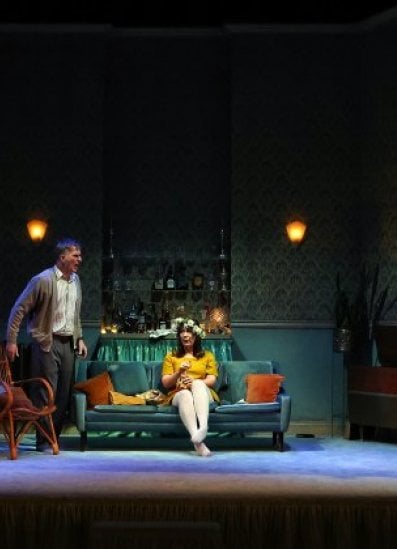
If Garabari is a balm, then Travis Alabanza’s Burgerz is a challenge: How do we push past discomfort and risk to build stronger communities and keep each other safe, respected and protected?
Burgerz tracks Alabanza’s obsession with burgers after having one thrown at them in broad daylight – a transphobic hate crime in which not a single onlooker, in a crowd of many on London’s busy Waterloo Bridge, intervened on their behalf. It raised a lot of questions for Alabanza, which they explore by inviting audience members to join them onstage for a wide-ranging conversation about our relationships with ourselves and others, on gender and race, solidarity and self-preservation – while also trying to make the perfect burger.
Like Garabari, Burgerz stresses we are stronger when we stand with each other and fight for freedoms. I caught the show on a Sunday matinee, where Alabanza and their new scene partners – touchingly awkward but gentle with each other – tackled frank conversations as well as the perils of live cooking. It’s cleverly written, funny and strongly shaped, but it’s also, if you care to look, a model. Here are questions we can ask each other to broaden our views and deepen our connections. Here are ways we can take care of the people around us. Here is an opportunity to pledge to love and support vulnerable people in our communities, and here are words and actions you can carry out of the theatre and into the roiling streets.
When the show ended, the full audience, many in tears, rose to give Alabanza a standing ovation. Then something unusual and uncommonly lovely happened: as a group, the already on-their-feet audience didn’t head for the exits; we all sat down again and took a few seconds, maybe a minute, to quietly process what we’d just watched. Finally, with kindness and patience, we filed out. We were again a group of strangers, unified.
These works are brightening Sydney, but the Australian arts landscape is fracturing under administrators’ growing censorship. As Sydney Festival opens with these softer edges in light of devastation, Adelaide Writers’ Week has been cancelled after a mass exodus of more than 180 authors – including Jacinda Ardern, Peter Greste and Zadie Smith – following the Adelaide Festival Board’s decision to drop Palestinian–Australian academic Randa Abdel-Fattah from its line-up, citing “cultural sensitivity” in the wake of the Bondi massacre. On Tuesday the board resigned and apologised to Abdel-Fattah for the way “the decision was represented”.
Moves like this go beyond easing a mourning heart. We can’t find liberation – or community – in censorship. Festivals at their best, glimpsed in snapshots over Sydney Festival’s opening weekend, showcase the ways artistic leaders, thinkers and creators have contributed to our great, enduring experiment of telling stories to better understand how to be human. They provide clarity and complexity and care. They help facilitate the conversations we need to have in order to understand, fight for and better take care of each other. They give cities spaces, opportunities and tools to remember why our communities are worth fighting for. When artists are censored, we all lose.
Sydney Festival runs until January 25.
ARTS DIARY
Heath Ledger Theatre, Whadjuk Noongar Country/Perth, January 22–February 1
EXHIBITION The God of Small Things: Faith and Popular Culture
Queensland Art Gallery, Meanjin/Brisbane, until October 5
VIDEO Richard Lewer: Steve
National Gallery of Australia, Ngambri/Canberra, until July 12
THEATRE My Brilliant Career
Southbank Theatre, Narrm/Melbourne, January 23–February 28
MULTIMEDIA Data Dreams: Art and AI
Museum of Contemporary Art, Gadigal Country/Sydney, until April 27
Last Chance
THEATRE The Secret Garden
Playhouse Theatre, nipaluna/Hobart, until January 17
THEATRE Trans Theatre Festival
Carriageworks, Gadigal Country/Sydney, until January 18
LITERATURE Big Book Energy Indie Signing Convention
Partridge House, Gunditjmara, Jardwadjali and Boandik Country/Glenelg, South Australia, January 18
This article was first published in the print edition of The Saturday Paper on January 14, 2026 as "City lightness".
For almost a decade, The Saturday Paper has published Australia’s leading writers and thinkers. We have pursued stories that are ignored elsewhere, covering them with sensitivity and depth. We have done this on refugee policy, on government integrity, on robo-debt, on aged care, on climate change, on the pandemic.
All our journalism is fiercely independent. It relies on the support of readers. By subscribing to The Saturday Paper, you are ensuring that we can continue to produce essential, issue-defining coverage, to dig out stories that take time, to doggedly hold to account politicians and the political class.
There are very few titles that have the freedom and the space to produce journalism like this. In a country with a concentration of media ownership unlike anything else in the world, it is vitally important. Your subscription helps make it possible.
Subscriber exclusive
Send this article to a friend for free.
Share this subscriber exclusive article with a friend or family member using share credits.