Theatre
Sarah Goodes’ production of Who’s Afraid of Virginia Woolf? adds a vicious new spin to Edward Albee’s portrait of a nightmare marriage. By Cassie Tongue.
‘Ritual, rage and middle age’ in Sarah Goodes’ Who’s Afraid of Virginia Woolf?
It has been 63 years since George and Martha first had guests over for drinks and brutal games, but Edward Albee’s Who’s Afraid of Virginia Woolf? still looms large in our cultural consciousness – a direct influence on art across genres and the source of a new shorthand for a troubled married couple. Our books, films and television shows often describe a warring couple as a “George and Martha” – it happens everywhere from Gilmore Girls to The Simpsons.
In the decades since its premiere, the theatrical canon has been full of plays, such as God of Carnage and August: Osage County, that show intimate relationship breakdowns and shocking revelations within a similar real-time, close-quartered space. None of these new works have managed to shake our hold on the original. Major revivals were staged on Broadway as recently as 2020 – cut short due to the Covid-19 shutdown – and in the West End in 2017, with starry Marthas – Laurie Metcalf and Imelda Staunton – on the boards.
Closer to home, the play remains a consistently popular programming choice and a work given significant value by academia: many Australians, including me, will have first encountered it as a prescribed text in the secondary English syllabus. The AusStage database counts 88 Australian productions, with the first staged in Sydney in the same month the original production closed on Broadway – May 1964. It was a hit, scoring a transfer from the small Old Tote Theatre, which seated fewer than 200 people, to the much bigger Palace Theatre, which had a capacity of about 1000. Melbourne’s first production opened in September of that year.
In the past decade alone, the play has been professionally performed in Sydney three times. There was a remarkable live-wire production directed by Iain Sinclair for Ensemble Theatre in 2017 and a production originally created for State Theatre Company of South Australia that played the Sydney Opera House as part of the 2022 Sydney Festival. Now after a sellout season at Melbourne’s Red Stitch and Comedy theatres, a new Who’s Afraid of Virginia Woolf? is at Sydney Theatre Company.
It seems as if George, Martha and their “fun and games” with guests Nick and Honey are as potent as ever – and that the social courtesies and publicly composed faces we put on to conform to ideas about marriage and success still need to be smashed to bits every so often to expose the pain and, sometimes, the rot festering underneath.
This production is directed by Sarah Goodes (The Talented Mr. Ripley, Julia) who, in her director’s note, describes her starting points as “ritual, rage and middle age”. All three are front and centre.
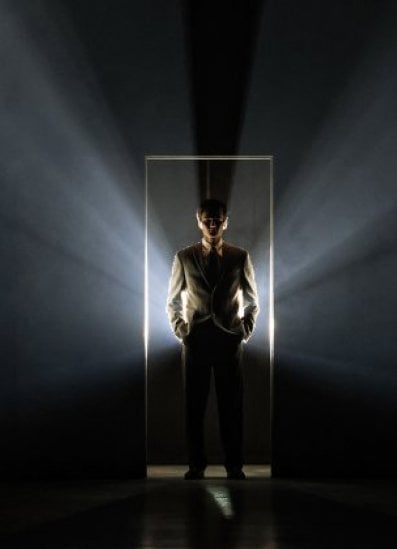
The ritual starts early – first, we catch a glimpse of our own, as George (David Whiteley) and Martha (Kat Stewart) make their way home from a university party by walking down the aisle of the Roslyn Packer Theatre, with quick apologies for brushing past seated audience members and bursts of sudden laughter.
Recurring ritualised motifs and symbols are woven like a spell into the action: placed in careful centre on the back wall, the bar in George and Martha’s living room, designed by Harriet Oxley, looks like an altar or a shrine. There’s also an insistent drumming before an argument turns unforgivable, and a breeze that picks up and ruffles the curtain through a living room window. A recurring, shimmering projection haunts the stage, both a mourning and a warning. While some of these veer into a heavy-handedness that threatens to undercut the precision and agility of the dialogue, others are striking.
It’s in this living room that we meet Nick (Harvey Zielinski) and Honey (Emily Goddard), the young couple Martha has invited over for a drink. And it’s here where we stay for the duration of the play, just over three hours, including two intervals, and where, of course, we witness the rage.
Martha’s barely concealed resentments over the state of her life and her marriage crash into George’s own, and their disappointments – those soft, vulnerable wounds they can no longer share with each other – turn into finely tuned weapons for their spouse. They are just as potent when deployed against Nick and Honey in a game of “get the guests”.
Those guests bring the “middle age” of it all into relief. Goodes often blocks the couples in parallel rituals and contrasts to emphasise the hopeful beginnings of one marriage and the atrophy of the other, lingering on scenes where the young and older counterparts of their partners interact. Their misaligned perspectives on love, connection and ambition only add more agitation to the proceedings.
Albee’s language, in the hands of Goodes – and Stewart and Whiteley especially – feels freshly corrosive. In the first act, George and Martha’s invective is hurled with delicious alacrity, and on opening night that great, ancient theatre magic – where it feels as though the air really is crackling with electric tension – began to stir. Stewart and Whiteley are exceptional: Stewart’s full-throated performance is a force of nature, a brawler to Whiteley’s fencer. His towering, though fallible, cerebral restraint makes them excellently matched partners.
As the nightcap descends into mind games, the hour grows late for George, Martha and their guests. The final act, “The Exorcism”, tackles the last and greatest illusion: the “game” about George and Martha’s son. This is where Albee’s sense of ritual is most on display – George recites Latin requiems – but it’s also where the pair shift onto fundamentally uneven ground.
Goodes’ quiet, affecting highlighting of the ingrained misogyny of the period hits the hardest here. Throughout the play she builds several moments where Martha and Honey look out for each other when their husbands are dismissive or aggressive, refusing to shy away from the social restrictions influencing their choices in the play’s time period.
Because these moments are in sharp relief, George’s final move at the end of the play feels less like the culmination of a shared dysfunction and more like an act of cruelty. Martha’s pain feels bigger and the sting of lost parenthood lands heavier on her: the truth feels like a colder and more violent comfort. It’s hard not to wish they were on more equal ground; it’s understandable that Goodes asserts they never were.
When this George and Martha say it’s all over and they’re left staring fear in the face, you get the sense it isn’t just the lies and the rituals that have ended. There’s little left with which to move forward. This exorcism is a shattering.
Who’s Afraid of Virginia Woolf? is playing at the Roslyn Packer Theatre, Sydney, until December 14.
This article was first published in the print edition of The Saturday Paper on November 22, 2025 as "All the rage".
For almost a decade, The Saturday Paper has published Australia’s leading writers and thinkers. We have pursued stories that are ignored elsewhere, covering them with sensitivity and depth. We have done this on refugee policy, on government integrity, on robo-debt, on aged care, on climate change, on the pandemic.
All our journalism is fiercely independent. It relies on the support of readers. By subscribing to The Saturday Paper, you are ensuring that we can continue to produce essential, issue-defining coverage, to dig out stories that take time, to doggedly hold to account politicians and the political class.
There are very few titles that have the freedom and the space to produce journalism like this. In a country with a concentration of media ownership unlike anything else in the world, it is vitally important. Your subscription helps make it possible.
Subscriber exclusive
Send this article to a friend for free.
Share this subscriber exclusive article with a friend or family member using share credits.