recipe
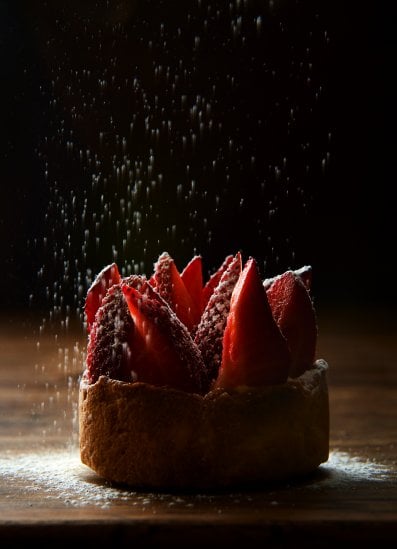
Strawberry and lemon myrtle jelly cake
What is it about jelly that’s so alluring?
In visual media, a wobbling motion adds a sense of life, movement or humour.
In music, the wobble triggers deep somatic and auditory pleasure, partly because of the visceral, vibrating quality that you feel deep in your chest.
In food, a gentle jiggle often signals that a food is soft, safe, moist and freshly prepared. It’s a sign of culinary finesse.
Jelly seems to blur boundaries between structure and chaos. One too many shakes and it could all fall apart. It’s also just funny.
I recently had my young nephews staying with me. As soon as I mentioned making jelly, screens were down and they were at attention at the kitchen bench. I think this intrigue continues into adulthood, but we graduate to fancier terminology and grown-up desserts such as panna cotta.
This jelly cake will satisfy both the adult and the child in you. It has a jelly top and panna cotta bottom and is impressive but also deceptively simple.
Flavours can be substituted to match the season – rosé and strawberries or pinot and cherry for spring and summer, riesling and pear moving into autumn and maybe apple cider and rhubarb in winter. The combinations are limitless, just like the jiggle.
Time: 20 minutes preparation + cooking + 2 hours for the jelly to set
- 1 punnet of strawberries, hulled
- 120g sugar
- 175g water
- 2.5 gelatine sheets, titanium strength
- 150g rosé
- 1 punnet strawberries (3-4 strawberries for layer, the rest to serve)
- 350g milk
- 400g cream
- 1 lemon, zested
- 150g sugar
- ¼ tsp ground lemon myrtle
- 4 gelatine sheets, titanium strength
- Lightly spray a non-stick, 20-centimetre bundt tin, cake tin or jelly mould with oil. Set aside.
- Place the hulled strawberries, sugar and water into a small pot over a medium heat and gently simmer for five minutes until the liquid turns pink.
- Bloom the gelatine sheets by submerging them in cold water for two minutes until they begin to soften.
- Add the rosé to the strawberry syrup and simmer for a further five minutes. Remove the pot from the heat.
- Squeeze the excess water from the bloomed gelatine sheets, stir and dissolve them into the strawberry syrup.
- Strain the syrup through a fine sieve into a jug, then pour it into the greased tin or mould. Refrigerate until set firm. This will take about two hours.
- Once the strawberry layer is set, thinly slice across three to four strawberries and spread them over the jelly in a single layer. Allow a three-millimetre border on each side to avoid contact with the sides of the mould. This will ensure the jelly cake layers stick together. Place the mould back into the fridge.
- To make the panna cotta layer, heat the milk, cream, lemon zest, sugar and ground lemon myrtle to above 40 degrees or to when it’s too hot for your finger to touch. Do not simmer.
- Bloom the second lot of gelatine as before. Squeeze away the excess water and then add the gelatine to the cream mixture. Stir to dissolve, then strain the mixture into a pouring jug. Cool until just warm to touch.
- Gently pour the cream mixture over the strawberry jelly, being careful not to displace the sliced strawberries. Refrigerate until set (about two hours).
- To release the cake from the tin, run a knife around the edges of the mould. Place a serving plate on top and then invert.
- Decorate the cake by either piling some strawberries on top or around the sides.
This article was first published in the print edition of The Saturday Paper on November 22, 2025 as "Strawberry and lemon myrtle jelly cake".
For almost a decade, The Saturday Paper has published Australia’s leading writers and thinkers. We have pursued stories that are ignored elsewhere, covering them with sensitivity and depth. We have done this on refugee policy, on government integrity, on robo-debt, on aged care, on climate change, on the pandemic.
All our journalism is fiercely independent. It relies on the support of readers. By subscribing to The Saturday Paper, you are ensuring that we can continue to produce essential, issue-defining coverage, to dig out stories that take time, to doggedly hold to account politicians and the political class.
There are very few titles that have the freedom and the space to produce journalism like this. In a country with a concentration of media ownership unlike anything else in the world, it is vitally important. Your subscription helps make it possible.
Subscriber exclusive
Send this article to a friend for free.
Share this subscriber exclusive article with a friend or family member using share credits.