Comment
Paul Bongiorno
Albanese caught in a Türkiye shoot
The politics of climate and the environment is just as messy at the United Nations summit in Belém, Brazil, as it is in Canberra and the Australian states. The fate of the planet is running a poor second to vested interests and crude personal power plays.
This was stark in the way Türkiye held to ransom an entire United Nations infrastructure designed to progress a worldwide response to catastrophic global heating.
A very disappointed South Australian premier, Peter Malinauskas, summed up the absurdity of UN rules that allowed President Recep Tayyip Erdoğan to block Adelaide’s bid to host this major event simply by refusing to withdraw.
Malinauskas was sympathetic to the efforts of the prime minister in trying to navigate “the quite frankly obscene process that exists internationally”. He said it’s very clear the rest of the world largely would have preferred COP to be in Adelaide but that Türkiye was going to exercise their veto right.
In the Western European and Others Group only Türkiye itself backed its bid. The rest were firmly behind Australia, but the weight of these numbers counted for nothing, creating a stalemate that could only be solved by the next Conference of the Parties (COP) defaulting to Bonn in Germany, where the UN Framework Convention on Climate Change is headquartered.
Energy and Climate Change Minister Chris Bowen spent the early part of the week in and around the conference venue at Belém, trying in the first instance to get Ankara to cede to the numbers. By Tuesday night it was apparent the Turks would rather crash the already tenuous climate framework than miss out.
Australia initiated a frantic round of consultations with its proposed co-hosts, the Pacific Islands nations, and Anthony Albanese began laying the ground for a strategic withdrawal.
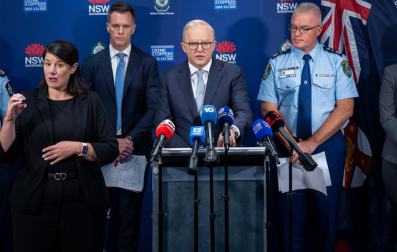
He told a news conference in Perth that the stalemate was causing considerable concern, not just from the Pacific, that conflict over hosting would not send “a good signal about the unity that’s needed for the world to act on climate”. He then raised eyebrows by adding, “If Australia isn’t chosen, we would not seek to veto that.”
In reality, under UN rules, neither host nation bidder could be chosen if both persisted.
On Thursday, Albanese put it succinctly: “It was either Bonn or Türkiye.”
If Bonn, as Bowen explained, there would have been no president of negotiations driving the agenda for the next summit. This is now a role the Australian minister will play in the compromise that still sees the 190-nation convention held in Türkiye but preceded by an international leaders meeting somewhere in the Pacific.
Former Australian climate diplomat Richie Merzian, who now heads the Clean Energy Investor group, saw the fiasco coming. Merzian told The Saturday Paper earlier in the week that Ankara played the system to its own advantage when it forced the United Kingdom into a series of concessions on trade facilitation and UN climate subsidies as the price for withdrawing from COP26.
Merzian, who is attending the Belém conference, says it was difficult to know what they wanted this time, “because they want to host a tourism event having seen other countries in the region do it”. He thought it would be hard to get them to budge.
Erdoğan certainly has his tourism event, while Albanese and Bowen say they are intent on getting real outcomes, laying a foundation for richer nations to join Australia in financing the Pacific Resilience Facility to fund climate catastrophe mitigation.
Nationals leader David Littleproud welcomed the collapse of Australia’s bid, which is of a piece with the climate vandalism pursued by the Coalition parties.
Just as fraught will be the government’s attempts to have its Environment Protection Reform bill pass the Senate next week. The Coalition joined the Greens in shunting the legislation off to a committee to report back next March, but Environment Minister Murray Watt will have none of that.
Watt threw down the gauntlet by saying the government had made it very clear “we will be passing these reforms next week in the final sitting week of the year”. He said it was up to the Coalition and the Greens to decide whether they want to be part of it or not.
A report in The Australian suggested that besieged Opposition Leader Sussan Ley was now not prepared to back the legislation in any way as she seeks to shore up support from her internal critics. Ley’s office says that applies only to the bill in its current form, suggesting Watt’s offer to negotiate amendments may well be taken up by shadow minister Angie Bell.
Watt called on the Coalition, “just for one week”, to put aside “their leadership turmoil and to focus on the real benefits that will come with these reforms”.
Watt sees his reforms as a win for business, saying they will cut red tape, particularly in housing. He says they are also a win for the environment. Still, he has a long way to go to win over the Coalition or the Greens.
While in Western Australia this week, Watt secured the approval of Premier Roger Cook, who said the reforms were good for business and “our wonderful environment”. Cook is widely seen as the roadblock to reforms agreed between former environment minister Tanya Plibersek and the Greens, which were withdrawn at the last minute before the May election.
The Greens are indignant that the government would even entertain negotiating with the Coalition after its abandonment of the net zero emissions target by 2050. Greens environment spokesperson Sarah Hanson-Young said the Liberals can’t claim “to care about the environment while dumping climate targets”.
Hanson-Young called on the Labor government to rule out “any deal on environment laws with the anti-science, anti-environment Coalition”, and the Liberals had “torched what little environmental credibility they had left”.
She said Labor must choose: side with the polluters, loggers and the environment wreckers, or truly protect nature and the climate.
An alliance of 26 industry groups, representing every part of the economy, including small, medium and large businesses, miners, farmers and the investment community, wrote to the minister and the shadow minister expressing strong support for the Watt reforms, “providing relevant amendments are made”.
Just what influence business groups have with the Coalition is questionable. These same groups were critical of the Coalition for dumping net zero and replacing it with “a plan in search of a plan”.
Ley made little headway during her media blitz this week, trying to sell the contradictory hybrid forced on her by the Nationals and an increasingly assertive cohort of right-wingers in her ranks, urged on by commentators such as Peta Credlin and former prime minister Tony Abbott.
Ley failed to convince her state counterparts in New South Wales to back her. One Nation leader Pauline Hanson added insult to injury, claiming the Liberals were following her lead and they “were in such disarray” that they “don’t know where they are”.
RedBridge Group polling released this week dovetails with the latest Newspoll, showing support for the Liberals at the lowest since Robert Menzies formed the party in 1944.
Pollster Kos Samaras says the message of the new policy resonates with the diminishing cohort of older voters and reinforces the perceptions among younger voters that the Liberals do not take climate change seriously.
Samaras says younger voters who have deserted the Coalition in droves do not see energy prices and climate action as a binary. They are concerned by both.
Ley’s problem is compounded by the widespread perception, reported across the media, that the net zero decision was the price of her remaining as leader. The person who, as a former environment minister, supported the target and did so just six months ago, has created the impression she is now selling something she doesn’t really believe.
It is proving too much for voters to cop.
This article was first published in the print edition of The Saturday Paper on November 21, 2025 as "Albanese caught in a Türkiye shoot".
For almost a decade, The Saturday Paper has published Australia’s leading writers and thinkers. We have pursued stories that are ignored elsewhere, covering them with sensitivity and depth. We have done this on refugee policy, on government integrity, on robo-debt, on aged care, on climate change, on the pandemic.
All our journalism is fiercely independent. It relies on the support of readers. By subscribing to The Saturday Paper, you are ensuring that we can continue to produce essential, issue-defining coverage, to dig out stories that take time, to doggedly hold to account politicians and the political class.
There are very few titles that have the freedom and the space to produce journalism like this. In a country with a concentration of media ownership unlike anything else in the world, it is vitally important. Your subscription helps make it possible.
Subscriber exclusive
Send this article to a friend for free.
Share this subscriber exclusive article with a friend or family member using share credits.