News
Pauline Hanson’s chief of staff lays out the party’s strategy to take more votes – and members – from the opposition, while exerting greater influence over its policy. By Mike Seccombe.
Your subscription makes these exclusive articles possible
Subscriptions make these exclusives possible SUBSCRIBE NOW
Exclusive: James Ashby’s plan to expand One Nation
One Nation is on a roll. The right-wing party doubled its Senate representation at this year’s federal election and claims since then to have more than doubled its membership.
Multiple opinion polls over recent weeks have also found it has doubled, if not tripled, its support among voters since the May election.
One Nation is also cashed-up. Over the five years to 2023/24, the party declared to the Australian Electoral Commission some $15 million in receipts. To which may be added several million in federal funding, a consequence of its strong vote in this year’s election. Plus whatever extra donations its success attracts. Plus fees from the rapidly expanding membership which, according to the party, was recently growing at a rate of one new member every 29 seconds.
Its burgeoning popularity is widely credited with having driven the National Party and subsequently the Liberals to dump their commitment to Australia’s net zero emissions reduction target and the policy prescriptions for achieving it.
Likewise, the Coalition’s commitment to a dramatic reduction in immigration numbers is seen as a response to growing public support for One Nation’s demands. A RedBridge Group/Accent Research poll in The Australian Financial Review this week found that 27 per cent of voters thought it was the party best able to deal with immigration, ahead of both Labor and the Coalition.
The same poll showed not only that One Nation’s primary vote had shot up to a record high 18 per cent, but support for the Coalition parties was down five points in a month, to a record low of 24 per cent.
Other recent published surveys, including Newspoll in the Murdoch media and Essential in Guardian Australia, tell a similar story.
Twenty-eight turbulent years since Pauline Hanson established her party in civic hall in working-class Ipswich, west of Brisbane, it has seen off all political rivals to the right of the Coalition, and is established as the fourth force in Australian politics alongside Labor, the Coalition and the Greens, says psephologist Antony Green.
It now looms as a direct threat to the Coalition parties – the Nationals in particular. “The way things are going, One Nation is going to savage the Nationals at the next election,” Green tells The Saturday Paper.
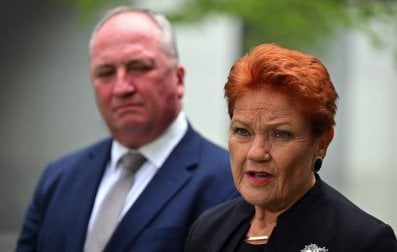
Hanson’s party may also be in the process of stealing not only Coalition voters but Coalition members. This week, Hanson added to speculation that former Nationals leader Barnaby Joyce might switch parties, telling ABC Radio that she planned to “cook him dinner and have a good talk, good chat with him”. There have been suggestions Joyce may not be the only target.
All in all, things have never looked brighter for the party of Pauline.
And it is the party of Pauline, in its name for the past decade and in the public mind. Without the former fish shop owner as its leader – as was the case between 2002, when she was expelled, and 2014, when she was reinstated – One Nation lost donors, voters and relevance.
Which makes the recent announcement that the party was changing its name – from Pauline Hanson’s One Nation to, simply, One Nation – perplexing.
The obvious reason, says James Ashby, is that Hanson is getting on in years. She is 71.
“It’s inevitable that she’ll want to one day retire. At this moment, it’s not on the horizon, but she’s not getting any younger, and she acknowledges that,” says Ashby, who became involved in One Nation in 2015, shortly after Hanson’s resurrection as leader, and who now serves as her chief of staff.
The name change is not just a rebrand but part of a broader restructure, says Ashby. Maybe even something of a democratisation of the party; certainly a loosening of Hanson’s tight grip.
Ever since her resurrection, One Nation has operated on a top-down model. Policy decisions and candidate selection have been largely matters for Hanson, Ashby and a small coterie of loyalists who make up the party’s executive. Ordinary members did not get a say.
There’s a certain self-protective logic to it. Having once been kicked out of the party she founded, Hanson has ensured it could not happen again.
“Pauline was acutely aware that some of the branches back in the original phase of One Nation were also the reason why she was ousted,” says Ashby. Hanson herself also realised that if the party was to grow, “it can’t be about one individual”, he says.
“There’s been no branch structure up until post the federal election, so there was no real way [for rank-and-file members] to have regular involvement in policy formulation or preselection involvement with candidates for their area.”
The party is in the process of rectifying that. Ashby says the new branch structure will devolve more power to the rank and file.
“We need that growth through the party structure of branches to help with preselection of candidates, the manning of polling booths, the formulation of policy and a raft of other minor details that parties rely on. It’s like a football team. You need someone that’s going to cut the oranges and get them out on the field as well,” says Ashby.
Of the 150 federal electorates in the country, One Nation now has branches in about 30, and most of them only had their first meetings this month or late last month. In a handful of others, the One Nation website promises “More details SOON”.
“It’s been about nine years since the party reformed with Pauline at the helm,” says Ashby. “Next year will be the big year for the party, and this is why we wanted to make sure that we started branches well before the next election.”
Once the branch structure has been established, he says, One Nation will start holding party conferences, although that won’t happen until next year at the earliest.
Jennifer Game is sceptical that One Nation is really democratising. She worked for Hanson for nine years, set up a South Australian branch, and has firsthand experience of the party’s command-and-control operation.
“The constitution gives national executive control completely over each of the state parties, and yet none of the members of the executive are elected.”
Nor, she says, is the party hierarchy much concerned with the quality of most candidates, for the simple reason those running for lower house seats have a negligible chance of being elected. “And where people have a better chance, which would be upper house positions in the states and also in the Senate, she [Hanson] and James Ashby personally decide.”
Game’s daughter, Sarah, was selected to run for the South Australian upper house at the 2022 election. To the surprise of almost all, including Jennifer and Sarah, she won, becoming the first One Nation candidate elected to the state’s parliament.
The ABC reported at the time: “Little is known about Ms Game, who appears to have a minimal online footprint and does not appear in One Nation’s campaign material, including the party’s own website.”
Former South Australia senator Rex Patrick recalls that when Sarah Game won, “the whole of South Australia was asking ‘who is this person?’ She got up on the Pauline Hanson brand.”
In May, less than halfway through her term, Sarah Game quit One Nation. As has her mother. This is not unusual. Antony Green says the party has a “terrible record” of losing members due to disputes with Hanson or other key people. About three quarters of successful One Nation candidates, at both state and federal level, have fallen out with the party, he says. One, Fraser Anning, quit before he even took his seat in parliament.
It suggests mutual cynicism between the party and its candidates. The candidates hope to ride into office on the Hanson brand, while the party, in the full knowledge most will fail, uses them to harvest public electoral funding.
The way the funding system works is that once a party or independent candidate wins more than 4 per cent of the vote, they get money for each vote – currently $3.39 – to compensate them for the cost of campaigning.
To have any chance of winning a lower house seat, however, a candidate needs a lot more than 4 per cent of the primary vote – a minimum of about 25 per cent, says Patrick.
At this year’s federal election, he says, One Nation ran candidates in 147 of the 150 House of Representatives seats. It did not come close to winning any of them, although it managed to attract 6.4 per cent of the overall house vote.
As Patrick wrote in a post-election piece for Michael West Media: “Taxpayers will pay Pauline Hanson’s One Nation $2.98M for her not to win a single seat in the House of Representatives.”
It did win two Senate seats – taking its total to four – on Coalition preferences. About 60 per cent of Coalition voters gave preferences to One Nation in the 2025 election, says Green, compared with 30 per cent at the previous, 2022 election.
It seems the Liberal and National parties forgot the lesson from the very first election Hanson’s newly formed party contested, in Queensland.
Ahead of that 1998 election, both the Liberal and National parties, in their eagerness to defeat a vulnerable Labor government, controversially decided to direct preferences to One Nation. Some in the Coalition argued that this could cost them, and they were right.
One Nation won 22.7 per cent of the first preference vote in the state – more than either of the Coalition parties – taking five formerly safe seats from Nationals, and six from Labor. Labor, meanwhile, won six from the Liberals.
The Coalition lost votes on the right to One Nation and on the left to Labor – exactly what the polls show is happening now. (Incidentally, all 11 successful One Nation candidates at that election subsequently quit the party.)
For the 1998 federal election some three months later, the Coalition parties followed Labor’s lead, putting One Nation last on its how-to-vote cards. The reduced flow of preferences saw One Nation take just one Senate seat, although it still received almost 15 per cent of the vote.
That vote was all about Hanson herself, and her brand of populist, resentful, xenophobic politics, as became clearer after the party expelled her in 2002.
In the subsequent federal election of 2004, One Nation’s vote share plummeted to just 1.19 per cent in the House and 1.4 per cent in the Senate. Its receipts for that financial year fell more than 90 per cent, to $237,000 from $2.7 million in 2001/02.
Attempts to bring in other high-profile candidates have not gone well. The stand-out example is Mark Latham, the former federal Labor leader, who was elected to the New South Wales parliament with One Nation, then clashed with Hanson and quit to sit as an independent.
James Ashby says the party will, over the coming few months, announce new big-name members: “names that you would never have, ever anticipated, that have had a gutful and signing up not just as members, but … for a tilt at the next election.”
Asked if he is referring to people who are currently outside politics, or people coming across from other parties, he says “both”.
In the meantime, the Nationals are clearly terrified at the prospect of their conservative rural and regional support base abandoning them for Hanson’s siren song. They are dragging the Liberal Party rightwards, costing it even more urban votes.
In Ashby’s view, the fundamental problem for the Liberal and National parties is that “their branches have been taken over by moderates”.
Most people would not think of the Nationals as “moderate”, but when Ashby talks about migration, his views are decidedly to the right of them. “We are not intolerant to migrants coming to Australia,” he says, but adds that Australia should simply ban all migration from certain countries and “backgrounds”.
“If the overwhelming number of people from a particular background is incompatible with the culture and wellbeing of this country, stop taking them.”
As to which countries or backgrounds, he says: “I’ll let you use your own imagination, but I think there’s been enough [evidence] now that we can see that are incompatible with the Australian culture, way of life.
“I mean, I wouldn’t put budgerigars in a, you know, in an aviary full of peach faces,” he says, referring to a species of lovebird. “Because I tell you what will happen, the peach faces will chew the legs off that bird. Some species are incompatible with others, and it’s just a fact.”
He compares the current poll numbers to a “health check” on the state of the parties.
“It’s like getting your cholesterol checked once a year. If you don’t like the numbers you get, you have a chance to do something about them. If you ignore the numbers, it could turn terminal. And I don’t know whether the Liberal and National parties are in a position where they want to, or can, turn those numbers around.”
He appreciates, though, that the Coalition is trying, by moving towards the policies of his party. The opposition’s abandonment of climate commitments is one example. Its stance on immigration is another.
He nominates several other policy areas where One Nation can exert influence and/or win votes. “Education is one, I think, that’s been largely overlooked by the major parties. The focus has gone from the three core values of education – reading, writing and arithmetic – to more of this feel-good, hysterical, climate change, uncertain of whether you’re a boy or girl…”
He keeps circling back to migration, however, with its subtext of race and religion. One Nation would see net overseas migration more than halved, to 130,000 a year. Ashby says new migrants should have to wait at least eight years before they can become citizens. “We think that you should have to prove yourself before we give you that right … to show you can assimilate,” he says.
Later on the same day as The Saturday Paper’s interview with Ashby, Opposition Leader Sussan Ley announced that the Coalition was looking at ways to screen new migrants to ensure they held “Australian values”.
Once again, it appears, the Coalition is following One Nation’s lead on policy.
Whatever else might be said about the party of Pauline: it knows what it stands for. Which is more than can be said of the Coalition parties.
Which is why One Nation is on a roll.
This article was first published in the print edition of The Saturday Paper on November 22, 2025 as "Exclusive: ‘They have an unlimited appetite for stupidity’".
For almost a decade, The Saturday Paper has published Australia’s leading writers and thinkers. We have pursued stories that are ignored elsewhere, covering them with sensitivity and depth. We have done this on refugee policy, on government integrity, on robo-debt, on aged care, on climate change, on the pandemic.
All our journalism is fiercely independent. It relies on the support of readers. By subscribing to The Saturday Paper, you are ensuring that we can continue to produce essential, issue-defining coverage, to dig out stories that take time, to doggedly hold to account politicians and the political class.
There are very few titles that have the freedom and the space to produce journalism like this. In a country with a concentration of media ownership unlike anything else in the world, it is vitally important. Your subscription helps make it possible.
Subscriber exclusive
Send this article to a friend for free.
Share this subscriber exclusive article with a friend or family member using share credits.