News
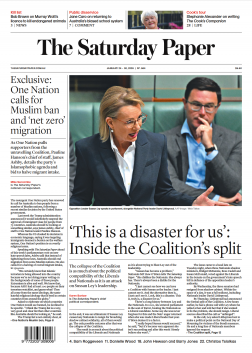
As One Nation pulls supporters from the unravelling Coalition, Pauline Hanson’s chief of staff, James Ashby, details the party’s Islamophobic agenda and bid to halve migrant intake. By Mike Seccombe.
Exclusive: One Nation calls for Muslim ban and ‘net zero’ migration
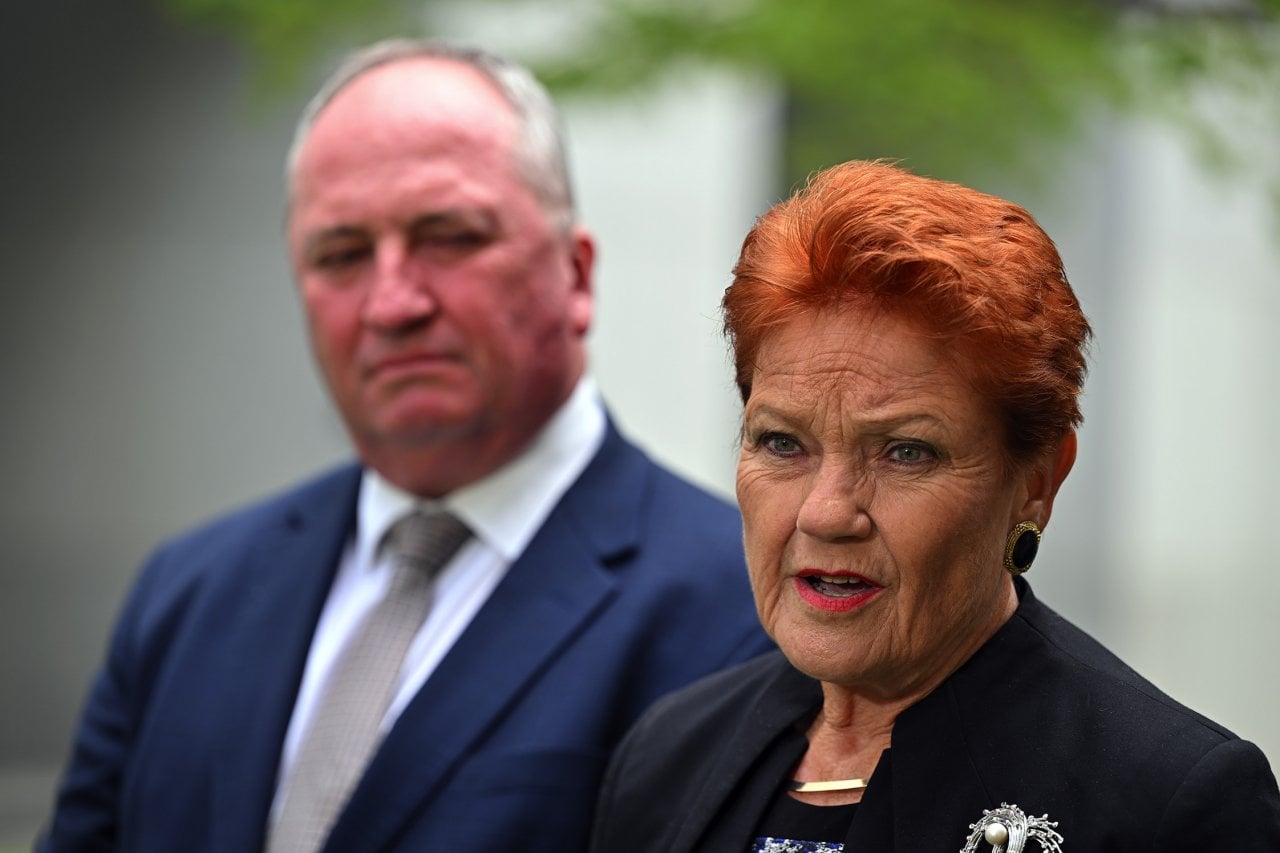
The resurgent One Nation party has renewed its call for Australia to ban people from a number of Muslim nations, following a recent similar decision by the United States government.
Last week the Trump administration announced it would indefinitely suspend the approval of immigrant visas for people from 75 countries. Australia should be looking at something similar, says James Ashby, chief of staff to One Nation leader Pauline Hanson.
Whereas the US cloaked its decision in economic language, saying it was targeting immigrants deemed a burden on the welfare system, One Nation’s position is on overtly religious terms.
Speaking with The Saturday Paper ahead of this week’s parliamentary vote on new hate speech laws, Ashby said that instead of tightening those laws, Australia should end migration from some Muslim nations. He also called for a halving of overall migrant intake, to 130,000.
“We certainly know that Islamic terrorism is being allowed into the country because we’re not doing proper vetting on the backgrounds of some of these people. Extremism is alive and well. We know that, because ASIO had at least 200 people on their terrorism watchlist, and guess what? They all come from the same ideology, the same hateful religious ideology that is bred in certain countries from around the globe.”
Asked to elaborate on which countries One Nation would see banned, he declined to be specific. “I think the Trump list is a very, very good and clear list that other countries like Australia should be looking at,” he said.
The Trump list is not entirely clear, at least in regard to religion. While most of the countries on it are African and Middle Eastern, Muslim-majority nations, such as Iran, Iraq, Pakistan, Morocco, Syria and Sudan, some are not, such as Nepal and Fiji.
What is clear is that immigration is a hot-button issue in America, where Trump was elected in substantial measure on an anti-immigrant platform and where militarised agents have been unleashed to terrorise the populace in various cities, with apparent impunity.
It is a hot-button issue, too, in Britain, where the populist right-wing Reform UK party of Nigel Farage is now leading the traditional parties of government in the polls. Similarly in much of Europe, far-right parties are on the march.
The same applies in Australia, where One Nation’s surging poll numbers are alarming the Liberal and National parties, and arguably contributing to their disarray this week.
If the Newspoll that ran in The Australian last week is to be believed, 22 per cent of electors now would give their first preference vote to Hanson’s party, ahead of the Coalition on 21 per cent.
The survey was taken a month after the December 14 terrorist attack at Bondi Beach – allegedly carried out by Sajid Akram, who migrated to Australia in 1998, and his Australian-born son Naveed – that killed 15 people.
One Nation’s vote was up seven points, while Labor was down four (to 32) and the Coalition was down three.
The decline in Labor’s vote might be explained by the initial vacillation of Prime Minister Anthony Albanese in responding to the Bondi attack. But what of the fall in support for the Coalition, despite its determined efforts to pin blame for the atrocity on the Labor government?
James Ashby reckons people saw the Liberal/National parties as being culpable too.
“The Australian people, they’re not stupid. They’ve got great bullshit detectors these days, and I think they sniff bullshit out of both major parties, who have been responsible for some of the largest intakes of people who are unsuitable to be in this country,” he says.
Asked if the recent surge in support for One Nation was attributable to the Bondi attack, Ashby says, “Sadly, yes.”
He also attributes the growing support for the party to the fact it has consistently held the same position in opposition to Muslim migration and to high levels of migration more generally.
“For a long time, we’ve been warning of the types of people coming into the country, and that’s been ignored, or we’ve been called Islamophobic, we’ve been called racist,” says Ashby.
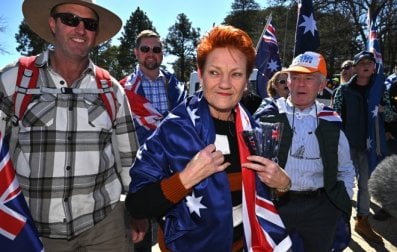
In her first speech to the Senate on September 14, 2016, Pauline Hanson declared that Australia was “in danger of being swamped by Muslims who bear a culture and ideology that is incompatible with our own”.
“Indiscriminate immigration and aggressive multiculturalism have caused crime to escalate and trust and social cohesion to decline,” she said .
Greens senators walked out on her. Her speech was widely condemned as racist.
Hanson has continued to reassert her anti-Islam views. She has twice entered the Senate chamber in a burqa, in 2017 and last November, in support of a ban on such attire. On that occasion she was suspended from the Senate for seven sitting days.
The virulent anti-Muslim rhetoric of Hanson and her party did not, for the most part, significantly affect either the vote share of One Nation – which has bounced around in the mid-single digits since her election – or Australians’ attitudes to Islam.
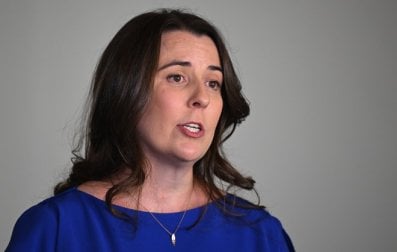
Until a couple of years ago, says Anthea Hancocks, chief executive of the Scanlon Foundation research institute, Australians were growing more tolerant of Muslims.
While it remained the case that “more people within society have negative attitudes towards people of the Muslim faith than any other faith,” says Hancocks, the proportion had declined sharply over several years, to 27 per cent in July 2023, according to the institute’s annual Mapping Social Cohesion report.
Then came the Hamas attack on Israel and Israel’s overwhelming military response.
The proportion of Australians with negative views of Muslims has picked up since October 7, she says, to 35 per cent in last July’s survey. The Gaza conflict also brought a sharp rise in negative views of Jews, from 9 per cent in 2023 to 15 per cent last year.
One clear difference between those with negative views of Jews and Muslims, says Hancocks, is that anti-Jewish sentiment is “pretty constant across different age groups, whereas negative attitudes to people of the Muslim faith tends to increase as people get older”.
Which makes the Liberal and National parties, whose voter base skews much older than that of Labor or the Greens, particularly receptive to the anti-Muslim agenda of One Nation.
The Scanlon Foundation also found the number of people who thought immigration was too high had more than doubled, to 51 per cent over the past four years – another development that plays to One Nation’s advantage.
Ironically, the Coalition parties and their supporters in right-wing media appear to have helped boost One Nation’s support, by persistently running a false narrative blaming Labor for encouraging “mass migration” to Australia, and blaming migration for cost-of-living pressures.
Says Hancocks: “When you’ve got people that are experiencing cost-of-living pressures and are feeling like their aspirations or their opportunities for future [are threatened] and somebody tells them ‘this is who you should blame’, that’s what they’re going to do.”
The Coalition’s hope was that people would blame Labor, but they did not, according to a RedBridge Group/Accent Research poll published last November. They blamed high immigration, and on the question of which political party was best equipped to deal with it, 20 per cent of respondents said Labor, 19 per cent opted for the Coalition and 27 per cent went for One Nation.
In reality, the current government’s position on migration is not much different from that of the Coalition government that preceded it.
While it is true migration ballooned when Australia reopened its borders following the pandemic, that was due to a backlog rather than any policy, and numbers have subsequently declined. Net overseas migration peaked at almost 540,000 in 2022/23. It fell to about 430,000 the following year, and a bit over 300,000 in 2024/25.
“Treasury is forecasting this financial year it will be 260,000 and the year after, they’re forecasting it’ll be 225,000,” says Abul Rizvi, a former deputy secretary of the Immigration Department.
“I have some doubts about Treasury’s forecasts. I don’t think they’ll get there,” he says.
Even if the government’s forecasts are overoptimistic, though, Rizvi gives less credence to the promises of the opposition.
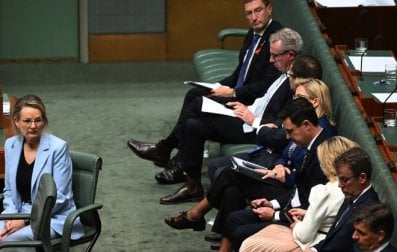
Before the last election, he notes, then opposition leader Peter Dutton set a target of 160,000, offering no detail on how the cut would be made. Under Sussan Ley, the Coalition has continued to bang the high immigration drum but with even less detail.
“They have said they want to bring down the number of temporary entrants into the country, but they’ve not explained by how much or what they would target,” Rizvi says.
Why, in the absence of any policy detail, the opposition has continued to raise the issue when it clearly benefits its rivals remains a mystery.
Meanwhile, the party of Pauline is promising to cut immigration to match annual emigration.
“Effectively, 130,000 just merely replaces the people we’re losing – net zero, although I hate using that term,” says Ashby.
Serious people would think it a preposterous proposition – but they are not One Nation’s target audience.
Political scientists and pollsters tell us that among all electors, those inclined towards the populist right have the least faith in government. They don’t expect major political parties to keep their promises, so they pay scant attention to policy, says RedBridge Group’s Kos Samaras.
“These individuals are experiencing financial hardship. They are experiencing a decline in living standards, and they just have given up hope that political parties can actually fix their problems.”
It seems there is a growing number of such disaffected people, primed to look beyond the mainstream parties. The problem for the Liberals and particularly the Nationals is that more of those people formerly supported them.
Peter Lewis, partner at Essential, a polling and research outfit, says the rise of One Nation poses an “existential threat” to the Nationals.
Essential’s poll for Guardian Australia in mid December – just after former Nationals leader Barnaby Joyce defected to One Nation and Hanson’s burqa stunt – reported a 17 per cent primary vote for One Nation, while 34 per cent went to Labor and 26 to the Coalition.
Lewis has since broken down the numbers further, to establish where those new One Nation votes are coming from.
“It was three to one coming from the Coalition,” he says. “The bleed of votes to One Nation is coming from older, conservative rural voters, which is obviously the Nats’ home turf,” he says.
“If you no longer believe that you’ve got a party that represents the interests of regional Australia, that can form government, then you will go somewhere else.”
The Nationals are desperate to get them back.
The Bondi attack, notes Samaras, led a lot of commentators on the political right to assume Labor would bleed votes back to the Coalition. “They were adamant that this was going to damage the Albanese government. I said, yeah, it’ll damage him, but you ain’t going to be the beneficiaries of it.”
The pollster was right.
Instead, the Nationals turned on their Coalition colleagues and voted against the government’s hate speech and firearms legislation. The opposition imploded, as every Nationals member of the front bench was either sacked or resigned from the shadow ministry. Now, with the Coalition dissolved, the Nationals must chase One Nation down the populist right-wing path.
The question is whether any of them, or even right-wing Liberals, will do as Joyce did, and switch to Hanson’s party.
Ashby says none of them are talking about such a move yet. For now, he appears to be enjoying the spectacle of the Coalition’s dissolution.
“I mean, you had an overwhelming number of Coalition members support the bill. We’re talking about the hate crimes bill. You had a percentage of Coalition members that abstained from the vote, and then you had a percentage of Coalition voters that voted against the bill. So you’ve got them going in three directions.
“It’s embarrassing to watch the former government of this country go down this path of indecisive action on our parliament floor.”
Embarrassing for them, he means. For his party, and for Labor, it could hardly have worked out better.
This article was first published in the print edition of The Saturday Paper on January 24, 2026 as "Exclusive: One Nation calls for Muslim ban and ‘net zero’ migration".
For almost a decade, The Saturday Paper has published Australia’s leading writers and thinkers. We have pursued stories that are ignored elsewhere, covering them with sensitivity and depth. We have done this on refugee policy, on government integrity, on robo-debt, on aged care, on climate change, on the pandemic.
All our journalism is fiercely independent. It relies on the support of readers. By subscribing to The Saturday Paper, you are ensuring that we can continue to produce essential, issue-defining coverage, to dig out stories that take time, to doggedly hold to account politicians and the political class.
There are very few titles that have the freedom and the space to produce journalism like this. In a country with a concentration of media ownership unlike anything else in the world, it is vitally important. Your subscription helps make it possible.
Subscriber exclusive
Send this article to a friend for free.
Share this subscriber exclusive article with a friend or family member using share credits.