Books
Julian Barnes
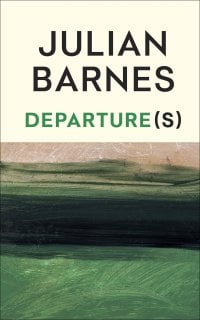
Departure(s)
Towards the end of Departure(s), the now 80-year-old Julian Barnes reminds the reader this “will definitely be my last book – my official departure, my final conversation with you”. It’s a decision precipitated by his discovery, just as the Covid lockdowns were beginning, that he has a form of bone cancer that is leading his marrow to “exuberantly” overproduce red blood cells.
The particular form of cancer Barnes has is not usually fatal. It can be managed with daily chemotherapy pills (as Barnes quips, it is not a death sentence, but “a life sentence: sentenced to live with my cancer until I died”). Nonetheless he argues, “Finishing my last book in my own time and then going silent … means you will not be cut off … in the middle of writing. In this way you are denying agency to death. Though in a very minor way, admittedly.”
Despite being best known as a novelist, Barnes has chosen to go out with book that isn’t quite a novel. Instead, Departure(s) claims to be a work of nonfiction. At its centre is the story of two friends of Barnes’s, Jean and Stephen. Theirs is a story in two parts. The first takes place at Oxford in the 1960s – a fact that gives Barnes pause, since in Flaubert’s Parrot his narrator advocated for a 20-year ban on Oxbridge novels – where Jean and Stephen meet and fall in love, only to separate after graduation. The second takes place 40 years later, when the now 60-something Stephen re-enters Barnes’s life and asks him to help broker a meeting with Jean. The subsequent encounter leads to the rekindling of their relationship and then marriage. Barnes moves from the role of matchmaker to – as their marriage unravels – agony aunt and dog minder. Around this story with a missing middle, Barnes weaves an account of his diagnosis and its effects, and a series of reflections on memory, death and fiction.
Despite claiming to be a work of nonfiction, Departure(s) complicates that claim in multiple ways, not only changing names – supposedly because by writing about Jean and Stephen he is betraying a confidence – and highlighting the slipperiness of memory but playfully suggesting resonances between Jean and Stephen and many of the characters that have populated Barnes’s fiction. The three-way relationship between Barnes and Jean and Stephen recalls the friendship in Talking It Over and Love, Etc, albeit without the adultery.
Stephen’s preoccupation with Jean’s past echoes in more muted form the miseries of Graham in Before She Met Me, and lies at the centre of The Sense of an Ending. The chapter on love in A History of the World in 10½ Chapters is invoked, and so – perhaps appropriately given this is Barnes’s last novel – is his first novel, the little-read but still delightful Metroland.
This tension is never resolved, nor does it need to be. When Jean complains, in a delightfully meta moment, “This hybrid stuff you do … it’s a mistake. You should do one thing or the other”, our unreliable narrator pushes back, telling her she’s entitled not to like his books, but she doesn’t get to assume he doesn’t know what he’s doing. When Jean realises he has also contrived a meeting between her and Stephen she grows angry and calls him a chancer, which leads Barnes to reflect “Isn’t that what all novelists are, essentially? In their books, at least.”
It’s little surprise Barnes’s final book should be so preoccupied with mortality and endings – as he deadpans in Departure(s), he’s “had a lifelong engagement with death”, even writing an entire book on the subject (the wonderful Nothing To Be Frightened Of ).
Memory and its deceptions and evasions have also been a perennial fascination. In Departure(s) he is sceptical of how much memory we can bear: the hilarious opening section is an extended riff on what are known as involuntary autobiographical memories or IAMs – essentially uncontrollable high-speed cascades of every instance of some particular activity or experience. What if IAMs were triggered by saying “I love you”? “How would you face the record … of all your lives, hypocrisies, cruelties both avoidable and (seemingly) unavoidable, your harsh forgettings, your dissimulations, your broken promises, your infidelities of word and deed?”
But in a way Barnes’s real subject has always been love. In Departure(s) we are treated to a deeply Barnesian portrait of love collapsing under the weight of its own contradictions or, perhaps more correctly, the contradictory needs of its time-crossed lovers. The story of Jean and Stephen is also about the gap between fictional love and real love, and fiction and life. As the book’s version of Barnes belatedly recognises, in helping to bring the couple together he had been treating them like characters in one of his novels, creations whose actions he could direct, and in so doing had been “confusing life with fiction”.
This wonderfully wise, witty and deeply moving book is not cynical about love. It is suffused with love. Near the end, Barnes describes seeing his friend Carmen Callil for the last time, the way her irrepressible energy exceeded the adjectives and anecdotes that would be used to describe her once she was gone. In contrast to Martin Amis, who once told him life is thin stuff compared with literature, Barnes’s final words to his readers insist upon an attentiveness to the wonder and possibility that surrounds us: “don’t stop looking … No, don’t stop looking.”
Jonathan Cape, 176pp, $34.99
This article was first published in the print edition of The Saturday Paper on January 24, 2026 as "Departure(s)".
For almost a decade, The Saturday Paper has published Australia’s leading writers and thinkers. We have pursued stories that are ignored elsewhere, covering them with sensitivity and depth. We have done this on refugee policy, on government integrity, on robo-debt, on aged care, on climate change, on the pandemic.
All our journalism is fiercely independent. It relies on the support of readers. By subscribing to The Saturday Paper, you are ensuring that we can continue to produce essential, issue-defining coverage, to dig out stories that take time, to doggedly hold to account politicians and the political class.
There are very few titles that have the freedom and the space to produce journalism like this. In a country with a concentration of media ownership unlike anything else in the world, it is vitally important. Your subscription helps make it possible.
Purchase this book
Departure(s)
BUY NOW
When you purchase a book through this link, Schwartz Media earns a commission. This commission does not influence our criticism, which is entirely independent.
Subscriber exclusive
Send this article to a friend for free.
Share this subscriber exclusive article with a friend or family member using share credits.