Books
Pam Brown
Guess the Experience
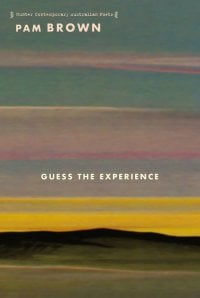
It’s apt that Pam Brown’s latest book is titled Guess the Experience. There’s a slipperiness to these poems that revels in the allure of the cryptic and the everyday strange. They track the disrupted fluency of urban attention, where in one moment we might be “cradling takeaway / like a babe in arms” (“It’s a problem”), the next confronted by “squelching / drain pong” (“A love supreme”). Anecdotes of miscommunication in shops and cafes segue into deconstructions of thought and aphoristic provocations, such as “is anyone / still doing ok / in the blur” (“Keep guessing”) and “the status quo is the catastrophe” (“It’s a problem”). The atmosphere is one of both ironic resignation and spirited resistance.
These are unpredictable poems of association and non sequitur. Meditations or scenes are either diverted elsewhere or are elongated, rarely lasting the duration you expect. The reader who wants clean resolution or cohesion could be frustrated by this asymmetry of elements. At times I was, but it’s the kind of frustration that feels apt for these times, generative in its effects. As Brown writes in “What a shaman”, “so much can happen in an aside”.
It’s also erudite poetry, though Brown would likely resist the term. Her poems reference or sample Rimbaud, Blaise Cendrars, Keats, Gig Ryan, Michael Farrell and many others, but they also bristle with quips against “spoken vanillanelles” and an “academics-showing-off / conference”. If at first this feels like the poet taking a position, it is – and at the same time it isn’t. Guess the Experience is concerned with the ways in which culture, and life itself, has been simplified and undermined from multiple angles, remembering “the gay club / in tatters / arson anonymous” and noting how “poetry’s geographies become / coaching children in sport”. It prioritises the question, the prod.
In the 1999 anthology Landbridge: Contemporary Australian Poetry, Brown wrote, “writing poems is one of the things to do in these high-density, activity-laden, entertainment and information-packed times”. Since then, the times have only become more dense and laden, and her poetry continues to mine subjective experience and its political-linguistic dimensions with laconic verve.
In Guess the Experience, she seems to me to be incorporating more white space, her voice more liable to interruption and hesitation. Is this a maturing, intensifying shift in her aesthetics in this, her 23rd book? Her answer comes with characteristic kick in “Water on the brain” – “Fuck ‘late style’ ”.
Hunter Publishers, 98pp, $24.95
This article was first published in the print edition of The Saturday Paper on January 24, 2026 as "Guess the Experience".
For almost a decade, The Saturday Paper has published Australia’s leading writers and thinkers. We have pursued stories that are ignored elsewhere, covering them with sensitivity and depth. We have done this on refugee policy, on government integrity, on robo-debt, on aged care, on climate change, on the pandemic.
All our journalism is fiercely independent. It relies on the support of readers. By subscribing to The Saturday Paper, you are ensuring that we can continue to produce essential, issue-defining coverage, to dig out stories that take time, to doggedly hold to account politicians and the political class.
There are very few titles that have the freedom and the space to produce journalism like this. In a country with a concentration of media ownership unlike anything else in the world, it is vitally important. Your subscription helps make it possible.
Purchase this book
Guess the Experience
BUY NOW
When you purchase a book through this link, Schwartz Media earns a commission. This commission does not influence our criticism, which is entirely independent.
Subscriber exclusive
Send this article to a friend for free.
Share this subscriber exclusive article with a friend or family member using share credits.