Comment
Paul Bongiorno
Albanese’s time to reassess ties to the US
The world as we know it is changing fast.
It is not at all clear what the seating arrangements will be or who will be leading the opposition when parliament resumes next Tuesday. At face value, the disarray of its opponents is a gift for the Albanese government, shifting attention from how it is handling the many daunting challenges confronting the nation to the other side of politics.
On Australia Day, the prime minister noted that the Liberals and the Nationals seemed focused on themselves. He put the fracture of the Coalition down to people “who simply don’t like each other”, denying them any credibility. “If you can’t govern yourselves,” he said, “I don’t see how you can be an alternative government of the country.”
It was a neat rhetorical flourish that ignored the fact the old two-party binary is looking increasingly obsolete in light of a string of opinion polls identifying a soaring primary vote for One Nation.
Labor figures are consoled by the fact the resurgence of the party founded by Pauline Hanson is coming mostly from conservative voters deserting the warring Coalition partners, equalling or besting the Liberals’ primary vote in some polls.
The more excitable commentators on Sky News see One Nation’s poll numbers as a harbinger of a Trump-like disruption in Australia or a replication of the performance of the populist right-wing Reform UK party headed by Brexiteer Nigel Farage.
Hanson admires both, and thanks to billionaire supporter Gina Rinehart has been introduced into United States President Donald Trump’s orbit, even skipping parliament to attend a right-wing conference at the president’s Mar-a-Lago resort in Florida.
Unlike Trump, Hanson is not leading an established party of government. In this, she is closer to the Farage comparison, in that both are yet to translate their opinion polling into seats. This is something One Nation has found difficult in previous elections, where it has lacked the infrastructure to cover polling booths and hand out crucial how-to-vote cards.
Earlier in the week Hanson tempered her Sky News interviewers’ enthusiasm by saying the task of winning government at the next election was possible, but it’s “a big ask”. She thought a more realistic goal would be to win enough seats to be the official opposition.
Hanson herself, despite the hype at Australia Day rallies, is not a candidate to be prime minister. She is in the Senate and has no intention of trying for a seat in the House of Representatives.
Hanson’s party is certainly targeting the Nationals’ regional seats and is setting up a branch in Maranoa, the electorate of embattled Nationals leader David Littleproud. Indeed, some Liberals are convinced that Littleproud’s unilateral decision to destroy the Coalition was born of panic and the desire to be free of the policy constraints imposed by being shackled to the more urban-focused Liberals.
One Liberal moderate scoffs at this construction, however, saying it is the bigger party that has paid a high price for caving to Nationals’ demands on the Voice, publicly owned nuclear power stations and, most egregiously, the abandonment of the net zero emissions target.
Littleproud’s ultimatum – that no National was prepared to serve in shadow cabinet while Sussan Ley remained leader – infuriated Liberals. One said it was a ham-fisted attempt to shift blame onto Ley for his own leadership failings.
Littleproud walked back his demand for Ley’s head, if she agreed to reinstate the three frontbenchers who voted against the hate speech amendments negotiated with the government.
Ley could not credibly do this while keeping faith with the Jewish community and fair-minded people who accept restraints on hate speech and the need to ban neo-Nazi groups pushing white supremacy or extreme Islamist groups pursuing virulent anti-Semitism.
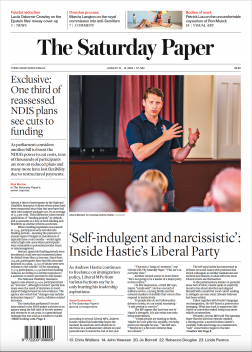
Hanson attacked the hate speech laws in her speeches this week and said Andrew Hastie’s support for them should rule him out as a future Liberal leader, days before he announced he wasn’t running. It is not clear if Angus Taylor would attempt to appease Hanson or the Nationals if he took the top job, or whether he would blunt Hanson’s appeal to deserting Liberal voters.
Ley’s people say without the laws columns of men cloaked in black and spreading hate would have hijacked Australia Day. Instead, they hid among the crowds. In Sydney, one took the microphone at a March for Australia rally and, according to the police prosecutor, made a “reprehensible” anti-Semitic speech. He was arrested and refused bail.
Midweek, Queensland Nationals backbencher Colin Boyce announced he would move a spill against Littleproud when the party room meets in Canberra on Monday.
Boyce admits he lacks the numbers but says his colleagues deserve a chance to debate Littleproud’s leadership. Boyce believes the National Party “is committing political suicide by removing itself from the Coalition”.
Sussan Ley is preparing for a similar challenge when her party room meets on Tuesday.
All of this is happening to the extreme frustration of the moderates.
Labor hardheads believe Hanson’s unabashed admiration and support of Donald Trump’s policies, particularly on immigration and the targeting of Muslim countries, will prove counterproductive for One Nation, particularly in the cities. She is, after all, planning to run candidates in every lower house seat.
Whether or not Hanson can turn polling into seats, her seizing on anger over housing affordability and cost of living is another matter. Anthony Albanese signalled on the ABC’s Insiders that he intends to tackle head-on One Nation’s threat to national unity and her racism. He also says, “just identifying grievance and not coming up with solutions is a cul-de-sac that doesn’t lead the country anywhere.”
Making the government’s task harder is the resurgence of inflationary pressures pushing the consumer price index outside the Reserve Bank of Australia’s target range of 2-3 per cent. Economists are now predicting a near certain official interest rate hike at Tuesday’s Reserve Bank Monetary Policy Board meeting.
Despite the higher-than-expected figures, Treasurer Jim Chalmers said, the rise in inflation was unsurprising and the government still expected it to return to the target band over the next four years.
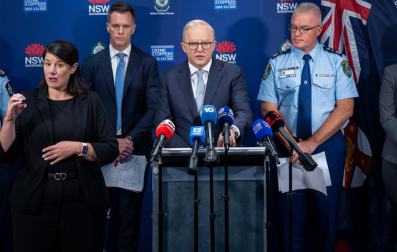
At the beginning of the week Albanese made two significant announcements with the intention of showing he was getting on with government while his opponents remained self-obsessed.
First, he appointed career public servant Greg Moriarty to replace Kevin Rudd as Australia’s ambassador in Washington. Moriarty is widely respected across the parliament and served with distinction as ambassador to Indonesia.
The Greens were critical of Moriarty’s tenure as secretary of Defence during “procurement disasters and scandals”, but former deputy secretary Hugh White pointed out that the issues at Defence were more complex than the top public servant. Ministers and government policies were as relevant, if not more so.
White says the lesson of Trump’s Washington is that it is no place for a former politician with a social media account. The Trump administration seems to agree and has welcomed the appointment.
As a second big moment for the week, the prime minister announced he had invited Canada’s Mark Carney to visit Australia and address the parliament. The invitation was issued before Carney’s speech at the World Economic Forum in Davos last week. Chalmers described Carney’s denunciation of Trump – and the hegemon – as “stunning” when he revealed it was being widely discussed in the government.
On Insiders, host David Speers quoted key points from the speech to Albanese. The Canadian said the world order was “in the midst of a rupture, not a transition”. He urged middle powers to “act together because if we’re not at the table, we’re on the menu”.
Albanese said he agreed with his Canadian counterpart, and the views expressed were consistent with his United Nations speech last year.
It is not consistent with Australia at last December’s Australia–United States Ministerial Consultations (AUSMIN) talks in Washington, however. There, Foreign Affairs Minister Penny Wong and Minister for Defence Richard Marles spoke as if nothing had changed in the world order, nor with the Trump administration’s disdain for the rules, as evidenced by its behaviour in Venezuela and stated designs on Greenland.
Carney said intermediate powers can build a new order based on their values, but it begins with honesty. He went on to say Canada is adjusting its policies to meet these new realities.
Hugh White says the time has come, indeed it is overdue, for Australia to make a similar reassessment of where it stands with the US, a powerful transactional ally whose influence in this part of the world is being challenged irreversibly by China, with no guarantees that it sees itself any longer as Australia’s protector, if it ever did.
Perhaps the invitation to Carney is a signal that the ever-cautious Albanese is doing some rethinking. Maybe.
This article was first published in the print edition of The Saturday Paper on January 30, 2026 as "The end times".
For almost a decade, The Saturday Paper has published Australia’s leading writers and thinkers. We have pursued stories that are ignored elsewhere, covering them with sensitivity and depth. We have done this on refugee policy, on government integrity, on robo-debt, on aged care, on climate change, on the pandemic.
All our journalism is fiercely independent. It relies on the support of readers. By subscribing to The Saturday Paper, you are ensuring that we can continue to produce essential, issue-defining coverage, to dig out stories that take time, to doggedly hold to account politicians and the political class.
There are very few titles that have the freedom and the space to produce journalism like this. In a country with a concentration of media ownership unlike anything else in the world, it is vitally important. Your subscription helps make it possible.
Subscriber exclusive
Send this article to a friend for free.
Share this subscriber exclusive article with a friend or family member using share credits.