Sport
After last Sunday’s astonishing ascent of the 508-metre Taipei 101 tower, Alex Honnold laid claim to being not only the world’s best free climber but also one of history’s greatest athletes. By Martin McKenzie-Murray.
Tracking Alex Honnold’s extraordinary Taipei 101 climb
In a world in which the most privileged souls, at least one billion of us, amuse ourselves with addictive screens offering a thin stream of ceaseless spectacles – a world much closer to Huxley’s dystopia than Orwell’s – we might struggle to distinguish between spectacles. Or care for longer than a few minutes, or hours, or days at best.
So let me state the obvious here, if only as a hopelessly modest barricade against the fickleness of our memories and imagination: it is extraordinary that a man just climbed one of the tallest buildings in the world, without the help or safety of ropes or a harness, and that the attempt was broadcast live with skilful and startlingly intimate camerawork.
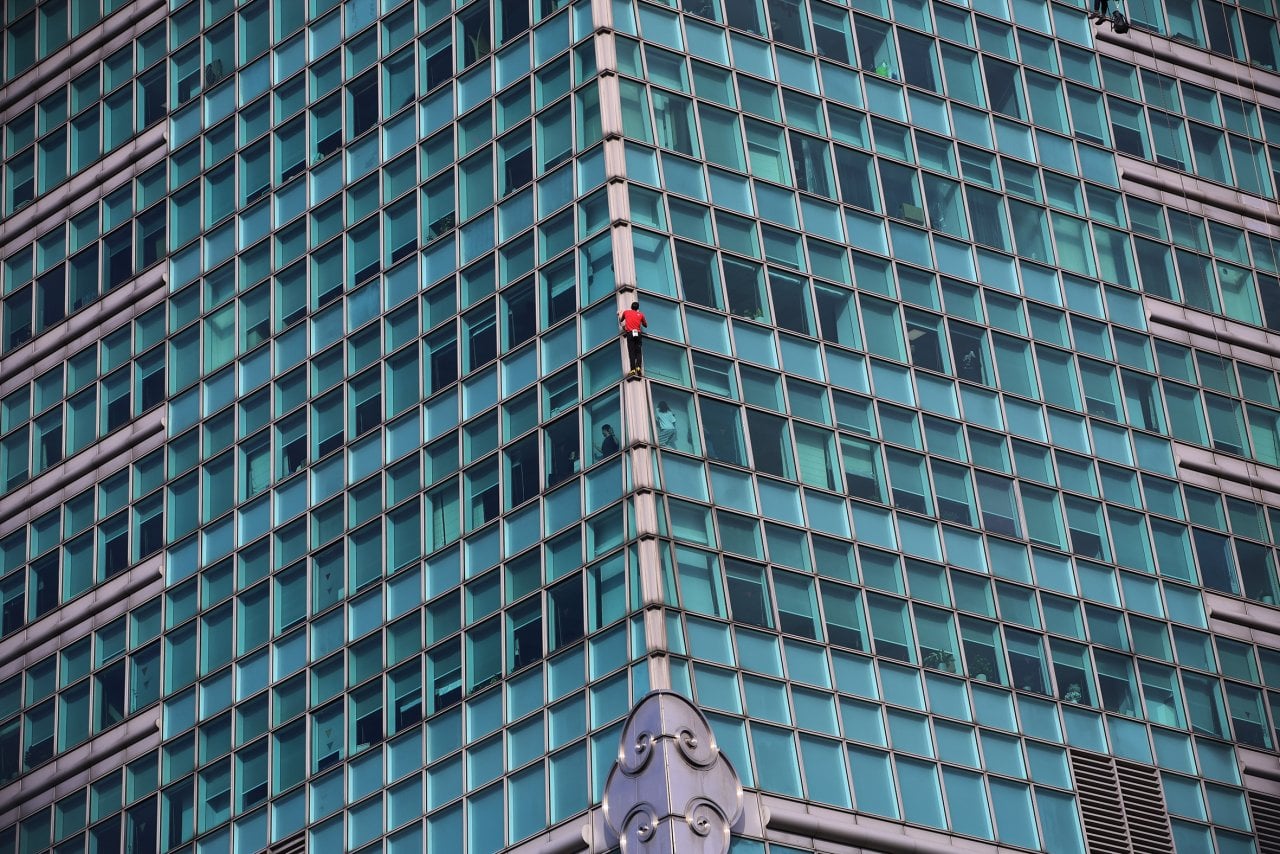
So it was last Sunday, as history’s greatest climber, Alex Honnold, began his successful ascent of all 508 metres of the Taipei 101 tower – one that ended not at its observation deck but continued all the way up its needle until he was standing upon the small metal sphere that contained its warning light for aircraft.
As reality TV, this wasn’t Floor Is Lava, in which obnoxious extroverts giggle over obstacle courses, nor was it The Bachelor, where obnoxious extroverts try to get laid. Nonetheless Netflix did its best to transform this inherently dramatic, historic and uniquely surreal moment into kitsch.
Anchoring the broadcast and assembled before a desk at the foot of the skyscraper were three people: the host, Elle Duncan, an ESPN broadcaster whose great power is garrulous prattle; Seth “Freakin’ ” Rollins, a professional wrestler who suffers the same fear of silence as Duncan; and, finally, professional climber and friend of Honnold’s, Emily Harrington.
About 35 minutes into the climb, there was a blessed period of about two minutes in which nothing was said, and the freakishness of what we were witnessing could be better appreciated. This was one spectacle that didn’t need any gravy.
Alex Honnold is now 40 and the father of two young girls. You might know him from the documentary Free Solo, in which his historic, unassisted climb of El Capitan – a 914-metre vertical rock face in the Yosemite National Park – was filmed with exquisite, nerve-shredding intimacy.
He wasn’t married when he made that climb. Nor was he a father. In an interview with The New York Times, published just a few days before climbing the skyscraper, he was asked about how he treated risk now he was a dad. His initial response seemed logical, if eerily so. “Honestly, I don’t think the calculus has changed that much,” he said. “Because I never wanted to die. Which is why I put so much effort into the preparation and training. I mean, implicit in the question is that I have more to live for, and, yeah, I have more to live for, and I’m still doing my very best to not die.”
Additional questions politely needled the theme of parental responsibility, and I thought the following exchange illuminated Honnold’s strange calculus of risk and consequence. The interviewer says: “But it’s not just that you have more to live for. It’s that your loss would be felt in a deep way for more than just [Honnold’s wife] Sanni.”
Honnold replies: “Kind of. I mean, baby Alice wouldn’t remember. Baby June probably wouldn’t remember. She’ll be four in another month. It’d be felt, and obviously it’d be super hard for Sanni, but they’d be well provided for. I don’t feel like I’d be leaving them in the lurch. They wouldn’t even necessarily be traumatised their whole lives.”
God forbid I muddy Honnold’s achievement with pompous implications of his selfishness. This interview fascinated me, though, in the same way the broadcast panel’s awkward broaching of his parental responsibility – glibly punctuated by an encouragement to viewers to hashtag the event – compounded the nausea I felt watching a man climb a fucking skyscraper.
The Taipei 101 building opened on New Year’s Eve 2004 and at the time was the world’s tallest building and the first to exceed half a kilometre in height. It was designed to withstand local vulnerabilities, which include typhoons and earthquakes – Taiwan sits perfectly on the Ring of Fire and seismic activity was one (imperfect) part of Honnold’s risk analysis.
Well before his climb, Honnold studied the building. He examined photos, watched film, visualised his climb – and then made two ascents with rope. There was also intense physical preparation: “one hundred reps a day: pull-ups, push-ups, core work, stretching.”
For his free solo ascent, he chose one of the tower’s corners. The building begins with a tapered base – the easiest part of his climb – before eight flared modules, each made of eight storeys, are stacked upon the other to resemble the segments of bamboo stalks. Honnold referred to these as the “bamboo boxes” and, as they flare outwards, they presented a modest overhang for him.
Perhaps the most extraordinary moment was when Honnold, now climbing the thick, concentric rings that decorate the base of the tower’s needle – rings that get larger as they get higher, and thus presenting Honnold with the severest overhang of the climb – hung by only one leg as he reached, with both hands, into his bucket of chalk powder.
It took Honnold just 91 minutes to reach the skyscraper’s tip, and it’s safe to say I felt much more anxious than he did – and I write this as someone who watched the climb only after he’d completed it, thus knowing he hadn’t died in the attempt.
Still, like the vast majority of those watching – live or on delay – I felt all the things one might assume Honnold to feel but didn’t. My palms leaked, my stomach leapt and my jaw ached from the involuntary grinding of my teeth. My nervous system was terribly provoked and were I not certain I would be writing about this, I would’ve turned it off.
And so, as impressive as Honnold’s physique is, I wondered just like everyone else: what the hell is this man’s brain like?
For others, the official signs warning us against precisely what we were about to do only spiced the thrill, but not for me. I couldn’t defiantly shrug them off – not when they were confirming what my brain’s threat response system was already urgently bleating about.
I was about to jump off a cliff. What’s more, I was about to jump into a river that was also a nursery for bull sharks. I was 19 and we’d come to the limestone cliffs of “Blackies”, otherwise known as Blackwall Reach, a section of Perth’s Swan River. It’s an idyllic spot but also one long woven into local lore as a place where those with immature prefrontal cortexes can indulge their undeveloped centres of rationality.
I have a pronounced fear of heights and was, and still am, a terribly weak swimmer. Nor was my capacity to assess risk underdeveloped – if anything, it was neurotically active (though, looking back now, curiously selective). In that situation, it seemed that a smorgasbord of grisly deaths had been presented to me: I could drown, become shark bait or be gruesomely pulped on the rocks below.
My body’s declarations of fear were obvious – sweaty palms, uncertain legs – and so it’s an extraordinary testament to the power of peer pressure that it could so easily disarm my brain’s alarm system, the one refined by thousands of years of evolution.
There were, from memory, two or three ledges to leap from at this spot – each one higher than the other. The highest point was about 15 metres, I think, though I selected a lower one of about 10.
To recall my jump now is to startle my own incredulity, as it is to revive the fear of that moment – the sweaty palms and queasiness. In fact, that’s all I recall: the alarm and uncertainty before I jumped. Of the jump itself, and of being in the river afterwards, I remember nothing. What was happening inside my head is now more memorable than what my body did when it defied the several departments of my brain devoted to keeping me alive – intensified by now learning that two young men died jumping from those cliffs in one year alone.
In 2016, Alex Honnold’s brain was examined. He entered the tube of an fMRI scanner, which observes brain activity via its blood flow, and while there submitted to an arousal test. Hundreds of provocative images, which included mutilated corpses, suffering children and piles of shit, flashed quickly before him.
The neuroscientist running this was Jane Joseph, and she was especially eager to examine the scans for Honnold’s amygdala – the almond-shaped, “reptilian” part of our brain that serves as our subverbal threat detector. It’s the part responsible for our fight-or-flight response.
What Joseph found was an amygdala of normal size and seemingly healthy. Remarkably, though, it was indifferent to the stimulus it was exposed to. They scanned the amygdala of their control subject, a fellow mountaineer who was also high sensation-seeking, and it was lighting up.
They wondered: what of his amygdala’s lack of reactivity owed to genetics, and what to his own will – of repeated exposure to danger coupled with a personality that was highly conscientious and minimally, if at all, neurotic?
What’s immediately obvious with Honnold is the discrepancy between how extreme his climbs are and the chillness of his demeanour. His nickname is No Big Deal, and he confirmed its appropriateness last Sunday when, 89 storeys high and fixed to the side of a building by nothing more than his feet and hands, he cheerfully waved to those inside.
So, of course his brain is of interest, but the physicality of what he did – the endurance and tensile strength – seems to me to flirt with the superhuman, regardless of his arguably greater feats on granite faces.
Writing about this, it seems hard to defy hyperbole and prevent Honnold’s achievement from being covered by the rubble of journalistic cliché. But what we saw was a strange and astonishing thing, and something that belatedly compels me to consider Alex Honnold as not just the greatest climber of all time, but one of history’s greatest athletes.
One might ponder the ethics or meaning of his climb, or the mysteries of his brain.
For now, I will settle with awe.
This article was first published in the print edition of The Saturday Paper on January 31, 2026 as "Ever upwards".
For almost a decade, The Saturday Paper has published Australia’s leading writers and thinkers. We have pursued stories that are ignored elsewhere, covering them with sensitivity and depth. We have done this on refugee policy, on government integrity, on robo-debt, on aged care, on climate change, on the pandemic.
All our journalism is fiercely independent. It relies on the support of readers. By subscribing to The Saturday Paper, you are ensuring that we can continue to produce essential, issue-defining coverage, to dig out stories that take time, to doggedly hold to account politicians and the political class.
There are very few titles that have the freedom and the space to produce journalism like this. In a country with a concentration of media ownership unlike anything else in the world, it is vitally important. Your subscription helps make it possible.
Subscriber exclusive
Send this article to a friend for free.
Share this subscriber exclusive article with a friend or family member using share credits.