Comment
Stan Grant
January 26 and the limits of history
My Australian story starts with a photo. It is a photo of a man with a face hitherto unseen in the world. The bearded man wears a long winter coat, collared shirt and stylish hat. In his right hand he holds a stone axe. He is standing next to a ceremonial scarred tree stump.
The man is my great-grandfather, William Grant. His father was an Irish Catholic rebel convict. His mother was a Wiradjuri woman.
I think of Grandfather Bill as the first “Australian” in my family. He could have existed nowhere else. No longer Irish. Not simply Wiradjuri. His face tells a new story.
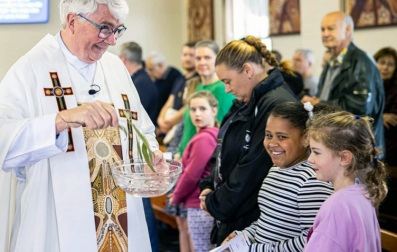
I thought of Grandfather Bill as I spoke at an Australia Day event in the New South Wales Snowy Valley, where I spend much of my time. I say Australia Day because here, in this humble place among modest people, that feels most appropriate.
Elsewhere the day takes on a more abrasive and necessarily political edge: Invasion Day or Survival Day. Here I confess to being held among gentler spirits. This is more a capacious, less contested space. It is on my ancestral Wiradjuri land. It is also a land where my wife’s Chinese great-grandfather came to work in the 19th century goldfields.
Here I meet people who carry the dust of their own ancestors’ journeys.
We are all part of the same story.
I spoke about Grandfather Bill, born of parents whose people from opposite sides of the world had suffered under British imperialism. I spoke of my other paternal great-grandfather, who was jailed for speaking his Wiradjuri language to my father when Dad was a boy. I spoke about how my father helped revive that language, how he co-wrote the first Wiradjuri dictionary. In 2009, Dad was named a Member of the Order of Australia.
We are all part of the same story.
I spoke about my white maternal grandmother, who was kicked out of home and moved in with a young Aboriginal man who lived in a tent by the river. They had a dozen children together.
We are all part of the same story.
I spoke about my childhood, poor and itinerant, moving from town to town. I spoke of a disrupted and sporadic education, of being told I would amount to nothing. Yet here I was speaking to these people with a 40-year international career in journalism behind me.
We each face hardship. We each know sorrow. We cry. We laugh. We despair. We hope.
We are all part of the same story.
January 26 is not an easy day. Living with memories is never easy. This day holds all of our stories. We can change the date, but we cannot change the history.
In such moments, I am put in mind of the words of T. S. Eliot: time is no healer: the patient is no longer here.
This past Australia Day, I shared truth. I did not tell it. There is a difference. Truth is not one thing. I don’t own the truth. Our stories don’t run one way.
One of the wisest people I met, Bungal David Mowaljarlai, said, “Everything has two witnesses.”
This Ngarinyin man was known as the Keeper of Creation: a poet, a songman, a sacred man. Mowaljarlai said: “Everything is represented in the ground and in the sky. You can’t get away from it, because all is one, and we’re in it.”
There are those who find certainty in history. For them history is a dry well from which they draw their identity. They live in William Faulkner’s lament, where the past is not dead, it is not even past.
History is a desolate place; nothing grows there. There is no truth. There is no justice. Time is frozen. It is a Sisyphean burden, futile and unbearable.
In the absence of God, we have made an idol of history. It is a pitiless deity. History is the salt in our wounds. It is the hate in our hearts.
Every war I have covered has at its heart history and identity.
W. B. Yeats knew this. His two Irish rebels talk of the breath of politic words, the wind that blows across a bitter sea.
‘But where can we draw water,’
Said Pearse to Connolly,
‘When all the wells are parched away?
O plain as plain can be
There’s nothing but our own red blood
Can make a right Rose Tree.’
Justice, yes. Peace, yes. No more blood; please, God, no more blood.
Surely in 2026, with the bloodletting of the 20th century still staining our world, with wars still raging, with the memory of Bondi burnt into our nation’s soul, surely we can be kind, gracious and forgiving. If we cannot, we have nothing.
Rarely is the divide between the noise of the chattering class and the sweat and smiles of ordinary Australians more stark to me than on January 26.
Driving here, my wife and I stopped at a popular highway pie shop. Two Arabic men beside me were debating whether to get a vanilla slice or a cream bun. A Cambodian man started chatting to me about his Christmas holiday in a popular spot not far from my house in the Snowy.
There were all the faces of Australia in that place of the most-Australian sustenance. All of us sharing space. No one hating each other. This is where Australia wears its history lightly.
The night before I left the city, my son and I attended a Nick Cave and the Bad Seeds concert in Sydney’s Domain. A magical Sydney night. Warm but warmer yet because of the smiles and the fragility of strangers.
There was a moment when the thousands of voices joined as one to sing with Cave: “Into my arms, O Lord / Into my arms...” A song of love now a shared hymn.
That’s where Australia speaks to me. In music. In shared sorrow. In laughter. In pie shops and barbecues, eating lamingtons and talking over cups of tea.
Yes, we vote differently. Yes, we disagree. Yes, we come from foreign lands, worship other faiths or none. Yes, we inhabit our histories. Mowaljarlai was right: all is one, and we’re in it.
There is a place for righteousness and a time to raise our voices against suffering and injustice. That should be precious to us all. Yet the imperative of our modern age to perform our anger, our grief, lends a vaudevillian sheen to much protest.
Albert Camus once said claims for justice are an invitation to hate. Nowadays, it is as much an invitation to laugh. Authenticity, aching lament and courage are lost in the absurdity of it all. The voiceless are subsumed by the volume.
My inclination now is to lower my voice. I cannot shout louder than history. In the quiet spaces we might be heard.
It is true to me that nations are built on what we do, not how loud we are. On Australia Day I stood with people – Aboriginal and everyone else – who drive buses, bake cakes for fundraisers, mow lawns for free just to keep our parks clean and safe for children.
We don’t hear about them in the media. Politicians don’t speak for them.
To believe our media and our politics is to think we are a nation tearing each other apart. No, that is only what they want us to think.
I am grateful to those quiet people who do the heavy lifting while others are busy talking. There’s a time for talking, but a nation is built on sweat and gratitude. You do a nation, you don’t talk it.
I am Aboriginal and Irish and a few other things besides, and on January 26 I am grateful for it all. I want to honour my forebears by doing what I can to make this country worthy of those who have built it.
I am the son of a Black sawmiller whose Irish–Wiradjuri grandfather had a new face, wore a hat and carried a stone axe. Dad has never protested a day in his life.
He sharpened saws to feed his family and he wrote a dictionary to honour his people. He gave us all – Indigenous or not – a way to tell a new story with an old language.
Thanks, Dad.
We are all part of the story.
The story never ends.
This article was first published in the print edition of The Saturday Paper on January 31, 2026 as "The limits of history".
For almost a decade, The Saturday Paper has published Australia’s leading writers and thinkers. We have pursued stories that are ignored elsewhere, covering them with sensitivity and depth. We have done this on refugee policy, on government integrity, on robo-debt, on aged care, on climate change, on the pandemic.
All our journalism is fiercely independent. It relies on the support of readers. By subscribing to The Saturday Paper, you are ensuring that we can continue to produce essential, issue-defining coverage, to dig out stories that take time, to doggedly hold to account politicians and the political class.
There are very few titles that have the freedom and the space to produce journalism like this. In a country with a concentration of media ownership unlike anything else in the world, it is vitally important. Your subscription helps make it possible.
Subscriber exclusive
Send this article to a friend for free.
Share this subscriber exclusive article with a friend or family member using share credits.