Profile
Sophie Hyde’s Jimpa, starring Olivia Colman and John Lithgow, lightly fictionalises her own family’s life. By Stephen A. Russell.
Director Sophie Hyde confronts family matters in Jimpa
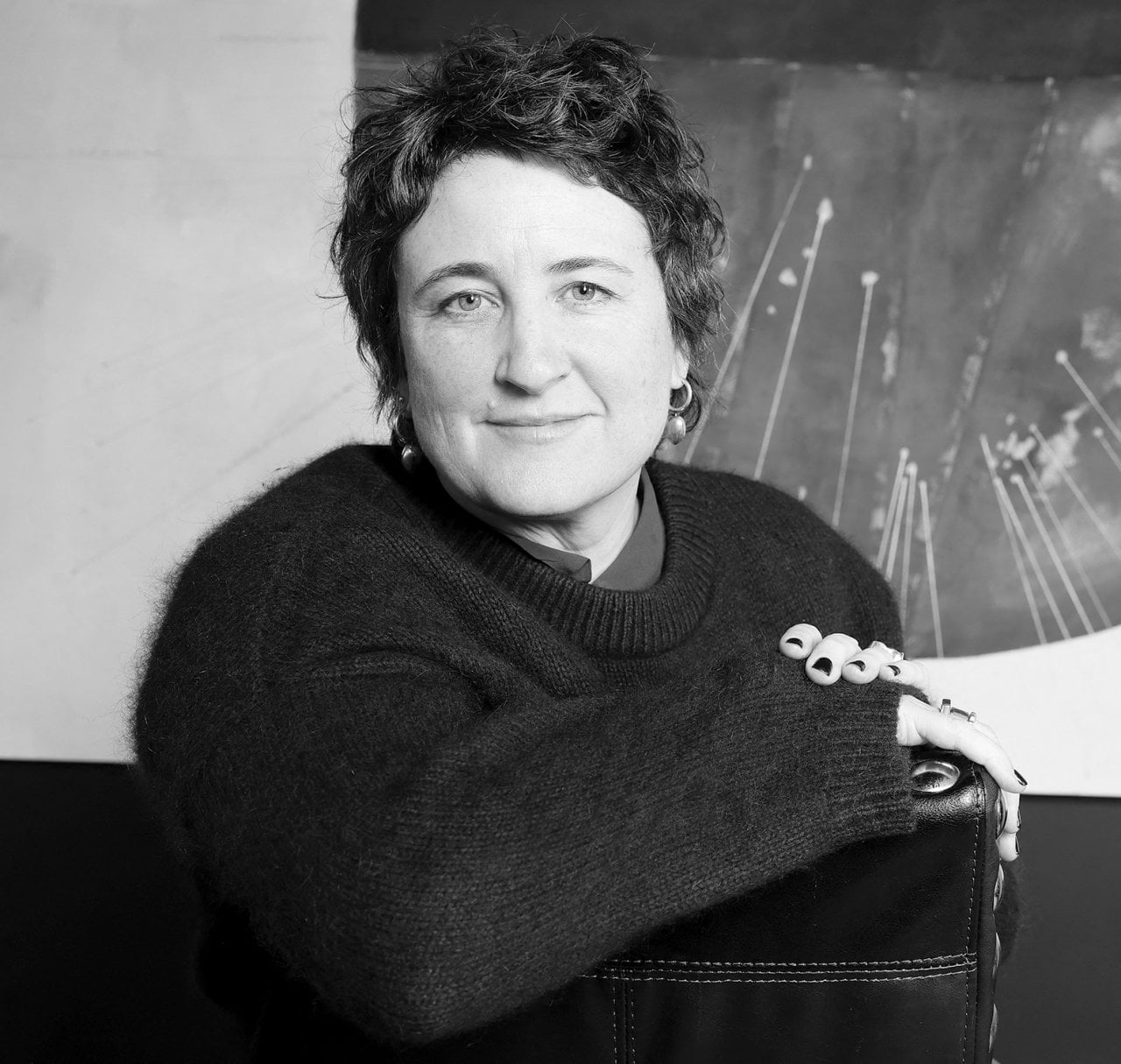
Filmmaking has always been a family affair for Jimpa director Sophie Hyde. She met her partner in life and business, the editor and cinematographer Bryan Mason, on set. When they had a child, Aud Mason-Hyde, they’d work together on films in Closer Productions’ purpose-built edit suite, housed in their garden shed. Aud slept in the house, emitting occasional shrieks and gurgles over the baby monitor.
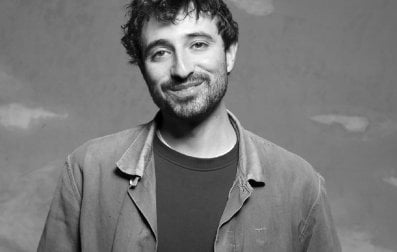
“Bryan and I worked together before we were together,” Hyde says, as she and Mason-Hyde joined me in the courtyard of the Exeter Hotel during the Adelaide Film Festival, where Jimpa had just enjoyed its Australian premiere in their hometown after debuting at Sundance. It opens nationally on February 19. “Creating is just part of our world, our house and our family.”
Hyde was once a Friday night glassie at the Exy, as it’s affectionately known. These days, the Sundance Directing Award-winner’s films screen at the Palace Nova Eastend cinema, just around the corner. They include the sex-positive Good Luck to You, Leo Grande, starring Emma Thompson and Daryl McCormack, and the remarkable 52 Tuesdays. Shot once a week over the course of a year, the latter features Del Herbert-Jane as a parent who is transitioning, with Tilda Cobham-Hervey as their daughter. Mason-Hyde has a minor role in that film.
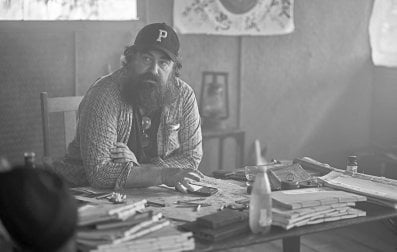
Hyde’s most personal work yet, Jimpa features Olivia Colman as Hannah, a filmmaker grappling with the emotional complexity of telling a cinematic story loosely based on her own life. In particular, she negotiates a reckoning with her spiky father, Jim, played by John Lithgow – an out and proud activist and academic who chose to leave the family home in Adelaide to live as a gay man in Amsterdam.
Many of Jimpa’s details resemble, if not exactly mirror, their family history. “My parents really did make this really big choice about not treating each other badly amid something very difficult, working out how to raise us while my dad lived elsewhere,” Hyde says.
The real Jim Hyde, a towering figure in Australia’s response to the HIV/AIDS crisis, moved to Melbourne, not Amsterdam. “I felt like I was parented by them both,” Hyde says. “I would go on the train to Melbourne every holiday.”
During the height of the crisis, in the ’90s, the personal was political for many gay men, with Jim always surrounded by fellow intellectuals equally fond of sparring. “It was combustible,” Hyde says. “He was a very provocative kind of person, pushing people’s buttons to get a response, but equally, he was very loving. It was kind of strange. You’d almost feel like he’d have an argument with you in one room and then go next door and argue your point to someone else.”
Jimpa wades in these choppy waters, crossing intergenerational faultlines while focusing on navigating connection, rather than centring conflict. Mason-Hyde plays Frances, Hannah’s non-binary teenager, who throws their mother a curve ball when they announce, at the start of a family trip to Jim’s place in Amsterdam, that they will stay on.
Mason-Hyde is grateful that both creativity and debate were integral to the family dynamic. “It feels so normal to be involved in cinema and the arts here in Adelaide, where it’s quite a tight-knit group. But there are moments in my childhood, now, that I look back on and think, ‘Wow, what an experience.’ ”
These moments include playing Jesus Christ in a satirical children’s nativity play staged in a window of the State Library of South Australia during Adelaide Fringe. “It was quite funny, but I don’t think I realised it was funny at the time,” Mason-Hyde says. “We were very sincerely playing these roles.”
Sincerity and respect radiate from their relationship. Mason-Hyde and Hyde finish one another’s sentences and leap into seemingly unrelated segues only to circle back to the point. “One of the things that I’m really grateful for, having parents in the arts, was that they were so supportive of both my queerness and my transness,” Mason-Hyde says. “Having had the real Jimpa, too, as my grandpa, allowed me not to internalise shame. I was always able to say, ‘Actually, no, I don’t think your system’s right here.’ ”
Mason-Hyde’s upbringing allowed them to feel pride in their difference. “Sometimes I joke with my friends that I was assigned butch at birth,” they say. “Everyone was like, ‘That’s a small lesbian, walking around.’ And then I had to figure out, am I rejecting cis femininity, or all of womanhood for me personally?”
The education system actively enforced erasure. “Primary school was hell. I loved the school part, but there was just such a white, cis, binary view of gender that was so pervasive. Everything was split by boys and girls, and we were flooded with heteronormativity.”
Mason-Hyde recalls one particularly grim day in sex education class. “The teacher looked me dead in the eyes, and I’ve got like a mullet and I’m wearing boys’ clothes, and says, ‘You know, some people are gay, yeah? You can find resources about that online, but they’re not in the room with us.’ And I’m sitting there like, ‘Sorry, I’m so fucking obviously in the room.’ ”
Like many a queer kid, they found sanctuary sheltering in the school library at lunch. “The bathrooms were not a safe space, nor was the sports field,” Mason-Hyde says.
Much as Jim once did, Mason-Hyde embraced the political. “I started Year 8 and, 10 days in, I was the captain of the LGBT club. I was so visible, and that’s a beautiful responsibility, but it is a responsibility.”
Cinema was another safe space. “I remember going to the Berlinale International Film Festival for 52 Tuesdays when I was nine years old,” Mason-Hyde says. “There was such amazing hospitality and I was able to see so many children’s films from around the world and just be totally enveloped in and immersed by that, and I think it’s totally shaped me.
“I remember getting picked up after school and going straight to film sets where my parents were working, then sitting in the corner reading a book while they finished their day.”
Now embarking on an acting career of their own, including singing on camera and over the end credits in a duet with Brendan Maclean, Mason-Hyde relished playing a not-quite version of themself in Jimpa.
“Frances is such a different person to me in so many ways, but what’s so interesting is the point in their life at which we meet them – that’s like where I was before I left school, feeling like there’s nowhere I can be fully myself,” Mason-Hyde says. “I’m either too queer or not acting on my queerness enough. Too odd or too sincere and I care too much.”
As director, Hyde helped Mason-Hyde maintain some sense of separation from the role. “There are things that happen to Frances that weren’t Aud’s experience in any way, so that made it a bit easier,” Hyde says. “What’s amazing, though, are the elements we drew on that are very true. Like the experience of having a trans child and realising, as someone who has tried to balance everyone’s feelings and opinions, that actually what I need to do is stand up very firmly for my child, above all else.”
Hyde hadn’t intended for Jimpa to feel quite so familiar on the page when she worked with her regular co-writer, Matthew Cormack. Even the family dog appears in the film. “I thought ‘us’ was just going to be a sort of a launch pad, then we’d create these other things, but as soon as you start writing ‘a filmmaker’, or ‘a trans child’, you’re like, ‘Oh my God.’
“It was really beautiful, because I was writing it with one of my oldest friends, who I’m very close [to], and we spent a lot of time together, just talking. It didn’t feel as much like therapy as that sounds, although there were some moments.”
Cormack understands Hyde’s rhythms as a filmmaker. “Matt’s very driven by craft, so he’s listening to me, but he’s also like, ‘What is the narrative? How does this work?’ He was always adjusting and we pushed each other around a little bit.”
That push and pull was exhilarating. “When we started to make Jimpa, it became more embedded in our lives,” Hyde says. “Now it’s hard to disentangle it, because I think we have also grown and changed through making it, in a way that makes us more entwined.”
Mason-Hyde agrees. “We get asked a lot, ‘Where is the line between fiction and reality?’ And the truth is, we’ve spent almost six years now thinking about writing, developing, making, finishing and releasing this film. So it’s fundamentally a huge part of us. Frances is a huge part of me. So it’s this wonderful, weird and twisted little thing.”
Speaking of weird, how does it feel to watch Colman, Lithgow and Daniel Henshall as Mason’s stand-in of sorts interpret roles that hew so closely to their home life?
“John is a very particular kind of person,” Hyde says. “He walks in and he’s like, ‘Tell me everything.’ He finds what’s incredible and beautiful and he really wanted to get inside Jim’s skin, right down to fake tattoos and nipple rings. He’s a real actor’s actor. You can imagine him on stage.”
Colman came with no armour, Hyde says. “She didn’t have her guard up at all. She was a little nervous about being in Adelaide, in a rehearsal space that she didn’t know, but she just sat so well inside it. She works very hard underneath, but she’s also very instinctual. You just go, ‘Your version is the version.’ That’s how I always felt. I never wanted her to pull towards me. There’s the writing and then there’s her take on it.”
An actor’s interpretation brings a fresh perspective to the art of storytelling, after all, particularly when, as Hyde half-jokingly suggests, she keeps writing the same ending to all her films.
“In 52 Tuesdays, Animals and Leo Grande, they all end in a moment where somebody is trying to work out how to feel free,” she says. “They don’t run away. They’re like, ‘How do I stand as myself and see myself?’ ”
Jimpa marks the first time that Hyde has worked with an intimacy coordinator, Anna van Schijndel. “I was a bit uncertain about how to do that, because I feel a lot of my work is already in that space,” the director says. “But we loved Anna. You want to be as close as you can get with your actors and as frank as you can be, but you still hope that they have someone they can go to if they feel like, ‘I don’t want to say this to Sophie.’ It was great for there to be this person that Aud could discuss things with when you’re like, ‘I’m so sorry, but you have to know this bit.’ ”
Hyde is used to negotiating these terms with Mason. “It’s hard for me to separate out this stuff, and maybe there aren’t good boundaries, but the people in my life, my family and my chosen family, we work together. It’s the chicken and the egg. I’m very close to a lot of my team and I really rely on them. Then new people come in and become part of the fold.”
It’s not always the way. “It’s a very hard thing to create and I think everyone who’s closest to me also agrees it’s still a battle to make a film like that,” Hyde says. “The process is actually amazing, but the film industry works in a certain way that almost tries to rip that off you – that thinks that closeness is something to get away from.”
As independent filmmaking is such a tough game, Mason-Hyde prefers their mother’s open-hearted approach. “When you make a film, you have to be immersed in it, so you may as well make it with the people that you adore.”
This article was first published in the print edition of The Saturday Paper on January 31, 2026 as "Family matters".
For almost a decade, The Saturday Paper has published Australia’s leading writers and thinkers. We have pursued stories that are ignored elsewhere, covering them with sensitivity and depth. We have done this on refugee policy, on government integrity, on robo-debt, on aged care, on climate change, on the pandemic.
All our journalism is fiercely independent. It relies on the support of readers. By subscribing to The Saturday Paper, you are ensuring that we can continue to produce essential, issue-defining coverage, to dig out stories that take time, to doggedly hold to account politicians and the political class.
There are very few titles that have the freedom and the space to produce journalism like this. In a country with a concentration of media ownership unlike anything else in the world, it is vitally important. Your subscription helps make it possible.
Subscriber exclusive
Send this article to a friend for free.
Share this subscriber exclusive article with a friend or family member using share credits.