Profile
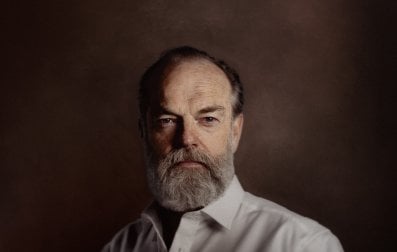
For director Constantine Costi, all the world’s a stage, whether it’s an opera production or a porridge-making competition in a Scottish village. By Stephen A. Russell.
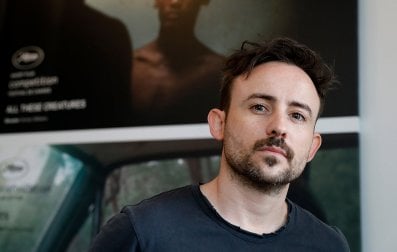
Director Constantine Costi on swapping opera for The Golden Spurtle
The Australian premiere of Constantine Costi’s documentary The Golden Spurtle at this year’s Sydney Film Festival took place in the awe-inspiring State Theatre. The vast, chandeliered auditorium is a far cry from Carrbridge, the tiny village in the Scottish Highlands that has hosted the annual World Porridge Making Championship since 1994.
“It was truly gobsmacking and humbling, looking around seeing 2000 people, or two and a bit Carrbridges,” Costi says. “After that screening, we all went to yum cha together and were sitting in silence, in shock.”
The Golden Spurtle, in Australian cinemas on December 11, is named for the contest’s gold-plated wooden spoon trophy, hand-lathed by Charlie Miller, the now-retired honorary chieftain of the porridge-making contest. The film sold out all sessions at the Sydney and Melbourne film festivals and has entertained international audiences from Copenhagen to New York to Edinburgh. When we speak, Costi has just returned home from Camerimage in Toruń, Poland, and the Cormorán Film Festival in A Coruña, Spain.
The film ostensibly follows Sydney taco chef Toby Wilson through the competition, but it’s really about the adorably kooky locals, who we’re laughing with, rather than at. “That was a guiding principle,” Costi says. “The Scots know this is serious, competitive business, but it’s also absurdly funny. Everyone had a glint in their eye which is really cheeky, so we were all in it together.”
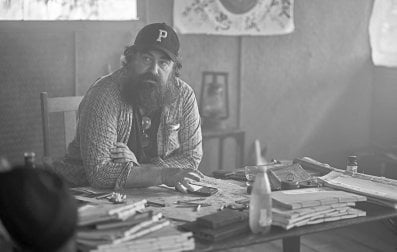
Competitors hail from as far afield as Canada and Zimbabwe, but the most entertaining drama comes from the rivalry between local Ian Bishop, a surly Sean Connery type returning to the fray after years away, and the super-confident English contender, Nick Barnard of London. “Nick genuinely loves porridge so much, maybe more than any of them, really,” Costi notes. Bishop mutters about martial arts under his breath. “It would be wrong of me to say that I’m not burning with desire to win the Golden Spurtle, 10 years in,” says Barnard, “having been in the final six or seven times now.”
Editor James Alcock, a Scot, was attached to the project after John Archer, at the British arm of production company Hopscotch, was sold on Costi’s exploratory phone footage. “It was a high priority to get Scottish involvement and John saw something in us, taking us on and providing a bigger team.”
Alcock helped the film say a lot in small moments, such as when Barbara Kuwall bows out after washing porridge-clad dishes for quarter of a century, or self-appointed raffle queen Jane Weston says she’ll be buried with her paper crown. “It was amazing to see how these quirky, eloquent characters kept evolving,” Costi says. “Just when we thought we’d maxed out on interesting locals, they kept coming. We littered the film with these tiny, imperceptible details that give you a sense of the care they put into it.”
How did an Australian director of opera, the former co-artistic director of the Old Fitz Theatre’s Red Line Productions, wind up making a film about international porridge-making prowess in Scotland? Costi’s debut film, 2020’s A Delicate Fire, was a series of vignettes celebrating the life and art of baroque composer Barbara Strozzi.
“The behind-the-scenes story is sort of insane,” Costi says. “Toby and I have a mutual friend who told me about him competing. It piqued my interest while I was working on [Schönberg’s] Pierrot lunaire for the Berlin Philharmonic. So I’m in pre-production with the world’s greatest orchestra and it was very intense, so I needed to do something lighter-hearted than staging atonal classical music.”
Costi contacted Miller. “I wrote him a really elaborate, over-the-top email asking if I could meet with him with no real master plan,” Costi recalls. “He wrote back with a very pithy Scottish reply, ‘Okay’, and I rocked up in the off-season, knocking on doors and taking little videos on my phone. I fell in love with the village and, most importantly, with Charlie.”
Knowing the 2023 competition would be Miller’s last, Costi squished in the two-week shoot before Pierrot debuted. “I frantically called my producer, Rebecca [Lamond], and was like, ‘There’s something here that we really need to make.’ ”
Costi immersed himself in Scottish culture, including the works of Robert Burns. “Poetry is kind of inescapable in Scotland, and this was a feeling we wanted to permeate the film,” he says. “I also read Arthur Herman’s The Scottish Enlightenment, a celebration of all these great thinkers like Adam Smith and David Hume, that makes a case that Scotland’s turbulent history laid the groundwork for the ‘Scottish Miracle’.”
Costi recruited his “dear friend”, cinematographer Dimitri Zaunders, “while I was the Mr Bean idiot of sound recording”. Zaunders shows Miller striding through misty glens in his kilt, consumed by Turner-like smoke billowing from a steam train, evoking a classic romantic hero.
“That’s spot on, because he is a bit of a romantic hero,” Costi says. “My favourite shot in the film is Charlie looking out the window and saying, ‘I can smell the wood smoke from the evening fires’, and it’s like Dylan Thomas. Maybe it’s something in the Scottish DNA.”
Costi shares some of Miller’s DNA in a roundabout way. “This information didn’t make the film, but I really connected with Charlie because he’s from Govan, quite a rough, working-class area of Glasgow. Growing up in council housing in the ’60s, he applied for art school, but practicalities meant he had to take a job.” It could have been Costi’s fate in another life. “I grew up on the North Shore of Sydney, in Riverview, Lane Cove,” he says. “My mother’s Italian immigrant family were all in fruit, and my father’s Greek–Cypriot side were fishmongers.”
Australia’s colonial history connects to the Scots. “You develop a similar sense of humour, which is maybe an intergenerational coping mechanism,” Costi says. “That attention to storytelling and that love of music, of culture.” I point out that Italians and Greeks have long staked a claim to this territory. “It’s so funny, I’d never thought about that, but they’re the inventors of opera and theatre and they don’t let you forget it.”
The outsider-insider disposition breeds artists, Costi suggests. “You have one foot firmly planted in the diaspora community and one in Anglo culture, so you’re perpetually looking in on both worlds. And I think that’s often the recipe to make someone who makes things.”
Costi would rope friends and siblings into performances and puppet shows as a kid. “I’m probably a little bit bossy, which makes you a natural director,” he confesses. This directorial spirit continued into his teenage years. He was part of a group of “arty weirdos” in high school, playing piano and guitar, wanting to be a musician. His efforts on the debating team, however, weren’t appreciated. “I remember the coach saying to me, ‘You’re not on the stage, Con, tone it down.’ And I was like, ‘No, I just think I might be on the wrong stage.’ ”
As for which stage was right, opera wasn’t on the cards at all. “Then I was mentored by [Bell Shakespeare founder] John Bell and, long story short, he encouraged me to apply for NIDA [the National Institute of Dramatic Art].”
It’s where Costi met the late German-born director Elke Neidhardt, who staged Australia’s first full production of Wagner’s Ring Cycle. “She was a formidable chain-smoker who obliterated my ideas and encouraged me to apply for an internship at Opera Australia, which I did.” Stepping into that world, Costi fell in love with opera’s form and potential. “I remember sitting there thinking, this can be the most boring thing in the world or the most beautiful and exciting.”
Something of a young Turk in the field, Costi brings a punk spirit. “I was able to truly understand the barriers for an audience and how to overcome them,” Costi says. “Playing catch-up, I launched myself obsessively into learning the repertoire, getting my languages up to scratch, all with that feeling of being behind the eight ball, which is the best recipe to combat complacency.”
Costi has assisted some of the great opera directors, including Berlin-based Australian Barrie Kosky, South African William Kentridge and Scotsman David McVicar. “I had this unbelievable education, going to the Komische Oper Berlin and, oh my God, seeing how these leviathan companies operate.”
Next year, Costi leads new stagings of Stephen Sondheim’s Into the Woods for State Opera South Australia and Puccini’s La Bohème for Opera Australia. “It’s a big year for me and I love how opera companies can cast a wide net to bring in lovers of classical opera and musicals, considering both forms equally important.”
As far as Costi is concerned, the division between so-called high and low art is imaginary. “People get too hung up on labels,” he says. “It’s something that plagues me, particularly in the opera world, where we need to dismantle these boundaries.”
He says there isn’t much separating his film and opera work. “On the surface, they seem like such different forms, but really, it’s about telling great stories. The way the team tells the Spurtle story is very theatrical. There’s a lot of attention to music and images that’s a little bit like a mini opera.”
Costi recruited conductor, composer and pianist Simon Bruckard, a fellow opera traveller, for The Golden Spurtle’s score. “I wanted someone I’ve worked with before and knew that Simon’s attention to character and his ability to create an atmosphere that’s familiar and evocative without relying on clichés was a real skill.” Bruckard aided the drama. “The fear is, you have this big build-up to the competition and then, ‘Three, two, one, go’, it’s just people quietly stirring a bowl,” says Costi. “The music creates excitement.”
They agreed on no bagpipes in the score. Of course, they show up on camera come competition day anyway. As does the rain, this being Scotland’s way. A wild ceilidh followed the competition. “We were so adrenalised and got completely wasted at the pub afterwards, dancing on tables like we’d won the Golden Spurtle.”
Costi recognises this boisterous ebullience in opera’s bones. “It’s a vibrant, mongrel, populist form enjoyed through the centuries,” he says. “I’ve been really passionate about taking opera out of the concert hall, as much as I love dressing up and having a cocktail on the Opera House steps.”
Hopefully, more Australian productions will follow. “Opera Australia are doing Leah Purcell’s The Drover’s Wife next year, and I think that’s a fantastic step in the right direction,” Costi says. “The work Kiwi writer Luke Di Somma and I did on Siegfried & Roy: The Unauthorised Opera for Sydney Festival, that’s not really an Australian story, but it feels like it. It’s in the tradition of Priscilla, Queen of the Desert, where that scrappy Australian theatricality permeates.”
Costi’s working on hush-hush plans for a movie musical, co-written with his brother Michael and Bruckard. “I’m really lucky that I’ve been able to surround myself with a coterie of talented artists like Simon and Dimitri, who similarly have a vocational pull to the absurd, to amazing stories and finding beauty in the mundane.”
As we wrap up, Costi’s anticipating the Opera Australia team dropping by with a miniature cardboard theatre to plot out La Bohème. “They’re great fun, because anything’s possible before the practicalities step in,” he says.
The box, with its paper figures, reminds me of a cute sequence in The Golden Spurtle where one is used to explain how the competition will run. “We gifted that to the village and they’ve put it in a glass case in the hall with a little plaque,” Costi reveals. “They’re a little village that punches above their weight, but they’re hugely reliant on tourism. So hopefully the film does good things for their local industry.”
Costi’s been touched by audience feedback. “A lot of people are walking away genuinely quite moved by the film, which I wasn’t anticipating,” he says. “We’re in the middle of this cultural and social revolution of profound disconnection and artificiality. So, to go to this village for 75 minutes and see this analogue world of real neighbourhood connection, there’s a beauty and a sorrow to that.”
This article was first published in the print edition of The Saturday Paper on December 6, 2025 as "From arias to oats".
For almost a decade, The Saturday Paper has published Australia’s leading writers and thinkers. We have pursued stories that are ignored elsewhere, covering them with sensitivity and depth. We have done this on refugee policy, on government integrity, on robo-debt, on aged care, on climate change, on the pandemic.
All our journalism is fiercely independent. It relies on the support of readers. By subscribing to The Saturday Paper, you are ensuring that we can continue to produce essential, issue-defining coverage, to dig out stories that take time, to doggedly hold to account politicians and the political class.
There are very few titles that have the freedom and the space to produce journalism like this. In a country with a concentration of media ownership unlike anything else in the world, it is vitally important. Your subscription helps make it possible.
Subscriber exclusive
Send this article to a friend for free.
Share this subscriber exclusive article with a friend or family member using share credits.