Fashion
Two of the most influential fashion designers of the 20th century are finally brought together in an NGV show that compares their anarchic visions of dressing women. By Lucianne Tonti.
Westwood | Kawakubo: NGV hosts the works of two iconic catwalk rebels
One of the few times designer Vivienne Westwood is known to have crossed paths with Rei Kawakubo was in 1974, when the famously discreet Japanese designer stepped into Westwood’s punk outpost on King’s Road in London, SEX. The store was the birthplace of DIY aesthetics, where Westwood popularised anarchic dressing: bondage trousers, straitjacket shirts and printed T-shirts so provocative they got her arrested. Some decades later, she would tell the comparatively demure Kawakubo – the creative force behind Comme des Garçons – she was “punk at heart”.
Aside from an impossible-to-find clothing collaboration in 2002, there’s little evidence of their worlds intersecting, despite their reputations as among the most influential designers of the past century. They will be juxtaposed for the first time in an exhibition this week, with the opening of the blockbuster Westwood | Kawakubo at the National Gallery of Victoria (NGV).
“It’s a brilliant idea for a show,” says Valerie Steele, the director and chief curator of The Museum at the Fashion Institute of Technology. She is speaking via Zoom from her office in New York. Her trademark feathery blonde hair is paler now, but her lipstick is still red.
“In many ways they are very different, but they’re both clearly avant-garde designers who were working at a somewhat different angle to the established fashion industry,” Steele says.
At the heart of this “different angle” is their approach to the body, a topic Steele – once described in The Washington Post as one of the brainiest women in fashion – covered in an essay for the NGV. “Westwood and Kawakubo seem to have intuited that fashion exists not only in relation to physical bodies, but also to individual, embodied subjectivities,” she writes.
The way they handle the body could not be more different, or more political. For Westwood – who died in 2022 – the body’s sexuality was a power to command. Corsets cinched waists and lifted busts, skirts widened hips, heels lengthened the leg. For Kawakubo, the body remains a puzzle piece that is sometimes ignored and almost never sexual. She alternates between outlandish silhouettes – floor-length coats and dresses that eliminate the body’s presence, or tailored jackets with extra arms and oddly placed padding that highlight the absurdity of its lumps and limbs.
“Both of them were so clearly against the docile image of femininity, it was anathema to them,” says Steele. “They were inspiring figures of liberated women. Whatever they designed was never about conventionality.”
Their respective achievements reflect this. Westwood died at the age of 81, a climate activist and dame of the British Empire. Kawakubo, who is a year younger, still presents collections in Paris twice a year, and is the founder of high-end international retailer Dover Street Market. She is only the second living designer to be honoured with an exhibition at the Met in New York.
Fifty years since their initial meeting in London, the audacity of their mutual rebellion may have faded. But these were women born in the 1940s – Westwood in Derbyshire and Kawakubo in Tokyo – three decades before women in Australia were even allowed their own credit cards. They would go on to defy the second- and third-wave feminists of their generation in different ways.
Westwood did not understand their desire to be sexually neutered, explains Steele. She felt “women should be revelling in the sexuality of their own body, emphasising curves, exposing legs, or playing entirely with binary sexual divisions – like showing women with penises on their underpants.”
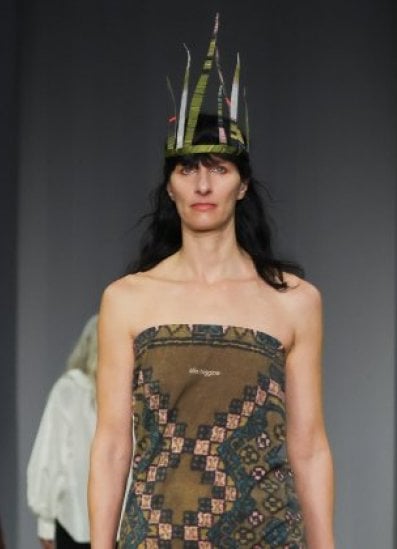
In the early 1980s, when Kawakubo began to present Comme des Garçons on the runway in Paris, having founded the brand in Tokyo in 1969, fashion editor Suzy Menkes described the clothes as “ink-black coat dresses, cut big, square, away from the body with no line, form, or recognizable silhouette”. Other journalists complained the collection was for women unwilling to dress themselves up so that other people would have something pleasing to look at.
“The exhibition pairs these artists not to say that they’re the same, or that they’re from the same kind of artistic movement,” says Danielle Whitfield, curator of fashion and textiles at the NGV. “But to say that at the heart of their practices are these ideas of freedom and rebellion and independence and autonomy, and there’s incredible crossover.”
Almost 150 works will be on display, including more than 100 from the gallery’s collection; loans from New York’s Metropolitan Museum, the Victoria & Albert Museum, Palais Galliera and the Vivienne Westwood archive; and 40 works given to the gallery by Comme des Garçons. The exhibition’s themes range from the influence of the punk zeitgeist of the 1970s to the interrogation of gender and the idealised body.
That might be the most charged theme in the current context. Both designers want the wearer of their clothes to feel empowered in their body, whether by accentuating its carnal beauty or by not thinking about it at all. With conservative politics in the ascendant around the world – exerting forms of control over women’s bodies that include pressure to be thin, white and youthful – it’s hard to watch Westwood and Kawakubo’s staunch rejection of submissive femininity slip out of the mainstream.
In the United States, says Steele, the president “is surrounded by these young, interchangeable women. They’re all in the little sheath dresses, they all look identical. Wealthy Republican women all go to the same plastic surgeon, and they all are on Ozempic.
“It’s a complete turn away from individual appearances or an acceptance of strange beauties. It’s very discouraging and one can only imagine [both Kawakubo and Westwood] would be horrified.”
Westwood reacted to the waif aesthetic of the 1990s by championing voluptuous bodies and subverting traditional gender roles. In 1983, she told Harpers & Queen magazine: “The great thing about my clothes – the way they make you feel grand and strong – is to do with the sexy way they emphasise your body and make you aware of it.”
In a rare interview with Kawakubo published in The New Yorker in 2005, the writer Judith Thurman observed that “the hegemony of the thin” was one of the designer’s targets. “I only came to Paris with the intention of showing what I thought was strong and beautiful,” Kawakubo told her. “It just so happened that my notion was different from everybody else’s.”
Amid the tensions of fourth-wave feminism, where intersectionality is undercut by woke-or-not debate, the raw energy and simplicity in the designers’ remonstrations against the status quo is enviable.
“Both rejected the common assumption that being ‘comfortable’ was the major criterion for contemporary dress,” writes Steele. “Instead, they stressed the need for ‘unorthodox’ thinking, as Westwood often put it, or as Kawakubo said, ‘new thoughts’ that make you ‘aware of your existence’.”
These concepts will be on display at the NGV. Westwood’s debut runway, Pirate (autumn/winter 1981-82), was described in the original press release as clothes “made to go hunting and fishing in, climbing trees and running through the wilderness – cassette pack on your back, loincloth between your legs, gold braids in your hair.” There are sculptural pieces, such as a black dress made of tubes and a voluminous satin cape from Comme des Garçons’ Blue Witch (spring/summer 2016), a collection Kawakubo described as being for “all outsiders who refuse to conform”.
In the many surprising parallels between the two designers’ legacies – tailoring, craftsmanship, destructionism, anti-authoritarianism, anger, power, provocation, unbridled talent – their shared view of clothing as a tool to help determine your own life might be the most consistent.
“When you put on clothes that are fighting against something, you can feel your courage grow,” Kawakubo told Interview magazine in 2015. “Clothing can set you free.” Or in Vivienne Westwood’s words, it can make you a punk at heart.
Westwood | Kawakubo is showing at NGV International, Melbourne, from December 7 until April 19.
This article was first published in the print edition of The Saturday Paper on December 3, 2025 as "Catwalk rebels".
For almost a decade, The Saturday Paper has published Australia’s leading writers and thinkers. We have pursued stories that are ignored elsewhere, covering them with sensitivity and depth. We have done this on refugee policy, on government integrity, on robo-debt, on aged care, on climate change, on the pandemic.
All our journalism is fiercely independent. It relies on the support of readers. By subscribing to The Saturday Paper, you are ensuring that we can continue to produce essential, issue-defining coverage, to dig out stories that take time, to doggedly hold to account politicians and the political class.
There are very few titles that have the freedom and the space to produce journalism like this. In a country with a concentration of media ownership unlike anything else in the world, it is vitally important. Your subscription helps make it possible.
Subscriber exclusive
Send this article to a friend for free.
Share this subscriber exclusive article with a friend or family member using share credits.