Fashion
The vast bulk of Australian wool exports are unprocessed, but Tasmania’s restored Waverley Mills points to a future for high-quality, sustainable domestic manufacturing. By Lucianne Tonti.
Waverley Mills: a blueprint for Australian wool manufacturing
My niece wasn’t born yet when I visited Tasmania’s Waverley Mills in September this year, but when I touched one of their merino wool baby blankets, I knew what she would be getting for Christmas. My brother and his Norwegian wife live outside Oslo, where the winters reach subzero temperatures and sunlight dwindles to a few hours a day. Giving my niece (who is now two months old) a blanket made from Australian wool, spun and woven in the country’s last full processing factory, felt essential. For my brother it would be a small piece of home, and for his daughter a gift from a place she will one day discover is her home, too.
Waverley Mills sits on the banks of Distillery Creek, a 20-minute drive from Launceston Airport through Tasmania’s grey-green rolling hills. The mill was built by Scotsman Peter Bulman in 1874, just as wool was establishing itself as Australia’s biggest export, an industry so vital to the economy that it would come to be described as “riding on the sheep’s back”.
The Scottish founders received a £1000 grant from the colonial government to establish the mill. During World War II, the Department of Defence placed a commission for 600,000 army blankets. The mill almost didn’t survive the free trade agreements of the 1990s and the influx of cheaper goods from cheaper markets, and has cycled through several sales, bankruptcy and receivership. Until 2008, it had a longstanding contract with Qantas to supply blankets for business- and first-class passengers. Over the years it has produced tweed, flannel and felted cloth. Even though it’s not perfect – it’s not even native – wool might be the closest thing we have to a national product.
At 150 years old, Waverley Mills is both a relic and the promise of a different future for Australian textile manufacturing. This country still produces 90 per cent of the world’s fine apparel wool, but due to decades of offshoring and a lack of investment in skills, technology and infrastructure, almost all Australian wool is exported before it has even been washed or scoured.
Waverley Mills’ red-brick buildings house the carding machines, spinning facilities and state-of-the-art looms of one of the only remaining domestic processors. The majority of the wool it handles is sourced from Tasmanian farms, and the balance is from the mainland. Those fleeces are scoured in Geelong and come to Launceston to be turned into blankets, throws, shawls and scarves.
The mill reverted to using locally processed Australian wool only very recently.
When Dave Giles-Kaye came on as managing director in December 2022, Waverley Mills was no longer able to produce its own yarn. The previous owners hadn’t maintained the machinery and it had stopped working. They were making blankets out of a polyester-wool blend imported from Italy. “When I started, I wanted to go back to the roots of the business and only deal with natural fibres,” Giles-Kaye says. “First principles: we’re trying to add value to Tasmanian wool before it gets exported.”
To restore the mill’s full operations, Giles-Kaye, now the executive director, had to secure sizeable investment. He says more than $10 million has been spent to buy new equipment, repair existing machinery and redevelop the site. Of this, $6 million was in grants from the Albanese government; another $400,000 came from the Tasmanian government. The remainder was from a group of investors. Now the major shareholders include an entrepreneur with local ties who prefers not to be identified in the media, and Southern Cotton, which owns a cotton gin in New South Wales.
The partnership with Southern Cotton arose from a shared ambition to bring value-added processing of natural fibres back to Australia. “They’re not pushing cotton on us,” says Giles-Kaye. “But they wanted to invest because all their cotton goes elsewhere and just disappears. They would like to turn it into a textile.”
Giles-Kaye headed up the Australian Fashion Council until the end of 2019 and hopes the government will see the economic opportunity in restoring more domestic capacity to process wool. Australia’s wool exports are worth about $3 billion a year, he says, and “we’ve just prepared a document which argues the case for how you turn that three billion into a hundred billion”.
Woolmark managing director John Roberts says that while Australia’s economic environment hasn’t encouraged significant investment in large-scale, onshore wool processing facilities, “small-scale operations like Waverley Mills highlight the potential for niche, high-quality processing that connects Australian wool directly to consumers, championing traceability and supporting local communities”.
Although it might seem niche, even processing 5 per cent of Australia’s wool clip onshore would amount to “a big industry”, says Giles-Kaye. But it’s a long-term plan. He is thinking about the industry over a 20- or 30-year timeframe, anticipating an increase in consumer demand for traceable, sustainable products. It’s a hopeful pushback against the growing tide of cheap, mass-produced synthetic products that has made Australians the world’s biggest consumers of fast fashion, according to The Australia Institute.
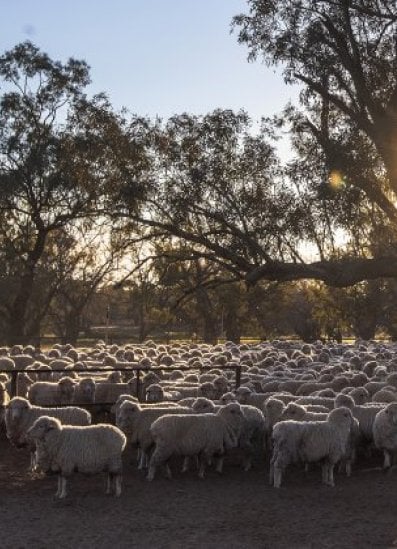
Although the introduction of sheep and cattle to this country has often been lamented as a source of deforestation, desertification and greenhouse gas emissions, Waverley Mills is committed to using natural materials. All its wool is from Responsible Wool Standard–certified farms, where the sheep are grazed using regenerative farming practices that sequester carbon and improve ecosystem functionality, biodiversity, soil health and water cycles. Similarly, the mill runs on renewable electricity – except a boiler, which will soon be replaced and run on gas – and a new system to manage its wastewater is also being implemented.
This sustainable outlook extends to the business’s circularity initiatives. At the back of the property, inside the enormous old shearing shed near a large wooden table – where years ago the wool would have been graded for its staple length and fineness – stands a large metal machine used to tear garment and textile waste into shreds that can be spun back into yarn. The machine is the soft green colour of vintage tools and running through its cogs and wheels are the bright yellow fibres of jackets that were worn by personnel in the Victorian Country Fire Authority. The uniform is made from a fire-retardant-treated cotton textile. The CFA is reissuing its uniforms over the next year and tens of thousands of old uniforms will be diverted from landfill and sent to Waverley Mills instead. At the mill, the recycled cotton will be mixed with virgin wool and woven into a golden-yellow car blanket that will be launched in January. Already on sale is a collaboration with Nudie Jeans – soft blue throws made from 70 per cent virgin wool and 30 per cent recycled denim.
The mill is processing 35 tonnes of wool a year, which amounts to about 35,000 products. Giles-Kaye says they have the capacity to process 120 tonnes a year – it’s something to work towards. “We came back from nothing really to get to where we are now,” he says. Since the carding machine was only fixed in August 2023, a lot of the growth has happened in just over a year.
Given wool’s prominence in this country’s colonial history, at least, it shouldn’t be so hard to buy Australian-made wool products. Waverley Mills itself is proof that, despite the decimation of supply chains, it’s possible to revive hyperlocal textile manufacturing. Giles-Kaye is rightly proud he has been able to protect the mill’s legacy. “When we are at markets, we often have old ladies come over and tell us, ‘Oh, I was given a Waverley Mills blanket as a wedding present and I still use it.’ ”
This article was first published in the print edition of The Saturday Paper on December 7, 2024 as "The miller’s tale".
For almost a decade, The Saturday Paper has published Australia’s leading writers and thinkers. We have pursued stories that are ignored elsewhere, covering them with sensitivity and depth. We have done this on refugee policy, on government integrity, on robo-debt, on aged care, on climate change, on the pandemic.
All our journalism is fiercely independent. It relies on the support of readers. By subscribing to The Saturday Paper, you are ensuring that we can continue to produce essential, issue-defining coverage, to dig out stories that take time, to doggedly hold to account politicians and the political class.
There are very few titles that have the freedom and the space to produce journalism like this. In a country with a concentration of media ownership unlike anything else in the world, it is vitally important. Your subscription helps make it possible.
Subscriber exclusive
Send this article to a friend for free.
Share this subscriber exclusive article with a friend or family member using share credits.