News
Labor insiders have criticised the prime minister’s treatment of his Left faction rival and say he is driven by personal grievance. By Karen Barlow.
Albanese’s Plibersek problem
The unfinished business of the 47th parliament has aggravated fractures at the very top of the Albanese government.
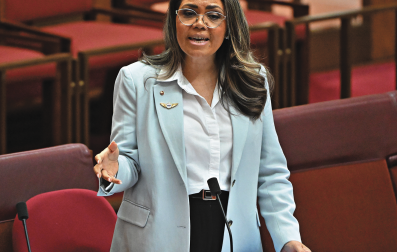
Insiders tell The Saturday Paper that party members are not happy about the prime minister’s treatment of Environment Minister and Labor Left faction rival Tanya Plibersek when he overturned a deal on strengthened environmental laws that was struck with concessions from the Greens.
“Tanya has a proper reason to be pissed off,” says a Labor minister who also noted Plibersek was being a “very good sport” about the prime minister dumping her main piece of reform, the second stage of the Nature Positive Plan.
“She has not gone on about it. She was prosecuting what was party policy. She has a right to feel let down.”
More than 40 pieces of legislation passed parliament in a last-sitting-fortnight-of-the-year cram, a herculean 31 in a single day, but a deal to honour the 2022 Labor election commitment of a peak federal agency to protect the environment was shelved, with Albanese cutting his minister out at the 11th hour. The about-face came just as the other parties to the agreement – the Greens and key crossbencher David Pocock – were preparing to announce it.
“We shouldn’t have been trying to do this this late in the term. The others … have smelt possible victory,” a Labor source tells The Saturday Paper, pointing to the Coalition’s resurgence in national polling.
“What she negotiated was good.”
The Greens were demanding consideration of increased carbon emissions, a legislated “climate trigger”, for major project approvals and an end to native forest logging. They were under intense pressure from environment groups and former Greens leader Bob Brown, a renowned and veteran anti-logging campaigner. Under a new spirit of pragmatism following bleak election showings in Queensland and the Australian Capital Territory, however, Plibersek got the Greens spokesperson, Sarah Hanson-Young, to drop the climate sticking point and compromise on the other.
Albanese met with Katy Gallagher, the manager of government business in the Senate, Greens leader Adam Bandt and Hanson-Young early on Tuesday evening to discuss all the legislation in train. It was here the prime minister said there was no deal on the so-called Nature Positive laws.
The prime minister’s office briefed the press gallery that the deal was off, which drew a response from Plibersek’s office that negotiations were still under way.
News stories about the deal being “scuppered” started appearing just before 7pm that evening. It wasn’t until almost two-and-a-half hours later that Albanese informed Plibersek directly.
The deal is widely understood to have been killed because it jeopardised Labor’s chances in Western Australia, where Premier Roger Cook, facing a state election in the coming months, had made his objections to the Nature Positive bill abundantly clear.
But as to why Plibersek was so bluntly cut out of the proceedings, one Labor minister says personal grievance drives the “bulk of” Albanese’s behaviour.
As two rising stars of Labor’s New South Wales Left faction, Albanese and Plibersek were always competitors, and the party’s preference for factional balance across its leadership made it difficult for both to rise together. Plibersek had Albanese’s support in December 1997 when she was preselected for the safe Labor seat of Sydney, neighbouring his electorate of Grayndler. She was elected in 1998 at the age of 28. She also enjoyed the support of the late Tom Uren, a former Whitlam government minister and a father figure to Albanese.
The particular frustration for Albanese is that Plibersek indirectly enabled Bill Shorten, of the Victorian Right, in the leadership contest following Kevin Rudd’s 2013 election defeat. Her run for the deputy position amounted to a setback to Albanese’s own leadership aspirations, and Shorten won the party room, with Plibersek unofficially assisting his ticket.
A month earlier, in September 2013, she’d been anointed by Julia Gillard, who was then departing politics. Australia’s first female prime minister told journalist Anne Summers Plibersek could be the next female leader of the Labor Party. She also named her as “one of the most gifted communicators” in Australian politics.
Plibersek quickly stepped out of the leadership contest following the 2019 loss, citing her responsibilities to her family and making way for Albanese’s bid to succeed Shorten. But asked by journalist and author Margaret Simons, for the biography Tanya Plibersek: On Her Own Terms, whether she withdrew because she didn’t have the numbers in caucus to secure the leadership, Plibersek said, “That’s absolutely what people who like to background against me would say. We’ll never know. It’s history. But I am pretty confident that if I had run, I would have won.”
Plibersek has had a sympathetic portrayal in the press in the wake of the Nature Positive decision and one insider says that within the party “people are starting to chip the PM over the way he is operating”.
As the prime minister, says one Labor MP, Albanese “needs to let it go and grow up”.
Albanese has flatly denied speculation about a feud and tried to explain his decision. “It’s about getting it right,” he told the ABC last week. “And we won’t support measures that don’t get it right. We want to support industry to be able to operate effectively, but also to operate in a sustainable way.”
The opposition has seized on the tension to stir leadership speculation in the lead-up to an election that must be held by May. Coalition figures make a habit of poking at Plibersek in parliamentary Question Time, as Albanese tends to turn away from the minister when she is speaking.
“The fact remains that Tanya Plibersek and Anthony Albanese have been in left-wing factional wars since they were both at Sydney University. And this is unfortunately the latest casualty in that war,” Nationals frontbencher Bridget McKenzie told Channel Nine’s Today.
While Labor insists it has a good story on the environment, differentiating itself from a Coalition that has labelled an environmental protection authority as “needless bureaucracy” and “anti-mining”, the predominance of Roger Cook in the debate over the Nature Positive laws suggests Western Australia is overshadowing that story.
Labor’s exposure to retaliation from mining interests in the state might be overestimated, however.
It’s fair to say the popularity of the then Western Australian premier Mark McGowan in 2022 had a big impact federally and that victories in the WA seats of Tangney, Swan, Pearce and Hasluck in 2022 delivered majority government to Labor despite its historically low primary vote. That primary vote has fallen further since. New numbers from the ABC’s chief election analyst Antony Green suggest that a swing of just 1 per cent against Labor could deprive it of its majority, while the Coalition would need a swing of 5.3 per cent for an outright majority. This is tempered by the many seat races that are not major party contests.
Treasurer Jim Chalmers has conceded there is a “possibility” Labor will not win a second term, telling the ABC his party is not taking the coming election result for granted.
However, with Cook now in charge in Western Australia, insiders insist “it’s not like things are collapsing in WA at all”.
The Saturday Paper has seen RedBridge Group polling, commissioned by the independent Senator David Pocock, of 1514 Western Australian voters in early October showing Labor in a very healthy two-party preferred position of 54.5 per cent to the Coalition’s 45.5.
The polling, which was also shared with Plibersek, showed 78 per cent of Western Australian voters wanted strengthened environmental laws, 43 per cent said it was “very important” to have an independent environment regulator, while 32 per cent said it was “somewhat important”.
Only 23 per cent of those polled in the west thought the federal Labor government had done the right amount on climate, while 47 per cent regarded it as doing too little.
In any case, the compromise on the Nature Positive reforms that removed a climate trigger left less to alarm even the mining industry, Bob Brown pointed out. He was firm on the Greens holding the line on demanding an end to native forest logging.
“The understanding was at least that the EPA, when it was set up, it would abolish the regional forest agreements, and that didn’t affect Western Australia, but it would have pleased voters in on the eastern side,” Brown says. “It was a win-win situation, if you like, on the environment.”
As for the minister’s outlook for the environmental laws, Plibersek declined The Saturday Paper’s request for an interview. Her office also declined a request for comment.
In her last interview as parliament rose, the minister told Sydney Radio 2GB, “It’s like asking a parent whether they think their kids should get a lead in the Christmas play. Of course, you always think your own bill is the most important and your own kids are the greatest stars, but, you know, we’re part of a team and I’d like to see this bill passed...
“I hope it’ll go through in February and it’s up to senators to do that.”
A February sitting is not a certainty as the prime minister mulls an election date. Brown, a mentor to Hanson-Young, tells The Saturday Paper that the Greens must strengthen their position on protecting native forests whenever the bill comes back up for debate.
Parliament is likely to return with a Greens contingent more committed to negotiation than it has been in years. Leader Adam Bandt made it clear in the final week of parliament that the party was keen to work with Labor to keep the Coalition out of office, and outlined the need for a structured agreement with Labor in the event of a hung parliament in which crossbench support was necessary to form government.
Brown, who had a similar agreement with former prime minister Julia Gillard, backs the suggestion. “I would hope that the Greens and teals are going to be very strong on having the regional forest agreements abolished as a hedge on both climate and the extinction of species,” he tells The Saturday Paper. “It’s the most urgent and big-ticket item for turning around our environmental descent.”
This article was first published in the print edition of The Saturday Paper on December 7, 2024 as "Albanese’s Plibersek problem ".
For almost a decade, The Saturday Paper has published Australia’s leading writers and thinkers. We have pursued stories that are ignored elsewhere, covering them with sensitivity and depth. We have done this on refugee policy, on government integrity, on robo-debt, on aged care, on climate change, on the pandemic.
All our journalism is fiercely independent. It relies on the support of readers. By subscribing to The Saturday Paper, you are ensuring that we can continue to produce essential, issue-defining coverage, to dig out stories that take time, to doggedly hold to account politicians and the political class.
There are very few titles that have the freedom and the space to produce journalism like this. In a country with a concentration of media ownership unlike anything else in the world, it is vitally important. Your subscription helps make it possible.
Subscriber exclusive
Send this article to a friend for free.
Share this subscriber exclusive article with a friend or family member using share credits.