News
The Liberal Party has hired controversial digital agency Topham Guerin to produce content for its election campaign, despite concerns about disinformation and deepfakes used by the group. By Jason Koutsoukis.
Exclusive: Dutton hires Morrison’s ‘disinformation’ team
The Liberal Party has re-engaged controversial New Zealand-based creative agency Topham Guerin, known for its aggressive use of disinformation tactics and deepfake technology, as it moves to bolster its chances of winning the next federal election.
Credited with playing a pivotal role in Scott Morrison’s surprise 2019 victory, as well as recent campaign successes for the Liberal National Party of Queensland and the New Zealand National Party, Topham Guerin has emerged as a go-to agency for conservative parties seeking to leverage digital media.
A senior Liberal Party source confirmed this week that the company has been hired to work with Peter Dutton as he heads into the campaign.
Founded in 2016 by former New Zealand Nationals operatives Sean Topham and Ben Guerin, the agency quickly established itself as a disruptive force in political communication, blending rapid content production with emotionally charged messaging aimed at unlocking voters’ “arousal emotions”, such as anger, excitement, pride and fear.
“I think they have really morphed and changed into a slicker outfit than they perhaps ever were,” says Andrew Hughes, a lecturer in marketing at the Australian National University.
“They’ve had a few hits and misses for sure, but they’ve refined their approach … which is all about behaviour change, not political change, which is a completely different kettle of fish. That is, what do you have to do to get people to vote for your candidate? And how they do that is mainly through emotion, by getting people really upset about something, because then they’re much less likely to switch to another candidate or party.”
Catapulted onto the global stage after helping Boris Johnson lead the British Conservatives to victory in 2019, Topham Guerin was widely condemned during that campaign for its role in rebranding the party’s Twitter account as “factcheckUK” during a televised leaders’ debate, with critics accusing the agency of eroding public trust in digital platforms and blurring the lines between genuine fact-checking and partisan propaganda.
“We were there to be playful and create some noise, to get attention and eyeballs on the Conservative Party,” Sean Topham told British media outlet The Spectator earlier this year, reflecting on the “factcheckUK” controversy.
“A little bit of controversy can be a good thing on social media, and it’s about making sure that that controversy relates back to an important message or something that you’re trying to get in front of a target group of voters or a larger group of voters and sometimes it means you have to wind up some very established members of the press to get that attention. Certainly we had a lot of fun doing that and getting a reaction out of it, but it was always with a deeper purpose to carry a message, to get information to the public and our voter base as to what actions they needed to take to solve the problems that they faced.”
While the tactic garnered significant attention and sparked debates about the boundaries of digital campaigning, it also highlighted broader concerns about the role of disinformation in political discourse and the ethical responsibilities of creative agencies in the digital age.
Following the Queensland state election in October, Topham Guerin posted its top two “takeaways” from its digital advertising efforts on LinkedIn.
The first, titled “Embracing AI Technology”, stated the Topham Guerin team put together 744 unique pieces of creative for paid advertising, including 465 custom video ads, during the campaign.
“That’s significantly greater volume than Labor and enabled more bespoke, targeted creative for the audiences. AI tools enabled the LNP to produce over half of these videos rapidly, allowing the LNP to easily speak to local issues in many marginal seats,” the post said.
The second top takeaway, titled “Video Dominance in Political Advertising”, revealed that nearly 80 per cent of the campaign’s advertising budget was spent on video.
“By utilising clever hooks and modern techniques, the LNP’s digital video strategy exceeded industry benchmarks for video advertisements,” the post said. “Video content often results in better message retention which is why this tactic was critical.”
One of the videos Topham Guerin created during the Queensland election campaign was a deepfake video of then premier Steven Miles dancing, prompting Miles to observe that while the video itself might have been harmless enough, it nevertheless represented “a pretty dangerous turning point”.
In the lead-up to the Australian Capital Territory election, also in October, Topham Guerin used generative AI to create a deepfake video of ACT Chief Minister Andrew Barr that featured in an ACT Liberals advertisement.
“Their willingness to play with the norms of political communication really sets them apart as being different from other kinds of political communicators,” says Professor Glen Fuller, head of the school of arts and communication at Canberra University.
“It’s fun to be playful every now and again; I’m just not sure if that’s suitable. It makes more sense if they want to be part of some kind of comedic sideshow, but is it really in line with the ethical norms of being a kind of professional communicator?”
Topham himself acknowledges that while there will always be ethical questions around the use of AI in political advertising, and how much social media platforms should be elevating or amplifying AI-generated content, people will get better at verifying whether something is real or fake.
Topham told The Spectator that AI “can do a lot of damage and can be used with malicious intent, but it could also be quite a powerful tool”.
As well as deepfakes, Topham Guerin is known for its use of video platforms such as TikTok to humanise politicians. The approach was effective for NZ Nationals leader Christopher Luxon who, like Peter Dutton, was mainly known for his bald, stern appearance and no-nonsense persona.
“He had a personality, and the more we got to know him, and the more we got to work with him on his social media, he was happy to reveal aspects of that and he did,” Topham says. “He did a ‘get ready with me TikTok’, which was ‘this is what I wear every day’ … that sort of stuff are little entrées to the type of politician they are.”
Perhaps signalling how the Liberal campaign will try to humanise Dutton, Topham said a lot of people might look at Luxon and think he would never “work” on social media. “At the end of the day, look, he’s a guy, he’s probably got friends, he’s got a personality, he’s probably got a sense of humour. It’s not a bad thing to reveal that.”
Since launching a personal TikTok account earlier this year, Dutton has posted seven videos to the platform. They have attracted more than two million views on subjects including the Dutton family dog, Ralph, and a 41-second spot on Dutton’s proposal to ban foreigners and temporary residents from buying existing homes.
As Topham Guerin co-founder Ben Guerin explained to a New Zealand tech podcast last October, ahead of the New Zealand election, the key test when posting political content to TikTok or any other social media platform is whether the content is entertaining.
“When people are scrolling through the TikTok app, they’re looking for entertainment. They’re looking for something funny or educational or useful or interesting,” Guerin said.
“The key lesson of whether you’re doing political campaigning in New Zealand, the UK, anywhere else, or if you’re selling anything at all, is just finding ways to make it entertaining so that you can win that battle of the thumbs. Get people to stop scrolling, watch your ad through and hopefully do something off the back of it.”
According to Ariadne Vromen, the Sir John Bunting chair of public administration at the Australian National University’s Crawford School, another interesting feature of Topham Guerin’s campaign in the New Zealand election was the use of online games as a way of humanising Luxon.“Ultimately, they’re trying to create shareable content,” says Vromen. “Whereas in the past it was broadcast – we were the recipients and not the sharers – but now we’re predominantly the sharers. So it’s not just that we’re having an arousal kind of reaction to the content and anger being the sort of dominant one these days, it’s that we’ll then share that content.”
Labor recognised it was outmanoeuvred online in the 2019 campaign against Scott Morrison. In response, it created a new digital unit ahead of the 2022 campaign, run as a kind of rapid response newsroom to enable content to be pushed out quickly.
“During the Voice referendum campaign, though, the Yes23 campaign was really outpaced by right-wing groups such as Advance, particularly its use of shareable content on TikTok,” says Vromen.
“There are people who’ve worked with Advance, who’ve worked with the Liberal Party, and I just think there is a growing network of people who work exclusively for conservative parties, and they’re ascendant. It used to be progressive groups such as GetUp! who dominated the digital space, but now conservative campaign actors are dominant.”
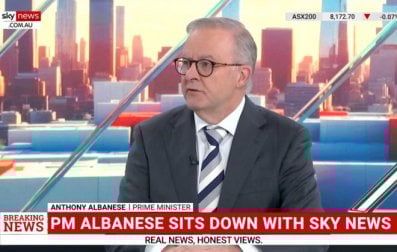
Vromen said the “No” campaign’s dominance on TikTok during the Voice referendum showed that it would be a serious political risk for Labor to cede that territory to Dutton in the lead-up to the election. While Dutton is on TikTok, Prime Minister Anthony Albanese is yet to set up an account.
“If Peter Dutton is using TikTok, then Anthony Albanese will absolutely have to compete with him in that space, so I think Albanese probably will have a TikTok account very soon,” Vromen says.
Still, one observation that’s made about Topham Guerin in political circles in Canberra is that the agency may have lost a little of its edge when it began doing more corporate work.
“The more corporate stuff you do, the more you find yourself being safe,” one Liberal insider says.
“Political campaigns are your opportunity to refresh those skills and techniques. So the more of those you do, the sharper you are. And for a while there, they were just doing a lot of corporate work. If they’re back on their game, I think that’s great.”
Yaron Finkelstein, who spent almost four years as principal private secretary to then prime minister Scott Morrison before becoming a founding partner at consulting practice Society Advisory, believes the test that should be applied to every piece of creative content is whether the person who just saw the ad understood what it was trying to tell them.
“Because that’s the point,” Finkelstein says. “There’s still a message that you’re trying to convey, and if it’s obscured by being too clever or too creative, and that message hasn’t gotten through, well, it’s failed as a piece of effective communications. Might be good art, but it hasn’t done the job.
“There’s a misunderstanding that, whether it’s your advertising agency or your digital agency, that they’ve come up with the strategy. But what they’re doing, if they’re good, is taking the strategies developed by the strategists and executing it well, according to their particular application. So if you’re the ad agency, you’ve done it according to the strategy. If you’re the digital agency, you’re not coming up with something different to what the overall strategy is.
“You do find sometimes that ad agencies, for example, move well beyond the strategy in their attempt at being overly creative and that’s an important test, because they’re not there for that purpose. The key thing is to keep to the brief, and if you execute it according to the bit you were asked to do, then all goes well.”
This article was first published in the print edition of The Saturday Paper on December 7, 2024 as "Exclusive: Dutton hires Morrison’s ‘disinformation’ team".
For almost a decade, The Saturday Paper has published Australia’s leading writers and thinkers. We have pursued stories that are ignored elsewhere, covering them with sensitivity and depth. We have done this on refugee policy, on government integrity, on robo-debt, on aged care, on climate change, on the pandemic.
All our journalism is fiercely independent. It relies on the support of readers. By subscribing to The Saturday Paper, you are ensuring that we can continue to produce essential, issue-defining coverage, to dig out stories that take time, to doggedly hold to account politicians and the political class.
There are very few titles that have the freedom and the space to produce journalism like this. In a country with a concentration of media ownership unlike anything else in the world, it is vitally important. Your subscription helps make it possible.
Subscriber exclusive
Send this article to a friend for free.
Share this subscriber exclusive article with a friend or family member using share credits.