News
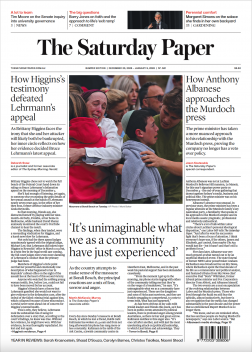
The prime minister has taken a more nuanced approach to his relationship with the Murdoch press, proving the company no longer has a veto over policy. By Jason Koutsoukis.
How Anthony Albanese approaches the Murdoch press
Anthony Albanese was not at Lachlan Murdoch’s Bellevue Hill mansion, Le Manoir, for this year’s signature power party on December 4 – the end-of-year gathering that draws together Sydney’s media, business and political elite. The prime minister was on his honeymoon instead.
Albanese’s absence was unusual. In previous years, the prime minister has been a regular attendee at the Murdoch family’s key Australian party, a familiarity that speaks to his approach to the Murdoch empire and its local media assets: pragmatic, professional and relatively untheatrical.
“There’s a lot of talk within Labor circles about Lachlan’s personal ideological disposition,” one Labor MP tells The Saturday Paper. “And after he won the succession fight that’s been a focus of attention. I think everyone’s hope was, if the others, James and Elisabeth, got control, then maybe The Aus would just die – but it hasn’t and that’s still a problem for us.”
Five days later, Albanese was very much present at what turned out to be an unofficial Murdoch event. The state funeral of former NSW Labor powerbroker Graham Richardson was broadcast live on Sky News, where Richardson spent the final decade of his life as a commentator and political analyst, and featured tributes from Sky News chief executive Paul “Boris” Whittaker, former Liberal prime minister and Fox Corporation director Tony Abbott, and Albanese himself.
The two events are a neat encapsulation of the evolving relationships between Labor and the Murdoch press. Those who lived through the Rudd era still fear the tabloids, almost instinctively, but there is also recognition that the media has changed substantially in the past decade and the power that so emboldened Rupert Murdoch is no longer there.
“We know, and we are reminded often, that less and less people are buying Murdoch’s newspapers,” says one Labor source. “But when you see some of their front pages – this week’s ‘Blood on Your Hands’ headline on the front page of the Tele comes to mind – and you hold the paper in your hands and keep staring at it, it’s very hard to dismiss the psychological impact of that. The instant reaction is almost a version of ‘What can I do to stop this?’ Even when you know that not that many people are even seeing those headlines.”
While the prime minister maintains a grinding and deliberately broad media schedule, the two interviewers he appears to trust most are Sky News’ flagship presenter, Kieran Gilbert, and the ABC’s David Speers, a journalist who cut his teeth at Sky before moving to the national broadcaster.
Gilbert’s Sky is not the Sky of the evening line-up, with its shock-jock rhythms and openly partisan edge. His Canberra program operates apart from the network’s “after dark” stable of ideological hosts, with an emphasis on process, policy and parliamentary mechanics, rather than provocation.
Yet Albanese is no stranger to the partisan side of the network. One example is the productive relationship he enjoys with Chris Kenny, a columnist for The Australian and the host of the weeknight Sky News program The Kenny Report.
A long-time former Liberal staffer, Kenny is a regular critic of the Albanese government’s policy agenda. However, his support for the Voice referendum, and his willingness to occasionally depart from conservative orthodoxy, have earnt him the prime minister’s respect, even when their ideological and policy disagreements are sharp.
Albanese has made a point of engaging across the media spectrum, especially with outlets that are openly sceptical or hostile to his government.
It is a point of pride for Albanese that he does so – and a strategic choice. To be confined to sympathetic platforms, he argues, is to forfeit the political fitness required to withstand national scrutiny – a mistake Albanese and his brains trust believe Peter Dutton made in the lead-up to this year’s election campaign, limiting his exposure to genuinely adversarial questioning.
Perhaps the clearest marker of Albanese’s pragmatism towards the Murdoch universe came not in an interview, but in December 2022, when federal cabinet approved the appointment of Siobhan McKenna as chair of Australia Post, elevating a figure long regarded as one of Lachlan Murdoch’s closest lieutenants to head the Commonwealth’s most significant public enterprise.
McKenna has served as News Corp’s chief of broadcasting in Australia and previously held senior leadership roles at Foxtel and Fox Sports. She was said to have been instrumental in planning Lachlan’s succession and, with Rupert Murdoch, his attempt to limit the power of his siblings over the empire. Now, following the sale of Foxtel to DAZN and the shrinking of her role, McKenna is due to leave News Corp by the end of the year.
Albanese’s approach stands in sharp contrast with the experience of his recent Labor predecessors, for whom the Murdoch press was not something to be managed but to be survived.
Kevin Rudd’s relationship with News Corp lurched from early accommodation to open warfare, culminating in a bitterness that outlasted his time in office. “The truth is, as prime minister, I was still fearful of the Murdoch media beast,” Rudd later reflected. “When did I stop being fearful? Probably when I walked out of the building in 2013.”
That fear shaped policy as well as politics.
In 2009, Simon Rice, now professor emeritus at the University of Sydney Law School, attended a dinner at which the then attorney-general Robert McClelland was present.
With a national inquiry having recommended the introduction of a federal human rights act, Rice asked McClelland when the government might respond.
McClelland’s answer was blunt: “There won’t be a human rights act, for as long as News Limited is opposed to it.”
Rudd’s successor, Julia Gillard, fared little better. Her minority government endured a relentless campaign of delegitimisation from Murdoch outlets, particularly as political pressure mounted around her signature climate change policy to tax carbon.
By the time Gillard left office – deposed by Rudd – hostility from the Murdoch press had become a defining issue for the government.
This pressure was not confined to Labor. Malcolm Turnbull, a Liberal prime minister who once imagined himself insulated by ideology and wealth, discovered how quickly Murdoch’s support could evaporate.
His pursuit of a progressive climate policy drew swift retaliation, underscoring a lesson long understood inside Canberra: Murdoch’s backing is never permanent, and dissent is rarely forgiven.
Albanese’s predecessor as Labor leader, Bill Shorten, chose a different path. In the lead-up to the 2019 election, he declined an invitation to meet Rupert Murdoch in New York, making a point of not participating in the traditional pre-election courtship between aspiring Australian prime ministers and the media proprietor.
Shorten’s refusal was intended as a statement of independence, but it left him exposed to a campaign in which Murdoch outlets made little effort to disguise their hostility – a reminder that opting out of the relationship does not exempt a leader from its consequences.
Read against that history, Albanese’s approach looks less like capitulation than adaptation. He governs with a clear memory of what happens when the relationship collapses – and with a determination not to repeat it in public. Whether that strategy ultimately protects his government, or merely delays the inevitable reckoning, remains an open question.
Still, there are clear benefits to his approach. Albanese does not expect Murdoch’s Australian mastheads or broadcast outlets to become cheerleaders for Labor’s agenda, nor does he deny that much of the coverage is sceptical, at times hostile.
He recognises that something more prosaic is at work: these outlets are, in part, serving their audience. Hostility, in that sense, is not always ideological so much as commercial – a function of who is being spoken to rather than a fixed editorial command.
Albanese rarely personalises criticism and almost never responds in kind, drawing a distinction between editorial posture and institutional engagement.
The government’s social media ban for children under 16 is the clearest illustration of that approach in action.
Murdoch outlets did not merely tolerate the policy; they embraced it, launching and prosecuting their own “Let Them Be Kids” campaign in support.
The backing was genuine, loud and sustained across print, digital and broadcast platforms.
For a government braced for accusations of censorship from global technology companies, it proved enormously helpful, legitimising the policy beyond Labor’s traditional constituencies and blunting the charge that it was an unnecessary intervention.
The alignment was revealing in more subtle ways, too.
Shortly after news.com.au, News Corp’s largest news site, published an exclusive detailing the “eye-watering” cost of Communications Minister Anika Wells’s September trip to New York, the story was swiftly taken down.
According to media reports, the decision reflected concern that the piece clashed with the Let Them Be Kids campaign, demonstrating an awkward collision between an important political story that soon spread into a parliament-wide expenses scandal, and a cause the company’s editors wanted to keep unsullied.
None of this means News Corp’s political coverage of Albanese has turned warm and friendly. It does, however, suggest that Albanese’s strategy of treating the Murdoch empire as something more than a hostile actor has delivered him a chance to engage an unlikely ally when their interests align.
That calculation is also shaped by a quieter reassessment inside Labor of how much power the Murdoch press still commands.
Labor insiders concede that when News Corp outlets move in lockstep – particularly across television, print and digital – they can still shape the terms of a debate.
Sky News’s reach into regional Australia, where it is broadcast free to air, remains a particular concern, and one the government watches closely.
Yet there is a growing belief that the era in which Murdoch could reliably determine electoral outcomes has passed.
Victoria is the reference point.
For decades, the Herald Sun was regarded inside both major parties as the most powerful newspaper in the country, boasting a circulation larger than Sydney’s The Daily Telegraph and a deeper, more pervasive footprint across Melbourne.
If Murdoch influence still operated at full strength anywhere, Labor figures reckoned, then Melbourne is ground zero.
Instead, the Herald Sun’s raucous campaigns against Daniel Andrews’ Labor government produced the opposite effect.
Across three successive elections, the Herald Sun prosecuted its case relentlessly, editorialising against Andrews with a force and consistency that left little room for ambiguity. The line was unmistakeable, the hostility total, and the resources deployed substantial.
“They campaigned hard against Daniel Andrews in 2014, 2018 and 2022 and they were… it’s hard to imagine how they could have taken a stronger editorial line,” notes one Victorian Labor source. “And they were, frankly, irrelevant. And what it showed to a lot of Labor people was that we don’t need their permission to govern.”
Inside Labor, that experience has become formative. It has not eliminated caution, nor erased the Murdoch press as a factor in political calculation, but it has altered the balance of fear.
Where once permission was sought, now engagement is transactional; where once opposition was fatal, now it is survivable.
Albanese’s pragmatism, on this reading, is less about deference than calibration – an acceptance that Murdoch’s power still matters but no longer commands the authority it once did.
Simon Rice, reflecting now on his 2009 exchange with Robert McClelland, believes the fear that once halted reform has become less pervasive.
Sitting on the desk of current attorney-general, Michelle Rowland, is yet another recommendation for the introduction of a federal human rights act. Rice doubts the response will be the same.
“If I was to say to the current attorney, ‘What are the chances?’ I can’t imagine her saying, ‘Not for as long as News Limited is against it,’ ” Rice says. “I think things have changed, in a way.”
Murdoch’s outlets still set agendas, still dominate news cycles, still exert psychological pressure well beyond their shrinking circulation numbers. What has changed is the veto power – the assumption that certain reforms are simply off limits.
The annual Christmas bash at Le Manoir still draws the Sydney carriage trade, but the power it symbolises is no longer absolute.
Anthony Albanese did not attend this year because he was on his honeymoon, not because he was making a point. That, perhaps, is the point.
In a political culture once organised around fear of a single media empire, the most telling sign of change may be that the prime minister felt comfortable enough to miss the party, and govern anyway.
This article was first published in the print edition of The Saturday Paper on December 20, 2025 as "How Anthony Albanese approaches the Murdoch press".
For almost a decade, The Saturday Paper has published Australia’s leading writers and thinkers. We have pursued stories that are ignored elsewhere, covering them with sensitivity and depth. We have done this on refugee policy, on government integrity, on robo-debt, on aged care, on climate change, on the pandemic.
All our journalism is fiercely independent. It relies on the support of readers. By subscribing to The Saturday Paper, you are ensuring that we can continue to produce essential, issue-defining coverage, to dig out stories that take time, to doggedly hold to account politicians and the political class.
There are very few titles that have the freedom and the space to produce journalism like this. In a country with a concentration of media ownership unlike anything else in the world, it is vitally important. Your subscription helps make it possible.
Subscriber exclusive
Send this article to a friend for free.
Share this subscriber exclusive article with a friend or family member using share credits.