News
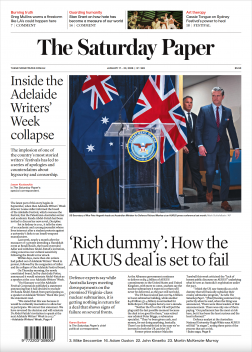
The implosion of one of the country’s most storied writers’ festivals has led to a series of apologies and counterclaims about hypocrisy and censorship. By Jason Koutsoukis.
Inside the Adelaide Writers’ Week collapse
The latest part of this story begins in September, when then Adelaide Writers’ Week director Louise Adler informed the board of the Adelaide Festival, which oversees the festival, that the Palestinian-Australian writer and academic Randa Abdel-Fattah had been invited to discuss her new novel, Discipline.
Set in Sydney in 2021, it tells the story of an academic and a young journalist whose lives intersect after a student protests against a university’s links to an Israeli weapons manufacturer.
Last week, nearly a month after the massacre of 15 people attending a Hanukkah event at Bondi Beach, the board overruled Adler and withdrew Abdel-Fattah’s invitation, citing concerns over cultural sensitivity following the Bondi terror attack.
Within days, more than 180 writers had pulled out of Adelaide Writers’ Week in protest, followed by the resignation of Adler and the collapse of the Adelaide Festival board.
On Thursday morning, the newly constituted board, led by chair Judy Potter, announced it would reinstate Abdel-Fattah as a speaker at the 2027 Adelaide Writers’ Week.
“On 8 January 2026 the Adelaide Festival Corporation published a statement announcing that it had decided to exclude Dr Randa Abdel-Fattah from participating as a speaker at Adelaide Writers’ Week this year,” the statement read.
“We stated that this was because it would be culturally insensitive to allow her to participate. We retract that statement. We have reversed the decision and will reinstate Dr Abdel-Fattah’s invitation to speak at the next Adelaide Writers’ Week in 2027.”
Ms Potter also apologised to Adler for the fact “that the incredible Adelaide Writers’ Week program she had worked so hard to curate for 2026 has been cancelled as a result of the events that have unfolded over the last week … We acknowledge the principled stand she took in the extremely difficult decision to resign from her role as Director.”
In a post on social media, Abdel-Fattah, who has launched defamation proceedings against South Australian Premier Peter Malinauskas, said she accepted the apology and would consider the board’s invitation to participate in the 2027 Writers’ Week “at the appropriate time”. She added she “would be there in a heartbeat if Louise Adler was the director again”.
Though the cancellation of Adelaide Writers’ Week took many by surprise, the conflict behind it had been building for years, involving a director unwilling to retreat, a board that had lost confidence in its authority, and a state government that denied intervening even though it applied sustained pressure to disinvite Abdel-Fattah well before the Bondi terror attack.
The earlier part of this dispute dates back to January 2023, when Adelaide Writers’ Week programmed a strong cohort of Palestinian and pro-Palestinian writers, including Abdel-Fattah, the Palestinian–American writer Susan Abulhawa, and the Palestinian poet Mohammed el-Kurd, who had previously described Israel as a Nazi state and defended a person who tweeted that she wanted “to kill every motherfucking Zionist”, “curse the Jews”, and supported Hamas.
The 2023 program drew sharp criticism from sections of the media and from Jewish and pro-Israel advocacy groups, who argued that the festival had become ideologically unbalanced and had failed to provide alternative perspectives.
Adler, a former chief executive officer of Melbourne University Press, defended the 2023 program as being consistent with the festival’s history. Writers’ Week, she argued, was not a neutral forum but a place where contested ideas were meant to collide.
That year, Premier Malinauskas also entered the public debate, saying on opening night that although he disagreed with some of the programming decisions and had faced pressure to defund the event, he had rejected that course on the basis that it would take Australia into “the territory of Putin’s Russia”.
Others were less convinced.
In January 2023, The Australian published a letter from Morry Schwartz, owner of this newspaper, calling for Adler’s resignation and at the same time urging writers to continue participating in the festival.
The danger, he argued, was not censorship but the narrowing of intellectual space – a programming approach that privileged activism over pluralism and risked undermining Writers’ Week.
In response to that year’s program, three Ukrainian writers withdrew citing comments made by Abulhawa, who had described Ukrainian President Volodymyr Zelensky as a “Nazi-promoting Zionist”. A major sponsor also ended their involvement. The event went ahead but the tensions were never resolved.
This week, former Adelaide Festival board member Tony Berg, who resigned last October, accused Adler of “hypocrisy in defending free speech”, alleging that she and Abdel-Fattah had previously led efforts to have The New York Times columnist Thomas Friedman disinvited from the 2024 festival.
In a letter to The Australian, Berg said he was “utterly astonished at Louise Adler’s statement in her resignation letter in support of free speech”, claiming both Adler and Abdel-Fattah “exhibit hypocrisy in defending free speech for some” after he observed them “to stridently oppose free speech” during his time on the board.
Berg alleged that at a board meeting in February 2024, Adler “led a demand” to rescind Friedman’s invitation after Abdel-Fattah and nine other academics called for his exclusion following a column comparing figures in the Middle East to animals, including caterpillars, wasps and spiders.
Berg said Adler told the board she would resign unless it agreed to exclude Friedman – a demand the board accepted, he said, with the festival just a fortnight away. This week, Adler refused to comment on Berg’s account, citing the confidentiality of board communications. She said his statements were “indicative of the way the former board operated, and I imagine it will be a rich case study for future management students”.
Friedman never spoke at that festival. The board issued a statement saying he would not participate “due to last-minute scheduling issues”. Friedman commented this week, suggesting that was not true. He said it was the festival that told him he would not appear in the proposed video link. “I agreed,” he said of the initial offer to speak. “A few days later, I was told by email that the timing would not work out.”
This week, Crikey revealed that Berg, a businessman, arts philanthropist and prominent member of Sydney’s Jewish community, had written to South Australia’s arts minister on October 22 advising that he could not serve on a board that employed a director “who programs writers who have a vendetta against Israel and Zionism”.
Berg’s October resignation is critical because it punctures the idea that the current crisis began in the wake of the Bondi attack.
Berg was not the only Adelaide Festival board member to resign in the latter part of 2025 – two other board members joined him.
After the state government appointed three new board members to replace those who had resigned, the reconstituted board formally supported Adler’s program choices.
The timing mattered.
In August 2025, the Bendigo Writers Festival collapsed after more than 50 writers withdrew in protest against a code of conduct they believed curtailed their ability to speak about Israel’s actions in Gaza.
Many of those same writers had also been invited to Adelaide, providing a strong indication that disinviting a writer on political grounds risked triggering a boycott that could destroy a festival outright.
The Adelaide Festival board and the South Australian government continued debating Abdel-Fattah’s invitation behind closed doors, with Malinauskas confirming this week he had known about Abdel-Fattah’s invitation to Adelaide Writers’ Week since September and had expressed his opposition to her attendance before receiving any representations from Adelaide’s Jewish community.
“When we’ve had similar issues like this in previous iterations of the Writers’ Week, it feels every year there’s a controversy about a particular speaker and I’ve always backed the independence of the board and made clear they should be free of any political instruction, any threats of cancellation of funding or anything like that, and that’s not just an important principle I believe in, it’s also a function of the law,” Malinauskas told the ABC’s 7.30 this week.
“I have a responsibility to call out those who expressly commit themselves to deny other people a voice as Ms Abdel-Fattah has done, when she advocated against the cultural safety of those people who believe in Zionism, which of course, is the vast bulk of Jewish people.”
In the days and weeks following the Bondi terror attack, pressure on the board continued to mount, from multiple directions, as questions of grief, safety and cultural sensitivity took on an urgent intensity.
Finally, on January 8, the Adelaide Festival board announced it had decided to disinvite Abdel-Fattah.
Stressing that Abdel-Fattah and her writing had no connection to the Bondi attack, the board argued that given Abdel-Fattah’s “past statements”, it would not be culturally sensitive for her to appear so soon afterwards.
The board did not specify which statements it meant, but Abdel-Fattah has previously attracted criticism for arguing that Zionists had “no claim or right to cultural safety”, and for a 2024 post on X that stated the goal of Palestinians with regard to Israel should be “decolonisation and the end of this murderous Zionist colony”.
Abdel-Fattah has also been criticised over an image she posted to social media in the hours after the October 7, 2023, Hamas terrorist attack on Israel, depicting a person parachuting with a Palestinian flag – imagery that echoed the paragliders used by Hamas fighters to breach Israel’s security fence and attack civilian areas, taking hostages and killing 1200 people.
To Adler, a Jewish woman whose own parents survived the Holocaust and who sits on the advisory committee of the Jewish Council of Australia, the logic of stressing on the one hand that Abdel-Fattah had no connection to the Bondi massacre but cancelling her appearance all the same was an attempt to associate Abdel-Fattah with mass murder. Abdel-Fattah described the move as a “blatant and shameless act of anti-Palestinian racism”.
Almost immediately, more than 180 writers began withdrawing from the Writers’ Week program.
Former Labor foreign affairs minister Bob Carr, one of federal Labor’s most prominent critics of Israel’s treatment of Palestinians, publicly backed the board’s decision, saying that some of Abdel-Fattah’s past statements had been counterproductive to the Palestinian cause and that, in the circumstances following the Bondi attack, the decision to disinvite her was not unreasonable.
“The Adelaide writers’ festival has supported hearing Palestinian voices, its record on this is unimpeachable,” Carr told Guardian Australia, making him one of the few invited speakers to defend the board.
Morry Schwartz again wrote a letter to The Australian, blaming Adler for the festival’s collapse.
In her own resignation statement, Adler framed the cancellation of Writers’ Week as a warning to the arts sector at large.
“The raison d’être of art and literature is to disrupt the status quo: and one doesn’t have to be a student of history to know that art in the service of ‘social cohesion’ is propaganda,” Adler wrote.
In an interview on ABC’s 7.30, Adler rejected the idea that writers should be judged by their social media statements, insisting Abdel-Fattah had been invited to discuss a novel, not to litigate her online history.
Within days, the three board members appointed late last year by the South Australian government resigned, followed by the chair, Tracey Whiting.
In a brief LinkedIn statement hinting at constraints beyond the boardroom, Whiting wrote that “recent decisions were bound by certain undertakings”.
The resignations left the board without a quorum and arguably in breach of the Adelaide Festival Corporation Act, with the remaining board members soon stepping down as well.
Stripped of rhetoric, what the Adelaide Writers’ Week collapse reveals is a failure of governance more than a triumph of principle.
For decades, Adelaide Writers’ Week rested on the assumption that institutions could host fierce arguments without being undone by them.
What failed was not the notion that books and ideas should be contested in public but the capacity of the institution built to hold that contest.
This article was first published in the print edition of The Saturday Paper on January 17, 2026 as "Inside the Adelaide Writers’ Week collapse".
For almost a decade, The Saturday Paper has published Australia’s leading writers and thinkers. We have pursued stories that are ignored elsewhere, covering them with sensitivity and depth. We have done this on refugee policy, on government integrity, on robo-debt, on aged care, on climate change, on the pandemic.
All our journalism is fiercely independent. It relies on the support of readers. By subscribing to The Saturday Paper, you are ensuring that we can continue to produce essential, issue-defining coverage, to dig out stories that take time, to doggedly hold to account politicians and the political class.
There are very few titles that have the freedom and the space to produce journalism like this. In a country with a concentration of media ownership unlike anything else in the world, it is vitally important. Your subscription helps make it possible.
Subscriber exclusive
Send this article to a friend for free.
Share this subscriber exclusive article with a friend or family member using share credits.