Editorial
The dull crack of anti-Semitism
This is not like other hatreds. It is ancient and particular. It is sly. It has its own tropes and symbols. For centuries it has contorted into different justifications, but it has always been the same.
There is a temptation to pretend otherwise, to pretend this is an attack on Australia. It is, but it is more than that: it is an attack on the Jewish community, an attack shaped by the licensing evil of anti-Semitism.
Wissam Haddad, a cleric whose prayer hall was linked to one of the alleged shooters, knows this hatred. In July, he was found to have breached the Racial Discrimination Act in a string of lectures at the Al Madina Dawah Centre in Bankstown.
He said the Jews are oppressors and control the media. They are by nature murderous and untrustworthy. They control the banks. They are schemers. They are cowards. They love money. He talked of the need to be “cleansed from the filth of the Zionists”. He said Jews were “a treacherous people, a vile people”.
The language is sick. For Haddad, a conflict with the Jewish people is inevitable. It is the end of time for which he says he is preparing.
“And we need to learn about these people because these are the people that we are going to always be dealing with until Allah sends Imam al-Nabi...” he says. “Towards the end of times, when the Muslims will be fighting the Jews, the trees will speak, the stone will speak, and they will say, ‘O Muslim, O believer, there is a Yahudi [Jew] behind me, come and kill him.’ ”
This week, through his lawyer, Haddad denied any knowledge of the massacre at Bondi. In an interview with the ABC in April, he said: “If I am a leader of violent extremism, why is it that people on the grapevine are saying these words, but law enforcement don’t have the same information?”
For several years, the Jewish community has been warning about rising anti-Semitism. Synagogues have been set alight. Jewish businesses have been vandalised. Cars have been firebombed. Hatred has been written onto the walls of homes and schools.
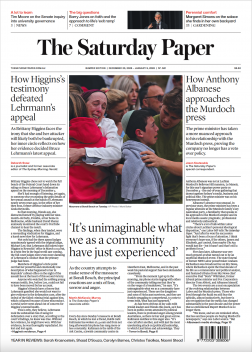
The response has been indifferent. Fears have been dismissed as sensitivities. Distinctions have been drawn where there are none. Anthony Albanese says the massacre is beyond comprehension, but Jewish Australians comprehended it. This is the difference between shock and surprise.
Anti-Semitism thrives on avoidance. It is stronger than optimism. The obscenity of the Bondi massacre, the hunting of people as they celebrated their faith, the dull crack of gunfire before each calculated reload, the mothers laying over their children, the elderly killed in each other’s arms – this is reality of a hate that lives in excuses. It must be stopped at all levels, in all forms.
At Bondi, tucked into a shrine of spontaneous flowers, there was another sermon: “And in this darkest hour, let us share the light of those lost, and release it into the sky of infinite love. We will rise…”
This article was first published in the print edition of The Saturday Paper on December 20, 2025 as "The dull crack of anti-Semitism".
For almost a decade, The Saturday Paper has published Australia’s leading writers and thinkers. We have pursued stories that are ignored elsewhere, covering them with sensitivity and depth. We have done this on refugee policy, on government integrity, on robo-debt, on aged care, on climate change, on the pandemic.
All our journalism is fiercely independent. It relies on the support of readers. By subscribing to The Saturday Paper, you are ensuring that we can continue to produce essential, issue-defining coverage, to dig out stories that take time, to doggedly hold to account politicians and the political class.
There are very few titles that have the freedom and the space to produce journalism like this. In a country with a concentration of media ownership unlike anything else in the world, it is vitally important. Your subscription helps make it possible.
Subscriber exclusive
Send this article to a friend for free.
Share this subscriber exclusive article with a friend or family member using share credits.