Gardening
In times of great pain and loss, retreating to the garden allows us moments in which to observe, to imagine and ultimately to cope. By Margaret Simons.
How to keep being
I am 65 years old. That means I have seen a lot of pain. My own, but mostly that of others.
I remember the Port Arthur massacre. Tiananmen Square. The London bombings. 9/11. The Christchurch massacre. Bosnia and Herzegovina. Sudan. Rwanda. Gaza.
I wasn’t present for these, other than in the modern mediated sense that brings us all into a kind of presence, a connection with each other. A variety of bearing witness. For most of human history, we would not have known so much about the suffering of others.
But I have seen suffering up close. Because of my work in the Philippines, I have seen old women and children picking through rubbish heaps.
Western men insist the young Filipinas find them funny and like their jokes, and that is why they suddenly seem to be more handsome in the bars of Manila and Angeles City than they are at home.
They have not seen where these women live or been mobbed by their children when handing out food.
I have seen poor people gunned down in the streets of Tondo, Manila, during president Rodrigo Duterte’s war on drugs. I was there for that. I saw that.
I want to write in the spirit of Humphrey Bogart’s classic line in Casablanca, surely the height of moral self-awareness and restraint:
“It doesn’t take much to see that the problems of three little people don’t amount to a hill of beans in this crazy world.”
Of course, there has been personal pain as well. I have sat up in bed and cried so hard and so long that I have never really cried since. I think I used up all my tears, though I have certainly been sad again. Lost too many people. Felt the heavy stone of grief in the stomach.
And again, this week.
Why all this in a gardening column, written in the shadow of the Bondi shootings? Written a day later than it should have been because, like much of Australia, I could not bring my full self to the work the day after?
There is no equivalence between these different incidences of pain and evil. Each comes uniquely into the world, carrying its own freight.
I just want to share how I have coped – I hope without growing wizened in the soul. And how I even manage to be happy, or at least content, most of the time.
Though it must sound trivial to those who are not gardeners, this is about the garden. To be a gardener is to be in a kind of alliance with things that grow, and die, because that is the way of things. We sow, plan, design, cut back, prune, spray and harvest. But mostly we are spectators.
The garden is not only my six square metres of growing space. It is the intermediary space between the world I can more or less control and the wilderness beyond. In times of trouble it is the opportunity, the licence, to pay close attention. To focus intensely and thereby to cope.
I have spent most of the past 48 hours abandoning the keyboard and wandering outside and looking at things, trying to find a footing in the present moment.
The extraordinary intricacy of the flower on top of a carrot going to seed. The smell of lemon verbena leaves crushed in the hand. A daffodil, the green of the stem topped with a brown papery sheath, like a reverse dunce’s cap. The yellow canopy of six petals, each with a shading of green at the base, and the tops slightly curly, like a newspaper just unrolled.
I went to harvest my mini-cauliflowers, coddled through winter and just coming into their own, only to find the mice or the rats or the possums have eaten them off the stems, and even scooped out little bowls in those stems with their ruthless tiny teeth. Those little bowls hold pearls of water, in which are floating shavings of the stems. And on top of those shavings there are tiny gnats and flies.
I imagine the rat – or mouse or possum – tasting the cauliflower. Did they pause to think of its sweetness, its crispness, or is eating for a rat all about food for fuel? Do they relish things, as we relish them? How do they suffer?
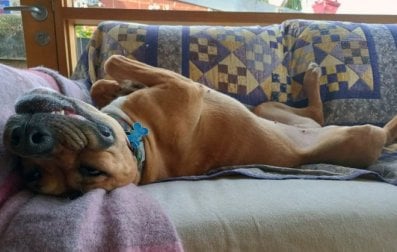
The dog flowing like liquid down the stairs into the garden the moment I open the door. The wind in the neighbours’ palm trees. The sun catching the walls of the public housing towers which, next month, will begin to be demolished.
Watching water from the hose trickle and pond and then disappear into the soil. Seeing the unfurling of bush bean seeds, that reliable miracle that converts dried-up specks of things into plants, and then into food.
The worms rising to the top of the worm farm. They have overcome the great worm farm crisis of two months ago, when, for reasons I don’t understand, the whole farm went acid and anaerobic and smelt like sin – the worms escaping into the surrounding soil.
I cured that by sprinkling sawdust from the newly sanded floors of the house next door. They are 100-year-old floors constructed from Baltic pine, which was probably imported from Europe. Such a journey, and now their top surface is worm food. The sawdust settled in, absorbed the water and the normal processes of appropriate decay have resumed.
I don’t want to suggest the garden is a balm or a compensation, since there is no such thing. The pain in the world is real. It cannot be pushed aside or ignored or minimised. It must be faced. It cannot be denied.
But this is how I cope. To focus, to think, to experience. And then allow the moment to pass, and the next one to pass, and the next one, and find that one is still going, and therefore is not completely broken, and can still live and love and strive and grow.
Margaret Simons founded Angeles Relief Inc, a non-profit to help the abandoned children of sex tourists in the Philippines.
This article was first published in the print edition of The Saturday Paper on December 20, 2025 as "How to keep being".
For almost a decade, The Saturday Paper has published Australia’s leading writers and thinkers. We have pursued stories that are ignored elsewhere, covering them with sensitivity and depth. We have done this on refugee policy, on government integrity, on robo-debt, on aged care, on climate change, on the pandemic.
All our journalism is fiercely independent. It relies on the support of readers. By subscribing to The Saturday Paper, you are ensuring that we can continue to produce essential, issue-defining coverage, to dig out stories that take time, to doggedly hold to account politicians and the political class.
There are very few titles that have the freedom and the space to produce journalism like this. In a country with a concentration of media ownership unlike anything else in the world, it is vitally important. Your subscription helps make it possible.
Subscriber exclusive
Send this article to a friend for free.
Share this subscriber exclusive article with a friend or family member using share credits.