Gardening
The garden takes root in the memory as much as in the soil, and can bring solace to the traveller far from home. By Margaret Simons.
Voyage and return
Is it possible to be homesick before you have even left home?
I just got off a plane in a far-off capital. In that strange humming tube of disorientation that constitutes modern air travel, I used the small screen on the back of the seat in front to watch Russell Crowe in Gladiator – his Academy Award-winning performance.
Everyone remembers the violence in this film, but I noticed the little things: the way in which the storytellers establish the character of Maximus Decimus Meridius as more than a killer. In the opening scene, after a battle, bathed in blood, he notices a little robin on a twig and his eyes follow it as it twitches its tail then flies off over the corpse-littered fields. Maximus smiles with his eyes, and almost with his mouth.
That evening, when the soon-to-be-murdered emperor Marcus Aurelius asks about his home, Maximus replies with the same sad almost-smile. The kitchen garden that smells of herbs during the day and jasmine at night. Thick black soil, the same colour as his wife’s hair. Warm pink stone walls surrounding his simple villa. Fig, apple and pear trees.
Google tells me Russell Crowe improvised some of this dialogue, drawing on his home life in Australia, but I didn’t know that when I watched it on the tiny screen. Yet my heart hurt listening to it.
My list, if I were to be asked about my home? The sunlight that comes through the windows in the living room.
The way the dog follows that sunlight around as the day progresses. The way she lies on her back, rear legs akimbo, head upside down and stomach exposed, showing her oddly crooked lines of teats. They tell me that posture means she feels safe. This is home. You are loved.
And the garden, which, as I prepared it to do without me for a few weeks, was just entering the spring flush of growth and optimism.
Perhaps it is only when I am leaving that I look for what is beautiful and successful about my garden, rather than seeing the jobs undone, the weeds and the rubbish, the pests and dead leaves and the plans that haven’t worked out.
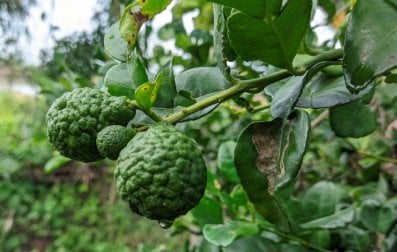
Almost without me realising, the back garden is now what they call “established”, which means harder to kill. The mandarin tree, the bay tree, the makrut lime and the lemon tree dominate the space and will survive neglect. In fact, keeping them in check is now the challenge.
The lemon verbena is tied to a stake to prevent it from flopping. The mint spills over the edges of the pot and there is enough of it for me to make fresh mint tea most days. In the spring mornings, I walk and pick and crush the leaves of all these plants in my hand just for the luxury of the smell. The smell of home.
The bay tree needs pruning. I didn’t get to it before I left. It will be urgent when I return and I will put the cut branches out on the footpath for people to take.
The strawberry plants have started yielding enough fruit for my breakfast.
The sprouting broccoli, which I have been steaming and dressing with sesame oil and lemon juice, will go to seed while I am gone. So too most of the kale, which I have nurtured through the early spring.
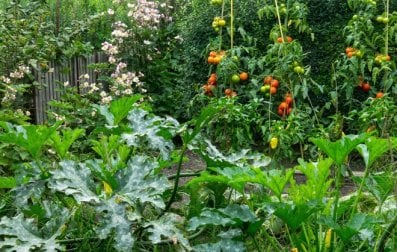
In the front yard is my main vegetable garden. With nobody there to spray and squish the caterpillars of the cabbage moth, will there even be cabbages when I return or just ravaged, lacy remnants of leaves?
I left just before Melbourne Cup Day, which means I planted out and staked my tomato seedlings earlier than usual. I tore up an old T-shirt to tie them to the stakes, although there was barely enough of them to make it necessary. When I return, will they have flopped under the weight of developing fruit? Will that fruit have rotted? Or will the stalks snap, meaning no homegrown tomatoes for me this season?
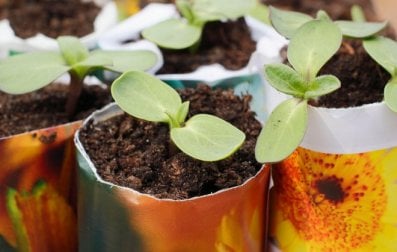
I also erected a trellis and pushed in bean seeds.
I have a house-sitter and an automatic watering system that requires her only to turn on the tap. But I cannot expect her to do what I do, in my gardening-loving craziness, and watch each day for the crisp green unravelling from the embryo seed, adjusting water to suit.
Then there are the pot plants inside. All through winter, I have been trying to save the life of my prayer plant. I probably would not have acquired this if I had known how difficult it would be.
The prayer plant looks great in pictures online and in aspirational home-decorating books. Striped leaves that sprawl, staying flat during the day then folding up in the evening like a supplicant – hence the name.
This, together with maidenhair fern, is one of those plants for which the care instructions are almost contradictory. Place in indirect light but not too much or the leaves will be burnt. Not too little or they will not grow. Water regularly or the leaves will curl. Not too much, because it is subject to rootrot.
Since I planted it, I have had all of those problems and for most of the time the prayer plant has looked terrible. First the drying leaves, then the rootrot accompanied by fungus gnats. I nearly threw the thing away but decided to persist.
As I was packing, however, I was rewarded. Two new leaves unfurling, perfect as newborns.
Will it thrive or die without me?
In all of human storytelling there are only a few plots, which we repeat in endless variations. You know them. Rags to riches. Love will find a way. Riches to rags. David and Goliath.
One of the archetypes is surely voyage and return. Think Ulysses – both Homer’s hero and that of James Joyce – Luke Skywalker or Frodo Baggins or Jack Kerouac or the Chinese writer Sanmao, whose travel writing made a generation of young women dream of loss, freedom and peril beyond the boundaries of the communist state. The traveller sallies forth, faces perils and adventures, and returns home to find it altered yet the same. Himself altered – wiser, perhaps sadder – yet the same, because no matter where we travel, we always take ourselves.
In a sense we can never return, because things change. Knowing this, I was homesick before I left.
In Gladiator, Maximus returns home twice. Once to find his home burnt to the ground and his wife and son murdered. Thus begins his second journey, towards revenge. At the end of the movie, he returns in the afterlife. A hand passing through heads of grass. His wife and son on the path ahead, coming to greet him.
I was worried about the dog. Despite my excellent house-sitter, the dog pines for me when I am away. She sits on the linen box at the front window and watches the street.
When I got off the plane in this distant capital, there were pictures from my house-sitter. Her six-year-old grandson had been to visit. There he was, on the lounge room floor, with the dog. They were clearly entranced with each other, heads tilted in rapt attention, the boy’s hand patting the dog’s flank. It was a still photo, but I could see what was going to happen next. The dog would roll over, exposing her stomach for a rub.
I keep looking at those pictures. Perhaps, after all, everything will be okay.
This article was first published in the print edition of The Saturday Paper on November 9, 2024 as "Voyage and return".
For almost a decade, The Saturday Paper has published Australia’s leading writers and thinkers. We have pursued stories that are ignored elsewhere, covering them with sensitivity and depth. We have done this on refugee policy, on government integrity, on robo-debt, on aged care, on climate change, on the pandemic.
All our journalism is fiercely independent. It relies on the support of readers. By subscribing to The Saturday Paper, you are ensuring that we can continue to produce essential, issue-defining coverage, to dig out stories that take time, to doggedly hold to account politicians and the political class.
There are very few titles that have the freedom and the space to produce journalism like this. In a country with a concentration of media ownership unlike anything else in the world, it is vitally important. Your subscription helps make it possible.
Subscriber exclusive
Send this article to a friend for free.
Share this subscriber exclusive article with a friend or family member using share credits.