Profile
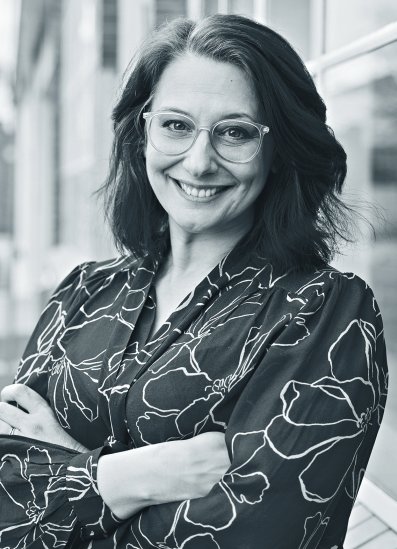
After failing ballet class in college, Stephanie Lake is now resident choreographer at The Australian Ballet, and preparing to launch a new work with her own company. By Steve Dow.
Choreographer Stephanie Lake’s creative rebellion
Stephanie Lake was often a rebel, relying on her creative confidence to scrape her way through. The future star choreographer fronted up for her dance college audition in Melbourne without any formal ballet training. She had mainly performed in forests and warehouses in Launceston with a youth dance group.
Lake not only had no idea what she was doing at the ballet barre at the Victorian College of the Arts, she had to fight to stay in the course. She found the repetition torturous, the art form constraints frustrating and the constant view in the mirror troubling.
“I was utterly confused about the coordination of arms and legs in ballet,” she says, as she speaks in her Melbourne home. “I felt like everyone else knew the codes of this language; the teachers would just say a combination or demonstrate with their hands, but for me, there was a lot of faking it and pretending I knew what was happening.”
Twenty-five years after stumbling her way through her 1999 graduation, Lake’s work Circle Electric played in Melbourne in October as part of a double bill at The Australian Ballet, where she took up the role of resident choreographer this year. She has a deep respect for these young dancers steeped in the formal technique she lacked.
She formed her eponymous Stephanie Lake Company a decade ago, touring high-energy, large-scale pieces such as Colossus and Manifesto, which brim with complex human emotions – but mostly with joy. The company’s latest work, The Chronicles, will feature 12 dancers and premiere in January at Sydney Festival and tour Melbourne, Adelaide and Brisbane.
It includes a soundscape by Lake’s long-time partner and collaborator, sound designer Robin Fox, that features the Sydney Children’s Choir singing the 1984 Alphaville hit Forever Young. While The Chronicles will delicately explore the fragility of life, Circle Electric requires the ballet dancers to scream at one another and the audience as a reflection of this divisive geopolitical moment. Some dancers privately confided to Lake they found the emotional outlet on stage cathartic.
The irony that Lake has landed an additional gig with a traditional dance institution is not lost upon her.
“What a place to find myself, it’s just such a dream,” says Lake, now 48. She describes the creative process as a “wrestling together” with the ballet dancers to find common ground within a collision of forms.
“In third year of VCA, I failed ballet,” she tells me. “I don’t think The Australian Ballet knows that, but I did, I got 47 per cent. I had to fight to graduate, I had to argue my case. I did, obviously. Ballet didn’t come easily to me at all and now I find myself resident choreographer of the national company.”
Looking back, Lake says she was “such a pain” at dance school. “I was always trying to change things. At that time, it was compulsory for women to do pointe work, where you’re up on tippy-toes with the pointe shoe. It’s an incredible technique, but I was a mature-age student going to VCA and to start that at that age just felt, frankly, dangerous and silly. It was ridiculous that it was compulsory, in my view.
“And so I challenged them about it and said it shouldn’t be a compulsory subject. I tried to get support. I lobbied all the teachers and the head of school and, in the end, to get the credit, I proposed I would write a paper on the history and the importance of pointe work. I was allowed to pass and the following year it wasn’t a compulsory subject anymore. So, yeah, I think I’ve always had a little bit of a rebellious streak.”
With rebellion came invention. Noting the lack of opportunity to choreograph in the course, Lake and others formed a group to create shows, despite having no money, which became a grounding in the advantages of collaborative creativity.
Remarkably, in an arts ecology battered by bruising funding cuts that often sees contemporary dance the poor sister of other performing arts forms and at a time when many dancers and choreographers have been forced to leave the field, Lake has always been able to support herself and her family as a freelance artist. She has two daughters, now both young adults: Scarlett, who is studying psychology, and Sapphire, who is just finishing Year 12.
Running her own company took a great deal of personal and financial sacrifice for the first few years and she had moments where she questioned her choices. “There were many forks in the road where I went, ‘Okay, I think what I’m hearing from the world is maybe it’s time to stop,’ ” she says. “I’m glad I didn’t, because this period that’s happening now is so thrilling and I’m glad I’ve stuck it out.”
Lake’s ethos of egalitarianism and participation led her to a plan to choreograph 1000 dancers for the opening night event of the 2025 Adelaide Festival. She’s just back from the city, after holding a workshop with a group of teachers that in turn will teach their groups the moves. The call-out is open to anyone aged over 12 who takes part in any style of dance class, including contemporary, ballet, hip-hop, street Latin, swing, tap, ballroom, bharatanatyam and jazz.
As demand for Lake’s work rises, she’s had to deploy a little self-care. In an interview in September, she said: “It is an all-consuming calling … when I’m working on a piece I don’t sleep, I don’t eat – it’s everything.”
Now, she says, “projects are so back-to-back I really have to keep myself calm and actually trust myself a bit more, because it’s just not sustainable to be in a constant state of agitation and churning. I have to just chill out sometimes and take pleasures in the small domestic things. That’s what keeps it all in balance.”
Where Stephanie Lake was born are dead-flat prairies, “entirely flat all the way to the horizon”, she says. There are family photos of Lake’s mum, Brenda, pushing her in a pram on a road that goes “all the way to infinity”.
Lake was born in 1976, the eldest of three girls, to Allan and Brenda Lake in Saskatoon in Saskatchewan province, Canada, where winters chill to the bone. In 2017 in Melbourne, Lake made a dance work titled Pile of Bones – the original name for the province’s capital of Regina, which honoured the accumulated skeletons of buffalo hunted there.
Canadian-born Allan, a high-school literature teacher and poet, met Scottish-born Brenda, who made a career in newspaper advertising and hosting community radio, on the Ibiza hippie trail in the early 1970s. They got married shortly after.
They thought of themselves as consciousness-raising hippies, “long hair, the flowers, everything”, says Lake. “Mum was only 19, so she was finding herself, but Dad was deep in it. They were flower power.” The house was filled with music and art and the family went to see dance performances together. “It was a very leftie household; we were brought up with those leftie values and that’s still the case.”
When she was eight, Lake’s family decided to migrate to Australia, seeking adventure after finding the Canadian winters unsustainable. Brenda had a sister in Perth, which made their immigration application easier. “I marvel they would move across the world not knowing anyone, really, not having jobs and taking that chance.”
The family chose Launceston to be “useful” to the Baha’i community there – Allan and Brenda were devout adherents of the 19th century Persian faith, which they had discovered during their earlier spiritual search.
“There was a lot of that [faith] in my childhood,” says Lake. “I feel completely intertwined with that [faith community] in how I evolved as a person and, maybe, arguably, into the art that I make as well. I was very involved until I was in my early 20s.”
Lake experienced a “slow undoing” of the faith and today calls herself atheist. “Questions [were] rising, contradictions rising and [I had] a general difficulty with organised religion in its totality,” she says. “I have total respect for people that follow a religious life, there’s no judgement, but for me it was just incompatible with how I saw the world.”
Lake began dance classes only in her mid teens, joining the Launceston contemporary youth dance group Stompin at the behest of her dance teacher, whom she idolised. “My parents say I danced around a lot,” she says. “The usual stuff: put on shows for people and boss them around and put them in my shows. But I didn’t take it seriously until I was much older.”
Today, audiences might experience restless leg syndrome in their theatre seats when experiencing her works on stage. Colossus, which premiered in 2018, ambitiously herded 50 dancers to flock and flow, patterning and bumping up against one another; Manifesto (2019) was exhilarating, with nine drummers playing on a platform above the dancers. Then came the melancholy Covid-era The Universe Is Here, for Sydney Dance Company in 2022, for which dancers dressed in gold moved around harp player Emily Granger, as Lake explored the “beauty of brokenness, the beauty of beastliness, the beauty of sadness”.
Music and dance in a Lake work influence each other, thanks to her successful ongoing working relationship with Fox. The pair met when Lake was making the work Mix Tape for Chunky Move at the Malthouse Theatre in 2010. She persuaded him to record one of the interviews to be used in the work.
“It was just an instant ‘click’,” Lake recalls. “I remember meeting him in the line to get a coffee at the cafe at Malthouse there and we got chatting and it was instant. I thought, What a great person, I would definitely like to collaborate with him one day.
“I wasn’t looking for a partner; I was turned off all of that. I was not looking for that at all. But the connection was just undeniable. So, I interviewed him for Mix Tape, which is a piece about romantic love and other types of love and I was trying to process all of that.
“His voice ended up in the work, and many of his personal belongings ended up in the set for the work, because he was moving to Germany and getting rid of all his reel-to-reel and tape machines and record-players, so even though he was an acquaintance, he was embedded into this piece I was making about love. Then we ended up falling in love and working together for the last 14 years.”
Fox was a “very open” interview subject, Lake recalls with a laugh. “That’s attractive to me. I found that quite extraordinary,” she says. “Now I know him so well, he is almost too open. He connects with people very easily and is very good at getting other people to talk about themselves, as well. There’s an amazing connection and intimacy – it’s unique.”
The ability to critique one another’s work has been a key factor in their partnership. “We can be very honest with each other. He’s never hurt my feelings, put it that way. Ever. He’ll go, ‘Sweetheart, there are just a couple of clanger moments, do you want me to tell them?’ And I’ll go, ‘Yes, tell me!’
“The clanger moments are when he’d felt a bit of a cringe. I’ll go, ‘Yep, I know what you mean’, or – and this has happened quite a bit – I’ll say, ‘Yep, I hear you, I totally disagree, it’s going to be good, trust me.’ ” She laughs. “He’ll then go, ‘You were right.’ ”
This article was first published in the print edition of The Saturday Paper on November 9, 2024 as "Full circle".
For almost a decade, The Saturday Paper has published Australia’s leading writers and thinkers. We have pursued stories that are ignored elsewhere, covering them with sensitivity and depth. We have done this on refugee policy, on government integrity, on robo-debt, on aged care, on climate change, on the pandemic.
All our journalism is fiercely independent. It relies on the support of readers. By subscribing to The Saturday Paper, you are ensuring that we can continue to produce essential, issue-defining coverage, to dig out stories that take time, to doggedly hold to account politicians and the political class.
There are very few titles that have the freedom and the space to produce journalism like this. In a country with a concentration of media ownership unlike anything else in the world, it is vitally important. Your subscription helps make it possible.
Subscriber exclusive
Send this article to a friend for free.
Share this subscriber exclusive article with a friend or family member using share credits.