Profile
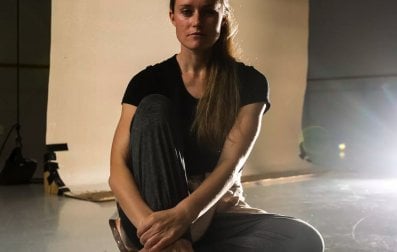
State Theatre Company South Australia’s artistic director, Petra Kalive, brings seldom-heard voices to her imminent first season. By Steve Dow.
Artistic director Petra Kalive
Director Petra Kalive discovered the life-changing power of personal stories early in her career. As an ensemble member and later co-artistic director of the improvisational theatre company Melbourne Playback, she worked with the African community in Footscray, refugees in Dandenong, with teachers and health professionals.
“I learned so much doing that for seven years,” says Kalive. She is seated in her office in Adelaide, where last year she was appointed artistic director of the State Theatre Company South Australia (STCSA). “The impact that work had on those communities, the power of hearing your story reflected in front of your own community – I saw so much transformation and it was so humbling.”
Kalive was appointed associate director of Melbourne Theatre Company in early 2020. Over the next few years, between Covid-19 lockdowns, she directed works that emphasised migrant and minority perspectives – Jean Tong’s Hungry Ghosts, Alice Pung’s Laurinda, Rashma N. Kalsie’s Melbourne Talam – and, having previously overseen a workshop production of My Brilliant Career, built on her direction of musicals with Carousel and Spring Awakening.
By 2023, Kalive was “absolutely” facing a professional crisis of meaning and contemplating a career change. She wanted to bring the community-engaged and -led work she so loved into professional theatre spaces and was despondent at the lack of traction she had gained for that idealistic ambition. She came to a crossroads: would she continue to pursue professional work with professionals or work in community?
“It was part of my desire to leave [MTC]. I knew I had more to offer, but I couldn’t find a way to bring all those intersecting parts of my skill set together in that role,” she says. “That’s no shade on anybody or on the company itself, it’s just that I was ready for something else and so I stepped out. People thought I was a bit crazy, leaving an incredibly amazing job that people aspire their whole lives to, after three years, to step into the unknown.
“But through that came a real consolidation of all my thinking. It made possible doing a Churchill Fellowship, really homing in on what I wanted to do and how I wanted to do it. Without that time, I don’t think I would have landed [this] job.”
For the fellowship, Kalive flew to Chile to attend PLATEA 24, an arts producers’ conference hosted by Fundación Teatro a Mil and held at the same time as the annual theatre and performing arts festival, Santiago a Mil. She had profound conversations with local theatre makers and admired how arts spaces there were “commandeered by everybody, and everybody feels a sense of ownership of these cultural places,” she says. “The only places in Australia [where] I’ve seen a similar kind of engagement are libraries.
“We tend to say to people [in Australia], ‘No, the doors to this cultural institution are closed right now, we’re going to open them at five o’clock, just before the show opens.’ But in these spaces, people were coming through all the time, they were places of cultural exchange. They weren’t transactional, they were just places you could be, which was really inspiring.”
Kalive also visited The Public Theater in New York and London’s National Theatre to discuss their public works programs, which she found exciting and engaging, and “hung out” with smaller companies, Common/Wealth Theatre in Bradford and Next Door But One in York, that make professional works that prioritise inclusivity and community input in unconventional performance spaces.
Kalive’s conclusions about Australian theatre in her fellowship report are clear-eyed. “Financial and logistical challenges make large-scale, community-engaged practices difficult to realise in mainstage theatre companies here,” she writes. “Additionally, there is a cultural aspect to consider: the performing arts are not valued in Australia in the same way they are internationally. We are still struggling to appreciate and value our own professional theatre makers and writers.”
What’s the answer to this lack of love for the performing arts here? “We need to constantly talk about the value of the arts, that it has an individual impact, a community impact, an economic impact, it has a tourism impact. There are multiple ways you can value what we do, and so often we’re just seen as this thing off to the side, that doesn’t connect into the world at large,” she says.
“You can see through history, at times where artists are given value and licence to do what they do, we see a rise in innovation and science and development and economic returns. The more you’re capping your artists, the more you’re capping culture as a whole. I’m just trying to figure out how to get that message out more.”
Kalive returned to Australia with a renewed commitment to create “extraordinary, large-scale public theatre works in professional settings”, but now she is taking a “more flexible” approach to her goals.
More flexible in recognising the demands of box office, perhaps? In 2024, the STCSA posted its second consecutive surplus on the back of the success of the adaptation of Pip Williams’ novel The Dictionary of Lost Words, a critically lauded play that has been a touring success and was programmed by Kalive’s predecessor as artistic director, Mitchell Butel, who is now artistic director of Sydney Theatre Company.
“Yes, and recognising that my ambition is big and money is a factor. We live in a very risk-averse environment. So demonstrating and growing slowly this idea is the way forward. To show people, hey, it was possible on this scale, so maybe next time you can fund it on this scale,” she says, her arms stretching ever wider, “and the next time on this scale, and it can continue to grow.”
Petra Kalive comes from a family of teachers and builders. “Nobody really understands what I do,” she says. The exception was her late mother, a primary-school teacher of literacy and numeracy who died 10 years ago. She loved theatre, and came to the town halls where Kalive performed monologues at eisteddfods.
Born in Melbourne and growing up in “then daggy” East Malvern with two siblings, Kalive wanted to be a performer, taking classical ballet classes from the age of five and playing piano. She remembers how the vibrations would rumble through her body and says that the piano became an “escape” from Kalive’s “rather turbulent family environment”.
“We grew up with my grandmother, so it was a multigenerational household,” she says. “I think she had had a very traumatic childhood, and the household was turbulent because of her mental illness. My dad’s bipolar as well. So, we just lived in a household that was emotionally messy.”
What impact did that childhood home have on Kalive’s ambitions? “Being an actor and being able to escape into other worlds and become other people attracted me,” she says. “I think [it] also gave me an empathy and a deep curiosity about what makes people behave the way they do.”
Kalive went to Perth to study acting at the Western Australian Academy of Performing Arts. In 2005, she was offered a career game changer at St Martins Youth Arts Centre in Melbourne’s South Yarra: the job of assistant director on a musical, The Wild Blue, that included dance, puppetry and yodelling.
“I absolutely still had designs on acting at that point, but I had an incredible mentor in Anthony Crowley, who wrote The Wild Blue. I was post-drama school and I was in that abyss you can find yourself in, where you’ve been incredibly busy and stretched artistically for three years at drama school, and then land in an industry that in the early to mid 2000s didn’t know quite what to do with me.
“I was bouncing around from audition to audition. I went back to Anthony, who I’d met in the performance ensemble that I’d done before drama school, and said, ‘I don’t know what I’m doing.’ He said, ‘Come and assistant direct this show with me.’ I fell in love with directing at that point. It opened a world of musicals for me as well. Anthony knew better than I did that my psychology was much better suited to directing and holding space for people than it was for performing.”
Kalive turned her hand to adapting and writing, notably Oil Babies, staged by Lab Kelpie in 2018. The play weighed up “our continued ‘hope-investment’ in procreation against our feelings of helplessness at the state of the planet”.
When writing the play, Kalive was contemplating whether to have children. “How do you bring children into a world that is burning and flooding and in a state of environmental crisis?” she asks. “There doesn’t seem to be leadership and a desire to address this in any meaningful way. I was grappling with the fact that in the face of this massive issue, people are catatonic and unable to find a direction through it.”
In the end, she decided that having children was “an act of hope”. She has two, now aged nine and seven. She is married to Tim Stitz, who until a few months ago was executive producer and co-chief executive of Geelong’s internationally lauded Back to Back Theatre company. The pair first met in 2008, when Kalive was looking for actors for a play she had written, and Stitz was cast in a role. They became an item two years later after bumping into one another in a theatre foyer. Now the pair are living on the Adelaide city edge.
Kalive is facing some unsettling changes at STCSA. For at least the next five years, the company will move into the old ABC building at Collinswood, north-east of the city, “with our workshop, unfortunately, at Marleston [west of the city]”, says Kalive.
STCSA’s regular performance spaces, the Dunstan Playhouse and the Space Theatre, are out of action until early 2026, as the Adelaide Festival Centre undergoes an upgrade, so the company is performing at the Goodwood Theatre and the Odeon Theatre in Norwood. It recently staged the musical Kimberly Akimbo at the refurbished Her Majesty’s Theatre. By about 2030, the STCSA will have moved into new “fit-for-purpose” accommodation, although the destination has not yet been confirmed.
Kalive says her 2026 season, which is announced next week, will reflect her interest in diversity and difference. In May she launched SPARK, a program for local independent theatre makers that builds on her predecessor Butel’s Stateside program. “It supports new voices, new works, works that you may not expect to see at a state theatre company,” she says. “We give them rehearsal and performance space, producing space, workshop support … all they need to do is bring the creative team and the work itself, and then they get 100 per cent of box office.” For Kalive, her focus in her new role is on “evolution, not revolution”, with the aim of amplifying lesser-heard voices.
Given her unconventional career path to date, where does she see herself in a decade’s time?
“Good question,” she says. “If you’d asked me 10 years ago, I would have said leading a major theatre company. Now that I’m here, I’m hoping that the work that I do here leads to a job down the track that can continue to inform cultural change. I hope I can be someone who can advocate for and change the conversation in Australia around the way we perceive the art that we make and the fabulous artists that we have.”
This article was first published in the print edition of The Saturday Paper on October 4, 2025 as "State of the art".
For almost a decade, The Saturday Paper has published Australia’s leading writers and thinkers. We have pursued stories that are ignored elsewhere, covering them with sensitivity and depth. We have done this on refugee policy, on government integrity, on robo-debt, on aged care, on climate change, on the pandemic.
All our journalism is fiercely independent. It relies on the support of readers. By subscribing to The Saturday Paper, you are ensuring that we can continue to produce essential, issue-defining coverage, to dig out stories that take time, to doggedly hold to account politicians and the political class.
There are very few titles that have the freedom and the space to produce journalism like this. In a country with a concentration of media ownership unlike anything else in the world, it is vitally important. Your subscription helps make it possible.
Subscriber exclusive
Send this article to a friend for free.
Share this subscriber exclusive article with a friend or family member using share credits.