News
The Senate inquiry into climate misinformation invited both News Corp and Advance to its hearings – senators have received 5000 emails from Advance supporters, telling them to back off. By Karen Barlow.
News Corp and Advance called to misinformation inquiry
Right-wing activist group Advance has disdain for the Senate inquiry into energy and climate misinformation, but it just can’t help getting involved.
Ahead of the first hearings this week, the Liberal-affiliated opponents of net zero tried to set their hefty subscriber base onto the members of the inquiry. The late Friday spamming effort fired off more than 5000 anonymous emails to each senator, essentially telling them to back off.
Advance describes its mobilising campaign against net zero as a “response to a political and policy issue”.
“So, the Greens and the pro-net zero lobby accuse Advance and its supporters of being ‘astroturfed’ and ‘fake’ and ‘bots’, and you think we’re going to take that lying down?” Advance’s executive director, Matthew Sheahan, asks The Saturday Paper.
“The best response for the mainstream Australians who support Advance is to email the politicians running this circus to tell them that they are in fact real, ‘misinformation’ is a political tactic to silence dissent, and that they oppose net zero.
“If the senators behind it think we’ll just sit quietly while they smear us with their political theatre, they’re mistaken.”
The group – which is registered with the Australian Electoral Commission as a significant third-party entity, as it fundraises and spends enormous sums on political causes – has targeted the Greens and teal independents for their environmental platforms over recent election campaigns. It has been named in the inquiry as a participant in what scientists call the “denial machine” that is working to delay global climate action.
Asked about Advance’s position on the science of climate change, Sheahan responds, “Why don’t you go have a meaningful discussion about ‘the science’ with China and India before you have it with the Australian people?”
The Murdoch media organisations were also among those invited to participate in the Senate inquiry. News Corp and its Sky News channel are yet to confirm either submissions or possible appearances.
Neither News Corp nor Sky News Australia responded to requests for comment.
The Greens have a largely fixed perception of News Corp, but they want to hear from its executives. “Certainly, going into this inquiry, I’ve seen them as the biggest cancer on climate action and climate policy in Australia,” Greens senator and inquiry chair Peter Whish-Wilson tells The Saturday Paper.
“Sky News Australia – biggest offenders globally. And a number of submitters pointed to specific examples and how they amplify reports that might come out of somewhere like the IPA [Institute of Public Affairs], for example.”
The University of Melbourne’s John Cook, an expert on information integrity, confirms conservative think tanks are often “the breeding ground of a lot of misinformation arguments”, which they then “spread out through either influencers, social media or policy methods”.
The IPA has made a submission to the inquiry opposing any attempt to “shut down debate”, but it says it has not yet been asked to appear.
“What we have witnessed so far with this committee is a show trial that would even make McCarthy blush,” Daniel Wild, the IPA’s deputy executive director, tells The Saturday Paper.
“The elites and the political class that push net zero understand that mainstream Australians are fed up with it.”
While conservative think tanks have been the global “breeding ground of a lot of misinformation arguments” since the 1990s, according to Cook, there are also denial or contrarian blogs and social media.
It is all being tracked.
“We’ve developed AI methods of extracting the different misinformation themes with really big sets of data. Through that, we were able to detect that 20-plus year trend towards solutions misinformation,” Cook told the inquiry.
Also invited were tech giants such as Meta, Google and YouTube, in recognition of how misinformation, or what the inquiry diplomatically calls “problematic information”, is being supercharged online. They have not yet responded to the invitation.
“Critical to this is the business model behind the social media platforms – a well-documented financial ecosystem that rewards extreme content because it sustains user attention,” Alex Murray from Climate Action Against Disinformation told the inquiry.
A 2020 study by the University of Canberra, cited at the inquiry, found that Australia ranks third in the world for climate denialism, at 8 per cent of the population, behind the United States (12 per cent) and Sweden (9 per cent). The global average is 3 per cent.
The study linked views to age as well as to news consumption. It found that about a third of the audiences of commercial AM radio, Sky News Australia and Fox News regard climate change as “not at all” or “not very” serious.
The inquiry’s focus is on organised deceit, rather than more-organic pushback from local communities on climate action such as fears over property values and the impact on tourism.
Nationals senator and strident net zero opponent Matt Canavan insists he has only seen genuine concerns.
“Certainly, in my experience, all of the local groups I’ve interacted with, any suggestion being funded or organised by outside groups is ridiculous,” the senator told the inquiry. “They just don’t want to live next to a 280-metre tower, or any towers. It’s not hard to explain the opposition.
“All politics is local, and if you dismiss local concerns as based on conspiracies or in the hock of well-funded dark money groups, I don’t think you’re going to get your project away.”
The inquiry noted, however, fake community groups that pop up only at election time or exist to attack the renewable energy rollout. This is “astroturfing” – often fossil fuel-funded groups pretending to be a grassroots, community-based movement.
Most witnesses to the inquiry, which comes a week after Prime Minister Anthony Albanese announced Australia’s 2035 emissions reduction target of 62-70 per cent at the United Nations, have noted a pivot over the past decade from climate denial to climate delay. That obstruction takes the form of attacks on climate solutions such as renewable energy and other efforts to reach net zero greenhouse emissions by 2050.
“My assessment is that those activities, in and of themselves, worsen climate change and worsen the multiple impacts of climate change on human rights,” the UN Special Rapporteur on Climate Change and Human Rights Elisa Morgera told the inquiry from Geneva.
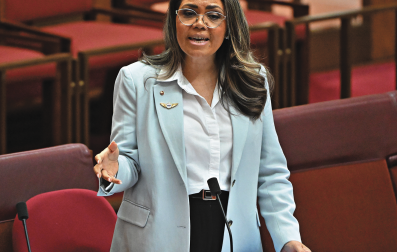
The first two days of the inquiry, with Labor’s Senator Michelle Ananda-Rajah as deputy chair, sought to grasp the magnitude of climate obstruction.
It goes way back to 1967, according to Jack Herring from global think tank InfluenceMap, which maintains a database for measuring corporate climate policy engagement. “Our research has consistently shown that the fossil fuel sector has employed a strategy of misleading climate claims and narratives to misinform the public and also shape policy outcomes in ways that are inconsistent with climate science,” Herring told the inquiry.
“Australia’s loose lobbying laws and loose transparency rules provide an enabling environment for companies to avoid accountability for what they’re really saying.
“Research does find that around 15 per cent of the world’s largest companies provide complete and accurate disclosures of their direct climate policy engagement. When it comes to indirect advocacy the standard is even worse, with around 90 per cent not providing any meaningful disclosure of what their industry associations are engaging on and what they’re saying.”
The shift is onto third-party groups engaged by industry giants, the trade associations or advocacy groups referred to as the “tip of the spear” or proxies. They allow companies to say, “look, that wasn’t us,” according to Professor Christian Downie of the Australian National University and the Climate Social Science Network.
Industry sponsors sporting teams – such as Woodside’s sponsorship of the Fremantle Dockers – pays for naming rights on arts events and funds school and university programs.
Downie says trade associations have a particular role to protect the social licence of their industry, to protect their reputation.
“We looked at about 90 trade associations in the United States over a decade that worked on climate change issues,” he told the hearing. “They had revenues of US$25.6 billion. They spent about 13 per cent of that on politics. So, US$3.4 billion was being spent on political activities over the course of a decade ... more than two thirds was going into public relations ... [M]ore than lobbying, more than political contributions … was going into public relations.”
The challenge is to track the money and therefore the influence.
“The way that funding is funnelled increasingly, over time, it’s gone dark,” John Cook said. “It goes through these third-party organisations, like DonorsTrust, which make it impossible to source the original source.”
Millions of dollars in donations from mining magnate Gina Rinehart to the IPA was only made public in 2018 due to court proceedings initiated by Rinehart’s daughter Bianca.
The think tank does not routinely reveal who funds its operations, but it counts resources and big tobacco companies among its donors.
Amid all the conspiracy theories, dark money and obfuscation, one senator wrestled with a different existential issue.
Andrew McLachlan, a Liberal senator from South Australia, considered the climate question from amid the ruins of his party as it tears itself apart over net zero.
“There’s been a lot of money spent, a lot of energy, a lot of tactical plays, and it’s failed. Help me. That’s an argument that goes through my mind. Is that legitimate? Or should I be fearful of the future?”
The witnesses did not have an answer.
The inquiry’s next set of hearings is due later this year.
This article was first published in the print edition of The Saturday Paper on October 4, 2025 as "Fighting the ‘cancer on climate action’".
For almost a decade, The Saturday Paper has published Australia’s leading writers and thinkers. We have pursued stories that are ignored elsewhere, covering them with sensitivity and depth. We have done this on refugee policy, on government integrity, on robo-debt, on aged care, on climate change, on the pandemic.
All our journalism is fiercely independent. It relies on the support of readers. By subscribing to The Saturday Paper, you are ensuring that we can continue to produce essential, issue-defining coverage, to dig out stories that take time, to doggedly hold to account politicians and the political class.
There are very few titles that have the freedom and the space to produce journalism like this. In a country with a concentration of media ownership unlike anything else in the world, it is vitally important. Your subscription helps make it possible.
Subscriber exclusive
Send this article to a friend for free.
Share this subscriber exclusive article with a friend or family member using share credits.