Life
A pulmonary embolism has Bob Brown reflecting on mortality and whether it is right to push too hard against death. By Bob Brown.
Bob Brown’s pulmonary embolism
In the 1970s I rode my bicycle from Liffey into Launceston to look after a three-doctor practice for the weekend. One night the phone rang and an anxious but sensible woman told me her husband, who had come out of hospital the day before, had collapsed and was unconscious on the floor.
Suspecting a pulmonary embolism, a catastrophe that in those days was often fatal, I gave the woman some instructions, rang an ambulance specifying that they bring oxygen, and pedalled off to the well-lit house that was about four minutes away.
Thirty years later I was walking down York Street in Launceston when the man, now quite old, tapped me on the shoulder. “Dr Brown,” he said, “you saved my life. I just want to tell you how much I have enjoyed the last 30 years with my wife, children and grandchildren.”
We had a good chat and parted happily.
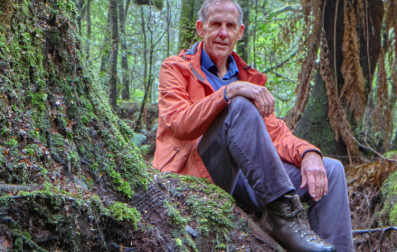
Twenty years later still, in July, my partner, Paul, and I gladly accepted a birthday gift from friends to stay a few nights at their cabin at Stewarts Bay, east of Hobart. On the Wednesday morning, as we were about to set out, I had a brief but debilitating pain in my left groin and, after we drove north to Hobart, was surprised to find myself puffing a little from the one-block walk up Murray Street to the office of our environmental foundation. Next morning, Thursday, at the cabin, I knew my turn had come.
As I walked from the bed to the lounge in the next room, I was right out of breath. My lungs had been knocked out by a pulmonary embolism or emboli. I was feeling well in myself and relaxed but a bit breathless even when sitting. My left calf, the source of the embolus, was sore but not painful.
I explained the situation to Paul and showed him the Mayo Clinic read-out, including “a pulmonary embolism is a blood clot that blocks and stops blood flow to an artery in the lung. In most cases, the blood clot starts in a deep vein in the leg and travels to the lung … pulmonary embolism can be life-threatening. However, prompt treatment greatly reduces the risk of death. Taking measures to prevent blood clots in your legs will help protect you against pulmonary embolism.”
I have turned 80 and took full responsibility for staying in the cabin with its serene sea views and birds calling from the trees. Paul was remarkable and, instead of panicking, went along with me. In the interests of “prompt treatment”, he drove to the Nubeena pharmacy to get some aspirin, an old-fashioned anticoagulant, and a stocking to support my left leg while I enjoyed the views of Stewarts Bay, free of the anxiety that had accompanied serious sickness when I was younger.
Paul was thinking ahead. He made us coffee and sat next to me. “Bob,” he began, and I knew this was to be a deliberative discussion. “I guess this means we can’t go to the Fox and Hounds for dinner tonight.” “Of course it doesn’t,” I replied, and we went as planned, though I was slow and panting getting to the front door from the car park in the rain.
In the Fox and Hounds we had stew by the fire and a surprise meeting with friends before heading back to the cabin. My only real concern was for Paul: if I collapsed and died, he might be left regretting that he hadn’t overridden my nonchalance, even though I had taken full responsibility.
There can be consequences from emboli short of death, including damage to the heart and brain. I knew that more emboli coming from the leg to the lungs could be fatal. I took the aspirin to help “melt” other possible emboli and fell into a good sleep.
The following day, Friday, we had to go back to Hobart. We’d planned to return to the cabin but, considering my condition, decided to go home to Randalls Bay. Along the way I got an appointment to see our local doctor on Monday morning.
At home, sitting by the window, I watched Saturday’s drenching rain. Raindrops fell through the fronds of our Huon pine and an occasional bird, including a Bassian thrush, came for a bath despite the downpour. Paul stayed nearby. The frog pond was overflowing and I was as content as could be.
On Monday, the doctor was sharp. She noted that I had twice before had deep vein thromboses in my left leg, though these hadn’t moved to my lungs. She prescribed a subcutaneous injection of a fast-acting anticoagulant and arranged for radiography in Hobart.
The radiologist looked very serious. Four of the five lobes of my lungs had been impacted by emboli from my leg, which had more thromboses in store. “I think you must go to hospital,” she said. So I did, and stayed for three nights, receiving the same injectable anticoagulant twice a day and swapping to tablets before being discharged.
Would it have made any difference if I had been rushed to hospital in an ambulance on day one? Not in my case, as it turned out. Fortunately I had a medical background, knew what was going on and could make choices about it. My advice to anyone else overtaken with breathlessness is, unless you’re ready to die, call an ambulance.
The question is how hard should we push to stay alive if we get into our 80s, 90s and beyond? I have had a full and adventurous life in preventive medicine – in saving the natural environment, which is humanity’s greatest relaxer. I am three score years and 10, plus 10 – 80 – on a planet where it is estimated that the average of the one hundred billion or more human life spans since we emerged as a species has been about 35 years.
There are now too many humans consuming too much of Earth’s finite store of natural resources. We are rapidly destroying the cornucopia of life on our planet. The destruction is at record levels and increasing, not decreasing. So much so that life on Earth – everyone’s future – is at stake, though most people, including most leaders, deny this and want the economy, including shopping, to expand.
Since I was born in 1944, Homo sapiens have destroyed three quarters of Earth’s wildlife. I would gladly give up the next decade of my life to end that destruction. As that’s not an option, I’ll continue to do all I can to throw a peaceful spanner into the ruination of this brilliant little planet and encourage younger people taking action for nature. Not another hectare of wild earth should be given over to the exploiters’ bulldozers or trawlers.
There are expensive methods by which we can temporarily prolong life as we age. These are not always the most level-headed options. Meanwhile, for want of money, thousands of children are starving on our same globe.
As much as I love life, I am not one for fighting the inevitability of death using every medical option. In recent years, nearly 3000 Australians have opted for voluntary assisted dying rather than enduring the more harrowing and expensive course of a terminal disease. That’s still a small percentage, but it’s good that the choice is now available and becoming more popular.
Minimising the indignity of death helps maximise the dignity of life. A good life is one that’s optimised happiness and, in particular, leaves the planet better off.
I neither want to leave Paul, nor for him to leave me, but our time is coming. We talk everything over and we’ll be there to look after each other’s wishes.
I think it’s a good idea to give away at least some of life’s bounty as death approaches. A gift to those starving children or to other people saving wildlife is especially rewarding. Sorting out what good can be done with whatever money or goods we have, while we’re alive, is much better than leaving it to become someone else’s headache or spending spree or lawsuit.
In 2011, Paul and I gave my property, Oura Oura at Liffey, to Bush Heritage Australia. These days it is a public reserve with a new caretaker’s cottage. I delight in the increasing numbers of visitors going there to see the quaint home, enjoy a riverside picnic or walk the mountain tracks.
In July I was ready to go but, as fortune has it, here I am, fit and alert and grateful for the anticoagulant to be taken morning and night for however few more years are in store.
When I see my doctor in the street, I’m going to tap her on the shoulder and tell her how good life has been since she sent me off to the radiologist and hospital.
This article was first published in the print edition of The Saturday Paper on October 4, 2025 as "A full life".
For almost a decade, The Saturday Paper has published Australia’s leading writers and thinkers. We have pursued stories that are ignored elsewhere, covering them with sensitivity and depth. We have done this on refugee policy, on government integrity, on robo-debt, on aged care, on climate change, on the pandemic.
All our journalism is fiercely independent. It relies on the support of readers. By subscribing to The Saturday Paper, you are ensuring that we can continue to produce essential, issue-defining coverage, to dig out stories that take time, to doggedly hold to account politicians and the political class.
There are very few titles that have the freedom and the space to produce journalism like this. In a country with a concentration of media ownership unlike anything else in the world, it is vitally important. Your subscription helps make it possible.
Subscriber exclusive
Send this article to a friend for free.
Share this subscriber exclusive article with a friend or family member using share credits.