Architecture
The Saturday Paper’s architecture critic looks back at the highlights of 2025. By Naomi Stead.
Best architecture: Melburnians are going wild
At this year’s Venice Architecture Biennale the Australian pavilion’s Home, led by an all-Indigenous creative team, pondered what Country means even when you’re far away – how to create space for gathering, memory and ritual in a strange land. It was a welcome refuge from the techno-utopian cacophony of the biennale at large, offering a place to be grounded by architecture in ways that didn’t feel possible in any other nation’s pavilion.
Back home the year brought the usual cluster of beautiful and desirable dwellings across the country: Studio Bright’s Hedge and Arbour House with its rigorous plan and sequence of stately outdoor rooms; the little ripper that is Carlton Cottage by Lovell Burton Architecture; and the sumptuous idiosyncrasy of Casey Brown Architecture’s Babylon, complete with cable car, like a house dreamt up by a magic realist. Anthony St John Parsons’ New Castle is dreamy in a different register – more surreal, even unsettling, while John Ellway has done it again with Niwa House, another iconoclastic reworking of an existing elevated timber Queenslander.
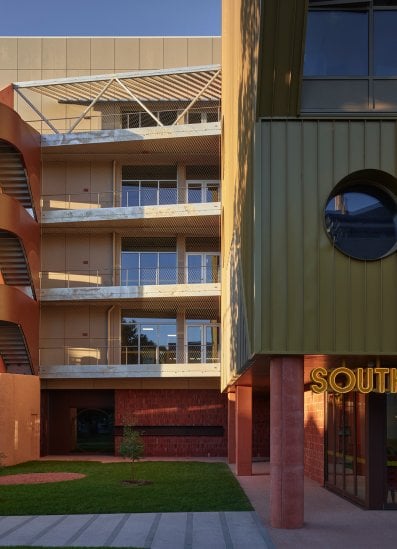
Educational buildings have provided some highlights. James Cook University’s Engineering and Innovation Place by Kirk with I4 Architecture and Charles Wright Architects is an airy tropical marvel, while way down south The Shed is Wardle’s latest addition to their suite of post-industrial buildings on the Inveresk campus of the University of Tasmania. Kosloff Architecture’s most recent additions to Pascoe Vale Primary School are as formally elegant as they are narratively rich.
This year saw the first Adelaide Design Week, and the opening of Besley and Spresser’s much anticipated Barangaroo Pier Pavilion made of luminous “oyster terrazzo”. DCM completed the Poombeeyt Koontapool Lookout, the last of a series of striking tourism infrastructure projects along the Great Ocean Road, while Searle x Waldron took an industrial workplace in a cemetery and lifted it into something beautiful for the Northern Memorial Park Depot. Lahznimmo Architects continued a streak of cracking public buildings with the Gosford Regional Library, while the regions have also benefited in Coffs Harbour’s Yarrila Place by BVN.
Just now Melburnians are going wild with joy about our new Metro – stations and tunnels and escalators, oh my. I haven’t seen such elation over public infrastructure since last year at the opening of the equally shiny Sydney Metro. The Melbourne version won’t be as transformative as its northern sibling, but the stations are again sleek and architecturally expressive. From the muscular forked trusses at Town Hall Station to the monumental arched void at Arden Station, there’s bravado and joie de vivre, plus an important public art program. If only every public building had access to the kind of mega-budget commanded by these big infrastructure projects, how different our cities could be.
Architecture’s peak bodies continue to advocate – with a mix of plaintiveness and success – for the role of design in addressing housing crisis. The NSW state government architect this year made a bold intervention with the Housing Pattern Book initiative, selling exemplary housing designs at peppercorn pricing with a streamlined planning approval process.
The rise of build-to-rent development continues, as does the design aspiration in such projects. Bates Smart’s Indi Sydney tower built above Gadigal metro station is a case in point. Profit-driven solutions won’t solve the problem of housing affordability, but they do hold the promise of producing some robust, high-performance buildings.
Other interventions that could improve affordability at the speed and scale we need it have gained traction this year – with prefabrication and other “modern methods of construction”. These don’t have to be dour exercises in minimising space and amenity, as Blok Three Sisters – a triplet of townhouses on Stradbroke Island by Blok Modular with Vokes and Peters – has shown.
In Victoria, thousands of occupants of public housing towers still wait under the threat of dislocation and demolition while in Sydney, BVN has completed the revised Sirius building, converting it from brutalist public housing into much softened and sanitised – and expensive – private apartments. It’s true the building has been saved and the conversion is sympathetic to Tao Gofers’ original design, but what about its social and political ideals? Displaced, just like the public housing tenants who used to call it home.
This article was first published in the print edition of The Saturday Paper on December 20, 2025 as "The year in reviews".
For almost a decade, The Saturday Paper has published Australia’s leading writers and thinkers. We have pursued stories that are ignored elsewhere, covering them with sensitivity and depth. We have done this on refugee policy, on government integrity, on robo-debt, on aged care, on climate change, on the pandemic.
All our journalism is fiercely independent. It relies on the support of readers. By subscribing to The Saturday Paper, you are ensuring that we can continue to produce essential, issue-defining coverage, to dig out stories that take time, to doggedly hold to account politicians and the political class.
There are very few titles that have the freedom and the space to produce journalism like this. In a country with a concentration of media ownership unlike anything else in the world, it is vitally important. Your subscription helps make it possible.
Subscriber exclusive
Send this article to a friend for free.
Share this subscriber exclusive article with a friend or family member using share credits.