Architecture
Brunswick’s open access community centre, Balam Balam Place, is a small marvel of public generosity. By Naomi Stead.
Community counts at Brunswick’s Balam Balam Place
I’m sitting on a low brick wall at Balam Balam Place, Merri-bek City Council’s new civic and community centre, chatting with caretakers and operators Millie Cattlin and Joseph Norster. Local legends in the Melbourne arts and cultural scene, the pair are the founders of These Are The Projects We Do Together (hereafter The Projects), with backgrounds in architecture, theatre and creative production. Over 12 years they’ve developed a unique custodial role in projects including Testing Grounds, The Quarry, Siteworks, and now the most ambitious so far, Balam Balam Place.
Gesturing at the new five-storey building rising above us – all yellow cladding, round windows and toothy profiled roof – Cattlin tells me about the wild diversity of community activities taking place inside, joking that every day brings new and delightful “list poetry”. She reels it off: Tongan choir, natural birthing workshop, theatre rehearsal, classical guitar class, historical society, maternal child health centre. On the ground floor a child’s birthday party is happening adjacent to the cafe, and an exhibition opening at the Blak Dot Gallery spills out into the garden, mingling with locals lounging on the grass.
The place is humming. I’m told it’s like this most days, alive from six in the morning until 10 at night. The Projects maintains the site but also manages its social operation, in a quietly revolutionary “hosting” model based on generosity and permissiveness. As Norster says, “It’s important to have a space where you can test and fail and fuck up and not be called out.” Quite so.
Balam Balam Place makes an inner-northern triangle with counterparts Collingwood Yards and the Abbotsford Convent. Each offers affordable working and gathering spaces for creative practitioners priced out of the inner city. But while the Yards and Convent are multi-arts precincts, Balam Balam Place has a slightly different emphasis – one that evidently causes some confusion. Folk show up expecting a curated program of arts events to attend, but actually it’s a direct mirror of whatever activities the community wants to do, entirely ad hoc and unselected. The rooms themselves are also “radically generalist” – comfortable multipurpose shells serving many possible ends.
The architects are Kennedy Nolan, who won the design phase of the project in 2021 alongside landscape architects Openwork – also their collaborators at the nearby Nightingale Village – and the environmental consultants Finding Infinity. The Projects had been engaged earlier, in 2016, with the ensuing nine years following the usual game of snakes and ladders – sometimes the project seemed doomed, sometimes it leapt precipitously ahead.
Cadging space to expand the next-door Brunswick Baths was one reason the council had bought the site in 2010. It previously belonged to the Catholic Church, which ran a school there for more than a century, leaving behind some modest 1950s classrooms and a heritage-protected polychrome mansion built in 1888 by pottery entrepreneur Alfred Cornwell. “Sherwood” has a curious asymmetrical plan, one front facing east towards St Ambrose’s Church, the other north to overlook the clay pits. The captain of industry surveyed his domain; now it’s a Woolies car park.
Several people I spoke with had a visceral negative reaction to this house – one describing its “seriously bad juju”. It’s true – I felt it as well. There are shadows there – not only in the colonial displacement of the Wurundjeri Woi-wurrung and the legacy of literally extractive industry but also dark murmurings about the priests who came later.
Mark Jacques from Openwork describes a desire to “recast the presence and the importance of that building in the ensemble … It’s the most important from a heritage point of view, but it’s the least interesting to all of us.” The new design surrounds the house with a “moat” of endemic plantings, directing the approach across a shallow bridge: the colonial artefact subtly unsettled.
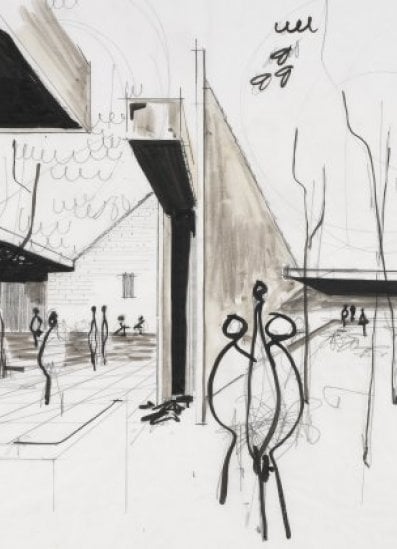
Kennedy Nolan’s Victoria Reeves says the aim was to stitch together a campus of buildings where the architecture and landscape design didn’t need to be heroic, only to provide a robust infrastructure for community use. At the northern end, those undistinguished 1950s school buildings, which would usually have been bowled over quick smart, have been retained – one stripped right back to skeletal form, saving both money and carbon by creating covered outdoor space from the remnant rough concrete frame and floor structure. The resulting outdoor room is surprisingly lovely, a long, thin, fine colonnade that users also flock to – running small markets and nocturnal film screenings. Reeves says “on a freezing Melbourne night you can find theatre groups there, rehearsing Hamlet in the shadows of the ruin”. The other north-west corner building is currently mothballed but set to become an art-making wet area.
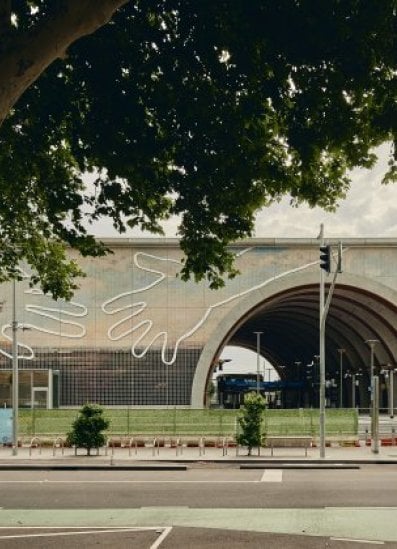
Clearly the most prominent construction on the site is the new, purpose-built south building. Its five storeys comprise bookable community spaces of various sizes, longer term rental for creatives and organisations, as well as some occupancies subsidised by in-kind exchange. The architectural form is fun – something like a giant friendly robot – but it’s the internal vibe that’s most striking. A friend who has facilitated and attended workshops there describes something indefinable in the atmosphere – a place where “it doesn’t seem weird to be singing, playing, lying on the ground.”
Maybe it’s because the communal spaces feel so domestic: the ground-floor entry, for example – its scale and materiality, use of brick, choice of colours, laid-back welcome desk. There’s also a homey feel in the adjacent cafe, which The Projects also runs. The fact that all furniture is second-hand or thrifted makes a powerful difference, along with the many pot plants, small artworks and mementos. It’s all part of The Projects’ longstanding interest in what Norster describes as “that domestic-civil squish”, bringing the comfort, informality and sense of welcome of a domestic space into the public domain.
The building is also very chatty – everywhere there are wall texts with encouragements, questions, research findings about who uses it and how. The building is here to “support people to do what they want to do”. The corridors “are extra wide because we want these spaces to feel civic and generous”. It’s an interesting way of guiding a place towards expansive use – architecture cannot, after all, speak for itself, or only in a language indecipherable to most. It’s no coincidence the idea of an architecture parlante has been around for centuries.
There could be a risk of cheesiness or didacticism in all this, but somehow it registers more like a dialogue – including with The Projects’ own inspirations. These include Robert K. Greenleaf’s concept of “the servant as leader”, and Mierle Laderman Ukeles’ feminist practice of “maintenance art”, explicitly referenced in The Projects’ “Caretakers Maintenance Manifesto”. There are also links with Assemble, the collective of young architects who sensationally won the 2015 Turner Prize for a community housing regeneration project in Liverpool in north-west England. The Projects, along with these progenitors, clearly sit in a lineage of socially engaged art practice: the work is to connect and enable people, attending to place equally in its material and social dimensions.
Jacques describes the whole project as a “social condenser”. There are certainly socialist shades here – 1927 Moscow via 1968 Paris. At times it feels utopian, or anachronistic – out of time. My favourite space of all is the canteen: emphatically not a corporate or institutional office kitchen, it’s a large bright room, clean and orderly and well-stocked, but the crockery doesn’t match, the big second-hand timber table is scuffed with use. The highest compliment I can pay is that it has the air of a far-flung regional branch of the CWA, three or four decades back, where mutual aid, trust, respect and care were simply givens.
These days such assumptions are precarious, the tides of incivility eroding the foundations of social cohesion. If the constructivists sought to redesign an emancipated life through collective living, and the French sought their own forms of liberté, égalité and fraternité, in Melbourne today it’s brave to offer sincerity and generosity to all comers – to be open, both literally and figuratively, to what might happen in public space. To find such a place actually functioning is a small wonder. It’s just as the street posters of Brunswick say: art is the answer; we are each other’s best hope.
ARTS DIARY
THEATRE The True History of the Life and Death of King Lear & His Three Daughters
Belvoir St Theatre, Gadigal Country/Sydney, until January 4
BALLET Cinderella
His Majesty's Theatre, Whadjuk Noongar Country/Perth, November 21–December 14
VISUAL ART Shifting Horizons
Social, nipaluna/Hobart, until November 26
CABARET Meow Meow's The Red Shoes
Malthouse Theatre, Naarm/Melbourne, November 19–December 6
MUSICAL Into the Woods
Glasshouse Theatre, Meanjin/Brisbane, until November 21
LAST CHANCE
EXHIBITION Grace Wood: A Garden is a Mother
Heide Museum of Modern Art, Wurundjeri Woi Wurrung Country/Bulleen, until November 16
This article was first published in the print edition of The Saturday Paper on November 15, 2025 as "Public good".
For almost a decade, The Saturday Paper has published Australia’s leading writers and thinkers. We have pursued stories that are ignored elsewhere, covering them with sensitivity and depth. We have done this on refugee policy, on government integrity, on robo-debt, on aged care, on climate change, on the pandemic.
All our journalism is fiercely independent. It relies on the support of readers. By subscribing to The Saturday Paper, you are ensuring that we can continue to produce essential, issue-defining coverage, to dig out stories that take time, to doggedly hold to account politicians and the political class.
There are very few titles that have the freedom and the space to produce journalism like this. In a country with a concentration of media ownership unlike anything else in the world, it is vitally important. Your subscription helps make it possible.
Subscriber exclusive
Send this article to a friend for free.
Share this subscriber exclusive article with a friend or family member using share credits.