News
EXCLUSIVE: As Sussan Ley confirms the decision to scrap the Liberals’ commitment to net zero, the party’s three new female parliamentarians speak of their views on the Liberals’ future. By Karen Barlow.
Who is the new vanguard of Liberal Party women?
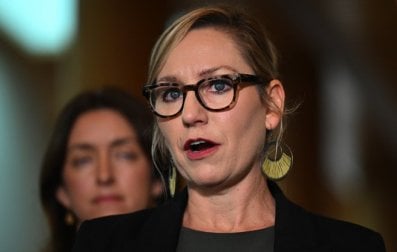
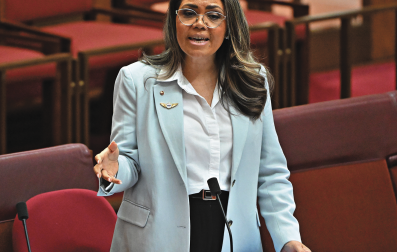
Jess Collins, one of just three new Liberal women in the 48th parliament, sees past the taunt that Labor has more women in its parliamentary ranks whose names start
with ‘A’ than the nine Coalition women left in the House.
The barb refers to Labor’s record 57 per cent female caucus, built from three decades of gender quotas. In the lower house, there are just six Liberal women, though they include the party’s first female leader, Sussan Ley. In the upper house, 11 of the 13 women are Liberals.
“I just think it is terrific,” the conservative Liberal senator for New South Wales tells The Saturday Paper. “How amazing that we have right now, of all these senators, 60 per cent of us are women. It doesn’t matter which political party you’re coming from. It’s great to see female representation.”
The other two new Liberal women on the hill are fellow conservative and former education executive Leah Blyth in the Senate, and former chief executive and member for Monash, Mary Aldred. Each has a somewhat different perspective on a party that is straining against its internal divisions.
They join following a historic defeat that saw the Coalition lose almost every urban seat – a defeat that has highlighted its lack of appeal to women voters, thrown its policy platform up for full review and leaves the party’s leadership on fragile footing, as well as the future of the Coalition with the National Party. The women spoke to The Saturday Paper on the eve of the Liberals’ decision to follow the Nationals in abandoning their commitment from 2021 to the net zero target under the Paris Agreement. At the same time, the party claimed it continues to uphold that accord.
Aldred, a moderate representing a rural seat, said of the party’s stance on climate, “I wouldn’t want us to step away from Paris, and I don’t think we will.
“My own perspective is that net zero has become an emotive slogan for both the hard left and the hard right.”
Collins this week brandished her opposition to net zero. As the party came together before Ley’s net zero announcement on Thursday, the new senator led a power walk of 16 similarly minded colleagues, including Jacinta Nampijinpa Price and Sarah Henderson and leadership aspirants Andrew Hastie and Angus Taylor, into the Liberal party room.
Blyth, the conservative who replaced leading moderate Simon Birmingham as a South Australian representative when he retired before the election, considers net zero a constraint on industry that will “impoverish our economy”. She says the bipartisan commitment to reducing emissions was unsuccessful for the Coalition in the past two elections. The gamble is whether ditching net zero and having a clear contrast with Labor on climate action and energy policy will be better or worse for the opposition.
“A political party that’s only interested in winning is never going to make decisions that are in the best interests of the Australian people,” she says. “We have to start making decisions and coming up with policy positions that are in the national interest and align with our values.”
All three women feel the pressure of rising competition from Climate 200-funded independents, whose support for action on global heating helped them win a clutch of blue-ribbon seats in the 2022 election. Collins previously sought preselection to take on Kylea Tink in the now abolished seat of North Sydney, while Aldred was challenged by independent Deb Leonard as well as the former Liberal member Russell Broadbent, who also ran as an independent.
Aldred, whose seat and that of neighbouring Gippsland takes in offshore wind farm locations, describes the teals as an “extension of the Greens movement”.
“They are quite captured by vested interests in the renewable energy sector,” she says. “The Labor party are the parliamentary wing of the union movement, and they’re upfront about that … I think the teals are the parliamentary wing of the renewable energy industry.
“There is a condescending view that I think many in the associated Climate 200 movement have of regions like mine, where there’s an expectation we should just bear all the burden of the energy transition.”
Collins regards the teals as a “pathway for Liberal voters to ease into a Labor government” and now there is a Labor super-majority, she regards them as having lost relevance.
Asked if she could have been one, Collins said she lives in an independent Sydney seat, but their “propositions do not speak to me. It doesn’t align with my values”.
She says the Liberals need to draw on elements of grassroots campaigning.
“The community don’t see themselves reflected in us any more,” Collins says. “We’re not putting forward members of the community that relate to them, but also we’re not out there enough in the community … We need to pick up the litter and do all that sort of stuff. Volunteerism is really dying.
“We are about families and households, and I don’t think that’s a space that the teals can own exclusively. I think that has always been ours.”
The three Liberals say they can see how the party has alienated women. None is openly pushing for quotas – nor is their leader. Ley said earlier this year she was “open” to quotas, though the party’s still-to-be-released review into the May 3 election rout is not expected to advocate for them.
Mary Aldred, a moderate and a daughter of former federal Liberal MP Ken Aldred, says she is “lukewarm” on quotas.
“Look, I think it’s a journey that we’ve got to continue down,” Aldred says. “My preselection I won with a very strong majority, and I did that by making a very convincing case to local preselectors who gave me their trust and confidence.
“But we also need to do a lot more work on encouraging women to join the party and then supporting them through a preselection … You’ve got to create a pipeline of opportunities that include training and mentorship and encouraging people.
“I’ve got a varied background,” she says, noting she left school at 15 to work in her parents’ business. “I’ve got three degrees. I’ve worked as head of corporate affairs for a multinational across the Asia-Pacific region. We need to do a better job of engaging professional women.
“I’m trying different things. We’re about to set up a business branch, so that for professional women who might not want to sit around for a three-hour branch meeting … they can juggle family and work and other things.”
Collins concedes “there are a lot of angry women in the New South Wales Liberal division seeing how few women got up”.
“There was a big call for gender quotas. And I pushed back on that,” says the former Lowy Institute research fellow. “We don’t need gender quotas, because if you actually look at the people that we put up for election, who got there through preselections – fairly – had we got in in all those key seats … we would have been close to gender parity in New South Wales. So, the greatest failure that we had was actually that it was the worst election ever.
“What do we need to do next? We need to make sure that all those amazing women return,” says Collins.
“I don’t really think about it in terms of whether we should have more or less women,” says Blyth, a first-generation Australian and former president of the Liberal Women’s Council. “The women who get there, you know you’ve done it on merit. That you’re not just filling a quota.
“I’ve got to represent men as a woman. I’ve got to represent the Australian people. I think their obsession with it probably detracts from the issues that really matter to everyday Australians. I don’t think Australians really care. They just want good government.”
Blyth wants to see pro-family policies rather than the “not very exciting” offering in the last election of a petrol discount. She wants to push back on a “woke agenda”, particularly in her previous field of education, where she is concerned about “ideological creep” in classrooms.
“I say this to people – which sort of stops them in their tracks – where I say to them, ‘Who taught you to masturbate?’ And they’ll sort of go, ‘Oh, no one.’ It’s like, ‘Yeah!’ So, why do we need to teach kids that now?” Blyth says.
That said, she sees the economy as the “single biggest issue” for the Coalition. “Culture wars are not your path to government, but I think we can’t ignore them either.”
She spoke of the “incredible women in the Senate” and a sense of solidarity. This was on display for the Liberals during a parliamentary debate last week when Collins mistakenly said that former Howard government minister Richard Alston was dead.
Collins corrected herself a day later, and Blyth was beside her in the chamber. “I said, ‘Right, I’ll sit here with you while you do it.’ … I think largely the women are there to support each other.”
What has not been helpful, according to a broad spectrum of Liberal women, has been the conflation by four Coalition men – Hastie, Barnaby Joyce, Tony Pasin and Henry Pike – of late-term abortions with the issue of employer-paid leave for parents of stillborn babies.
Backbencher Jane Hume said female colleagues were “horrified” by the suggestion, during the debate over a bill to protect parental leave, that women might seek late-term abortions to exploit the ruling. Ley said the intervention was “insensitive”.
Aldred says she strongly disagrees with her male colleagues. “But we are the Liberal Party and we incorporate a broad spectrum of views on things,” she says.
Blyth and Collins joined Price and Henderson in supporting a failed amendment from conservative Senator Alex Antic to prevent “intentional” abortions from being treated as stillbirths under the law.
“I felt like it was the right thing to do, that life is precious, and it really makes me uncomfortable when government is getting involved in life and death,” Blyth says. “I do genuinely believe in smaller government and less government intervention.”
The South Australian says she sees the distinction between stillbirths and abortions, and the Coalition men failed to draw it. “I am very reluctant to make generalisations about what women who choose to have late-term abortions are thinking or why they’re doing it. Because I think that is so nuanced, and it is case by case.
“To represent it in a speech and generalise, I think, is insensitive.”
The new Liberals say they want to reach out to the younger Millennial and Gen Z voters who will be increasingly deciding federal elections.
Collins derides Labor’s HECS-HELP debt policy, which featured a one-off 20 per cent cut, as “sucking” young people into voting for Labor.
“It is the greatest election bribe in all of history,” she says.
As for the party’s future, Collins says a “sense of hope” is key. She believes her colleagues must “get better at not airing grievances”.
Blyth says her party must get better at explaining its positions, like the decision to dump net zero.
Aldred says the focus needs to remain on the government. “We absolutely have challenges right now, but I am very confident in our future,” she says.
“The government has come to this term with a very big majority of 94 seats. But it’s not unprecedented either, in terms of the Abbott and Howard governments both being in the 90s, I think, and so events do turn.
“We need to be rowing in the same direction.”
This article was first published in the print edition of The Saturday Paper on November 15, 2025 as "Who is the new vanguard of Liberal Party women?".
For almost a decade, The Saturday Paper has published Australia’s leading writers and thinkers. We have pursued stories that are ignored elsewhere, covering them with sensitivity and depth. We have done this on refugee policy, on government integrity, on robo-debt, on aged care, on climate change, on the pandemic.
All our journalism is fiercely independent. It relies on the support of readers. By subscribing to The Saturday Paper, you are ensuring that we can continue to produce essential, issue-defining coverage, to dig out stories that take time, to doggedly hold to account politicians and the political class.
There are very few titles that have the freedom and the space to produce journalism like this. In a country with a concentration of media ownership unlike anything else in the world, it is vitally important. Your subscription helps make it possible.
Subscriber exclusive
Send this article to a friend for free.
Share this subscriber exclusive article with a friend or family member using share credits.