Books
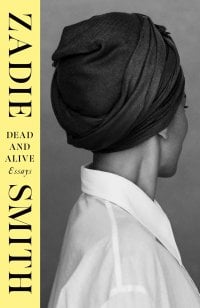
Zadie Smith
Dead and Alive
“Essays are easy. Fiction is hard,” says British writer Zadie Smith in an interview reproduced in Dead and Alive, her fourth essay collection. “Essays are about your opinions,” she replies to a Spanish journalist from El Cultural. “Everyone has opinions and everyone loves to air them.” It’s a surprisingly narrow definition of an infinitely flexible form, in which opinions are just as often muted to elevate more urgent or compelling materials. Think of Christina Sharpe’s sober inventories of Black American life, or Eliot Weinberger’s vignette-essays on the first Trump administration, which compress events of eye-watering ineptitude into an indicting catalogue.
Smith is best known for six novels, after publishing her acclaimed debut White Teeth at 24. While essays increasingly borrow fictional techniques to animate their subjects, for Smith the two forms remain usefully distinct. In Dead and Alive the essay is primarily a rhetorical device and the unity of tone and structure is at least partly because all but three pieces were written for specific outlets or occasions. Here are forewords, speeches, thorny pieces on current events, articles for The Guardian, Zoom lectures and even a “scrap … for a self-published zine, to raise money for a local food larder”.
“Some Notes on Mediated Time” traces the forms of representation that shaped Smith’s early understanding of narrative and led to a “persistent sense of unreality” as a child. In Willesden, a multicultural suburb in north-west London, television “raised” her as she watched up to nine hours a day. There was moral panic even then, she reminds us, though “nobody thought much about the form of TV itself … The seamlessness, the sharp cuts, the fades in and out … the storification of every element of life from the most personal to the world historical”. This early flattening and aligning of radically different events and experiences is amplified in unmediated online content. Smith admits to a nostalgia for “the many delusions of pre-digital storification”. Writing essays is partly a reaction to today’s indistinguishable mush of fact and fiction online. In the essay she can practise “a lengthy and sometimes oblique way of thinking” that doesn’t unfold with or through the internet. An act of resistance.
Smith recently traced her formation as an essay writer in a piece for The New Yorker. In high school, a rectangle with arrows taught her the logical progression of introduction and argument, a blueprint she still admires for its “impersonal and ruthless forward thrust”. At university, three teachers who shared her working-class roots showed her how the essay was bound to questions about class. Literature was “a living concern in their work, not an animated bourgeois dinner party”. We can detect those early models throughout this collection, which spans thoughtful meditations on visual artists, elegies for favourite writers and a craft talk indebted to James Baldwin, who “never was cynical or contemptuous of the mystery of the person”.
Her most persuasive work couples a ruthless drive to understand with a willingness to hold multiple truths. In an acute analysis of British painter Celia Paul’s memoir, the competing forces of art, motherhood and personal sovereignty are eternal, and warped by cultural conventions. Smith notes the “selfishness” Paul required to sustain her art after becoming pregnant to fellow painter Lucian Freud. Paul relinquished the care of their son to enable her work – a decisive act that was also a “defence against obliteration”. Freud, who fathered children with several women, seemed untroubled by such questions of care. In a portrait of Paul, Freud paints her as a timid muse, revealing his distorting misogyny, “a way of not seeing, of assuming both too much and too little”. Later, Paul paints herself as Painter and Model, her bare feet anchored to the studio floor, her eyes averted but hardly meek. Instead she peers into herself. “By looking at myself I don’t need to stage a drama about power; I am empowered by the very fact that I am representing myself as I am: a painter.”
Such knotty questions about what’s required to commit to art and freely express the self despite class, race and gender have long animated Smith, whose mother grew up in Jamaica and whose father is English. Despite, or because of, being biracial she has resisted some constricting aspects of identity politics, putting faith in fiction’s capacity to transcend individual experience. Questions of identity are “perhaps the most complex negotiation of all”, because they engage “something radically intimate, meaningful and private to each of us, and the siren call of the group”. In “Fascinated to Presume: In Defence of Fiction”, Smith suggests the best novels enable an encounter with “the mystery that lies at the heart of all selfhood … what a self may contain that is both unseen and ultimately unknowable”. After all, our “social and personal lives are a process of continual fictionalisation, as we internalise the other-we-are-not, dramatize them, imagine them, speak for them and through them … All storytelling is the invitation to enter a parallel space, a hypothetical arena, in which you have imagined access to whatever is not you”.
Countless women, Smith included, can identify with Madame Bovary and Anna Karenina even if their heroines were authored by men. Yet without recognising fiction’s blind spots we wouldn’t have those vital reworkings of Western canonical texts that once claimed to represent all of “us”. We wouldn’t have Algerian novelist Kamel Daoud’s restaging of Camus’ The Stranger, which grants Camus’ anonymous victim a name, Musa. Smith recognises the need to address the gaps that remain in literary representation but notes, “I can still pick up a novel by a woman like me in every particular – same race, class, sexuality, nationality, heritage – read the first sentence and find she is not, after all, ‘like me’ … But none of this will make me either put her book aside or read it ravenously … if the sentences don’t speak to me, nothing else will.”
Penguin, 352pp, $36.99
This article was first published in the print edition of The Saturday Paper on December 6, 2025 as "Dead and Alive".
For almost a decade, The Saturday Paper has published Australia’s leading writers and thinkers. We have pursued stories that are ignored elsewhere, covering them with sensitivity and depth. We have done this on refugee policy, on government integrity, on robo-debt, on aged care, on climate change, on the pandemic.
All our journalism is fiercely independent. It relies on the support of readers. By subscribing to The Saturday Paper, you are ensuring that we can continue to produce essential, issue-defining coverage, to dig out stories that take time, to doggedly hold to account politicians and the political class.
There are very few titles that have the freedom and the space to produce journalism like this. In a country with a concentration of media ownership unlike anything else in the world, it is vitally important. Your subscription helps make it possible.
Purchase this book
Dead and Alive
BUY NOW
When you purchase a book through this link, Schwartz Media earns a commission. This commission does not influence our criticism, which is entirely independent.
Subscriber exclusive
Send this article to a friend for free.
Share this subscriber exclusive article with a friend or family member using share credits.