Profile
Justin Kurzel’s new miniseries, The Narrow Road to the Deep North, adapts Richard Flanagan’s Booker Prize-winning novel into a war story that resonates with hope. By Stephen A. Russell.
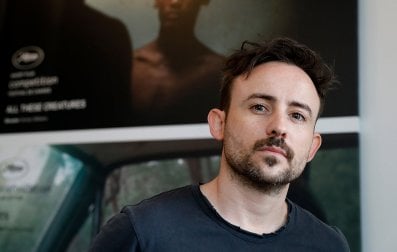
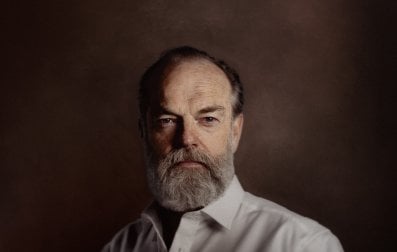
Filmmaker Justin Kurzel
Filmmaker Justin Kurzel and his partner, actor Essie Davis, were in London with their close family friend Richard Flanagan when the author won the 2014 Man Booker Prize for his harrowing novel, The Narrow Road to the Deep North. “We both live in Tasmania and his life, the books that he has written, are really precious to me, so we were enormously proud,” recalls Kurzel. “It was an amazing night, celebrating with him.”
We’re discussing this happy moment while huddling in a huge suite at the Grand Hyatt Berlin on a snowy day. Kurzel is here for this year’s Berlin International Film Festival, where the first two episodes of his new miniseries, based on Flanagan’s book, are premiering. (It debuts this month on Amazon Prime.)
Kurzel and his regular writing partner, Shaun Grant, adapted Flanagan’s novel into a five-part series, featuring Saltburn star Jacob Elordi as Dorrigo Evans. The story dips in and out of Dorrigo’s life, from a youthful affair to haunted old age, around the shattering story of Australian prisoners of war captured by Japan and forced to build the Burma–Thailand Railway during World War II.
Kurzel and Grant wanted to approach the Australian legacy of the war from a different angle, and felt The Narrow Road to the Deep North was their way in. “There was something about Richard’s book that felt like such a unique take on that,” Kurzel says. “It’s this notion of love in it.”
Before enlisting in the army, Dorrigo, a doctor, has an affair with a publican, Amy, played by a luminous Odessa Young, who also appears in Kurzel’s North American crime drama, The Order. Unknown to Dorrigo, she’s married to his Uncle Keith (Simon Baker). “That summer of love with Amy, you feel it throughout the episodes as it grows and evolves,” Kurzel says. “You can spend time with a stranger – it could be a week, six weeks, even a day – but the memory becomes something else. It becomes even stronger.”
Their brief affair sustains Dorrigo during his darkest hours in the jungle. “Amy becomes a sort of sanctuary,” Kurzel says. “Everything that happens to him and what he observes is linked to her memory, which becomes so elevated almost to the point of being unreal. She becomes what she needs to be for him, and I found that so deeply moving.”
Later, Dorrigo is appointed camp surgeon by the brutal Major Nakamura (Tokyo Vice star Shô Kasamatsu), and battles against appalling odds to protect his men. “Their dependency on each other in the POW camp, that warmth and tenderness they find within such horrifying conditions, is another form of love,” Kurzel says.
“Richard talked about how, in a life, you have events, maybe only one or two, that are kind of like a meteorite that comes from the sky and smashes into the ocean, rippling through your entire life,” Kurzel says. “And for Dorrigo, that first experience of falling in love and those incredibly visceral moments in the camp are those twin explosions.”
Dorrigo’s passion for Amy still burns bright as an older man (played by Ciarán Hinds) in the 1980s. Now married to his supportive wife, Ella (Heather Mitchell), on whom he heavily depends, he is cheating with Lynette, played by Davis. Racked by doubt, he doesn’t believe he deserves his status as a war hero. This roiling inner conflict has shades of Macbeth, Kurzel suggests, thinking of his big-screen adaptation of the play. “You’ve got a country that wants you to be a certain thing that represents a certain time, and another sense of identity he’s trying to satisfy, while desperately trying to understand the fog of war.”
The novel’s weight feels deeply personal to Kurzel. He grew up in Gawler, the oldest country town on the Australian mainland, about 40 kilometres north of Adelaide on the edge of the Barossa Valley. “On my mother’s side, my [Maltese] grandfather was a soldier in [the Siege of] Tobruk, “ Kurzel says. “He didn’t speak much, and he had his secret bottle of alcohol that he’d hide away and drink throughout the day. We’d drop him off at the RSL and pick him up. He was a very isolated and lonely figure.”
On his father’s side, Kurzel’s family were Polish refugees. “They were in labour camps and arrived in Australia as immigrants,” he says. “Within the suburbs of Gawler, the war would play out in the backyard. I just remember as a kid that they were always looking into the distance. There was this huge shadow that was impossible to talk about but was very present for me, being around them.”
Kurzel is used to reflecting on difficult history through a lens. His 2011 debut feature, Snowtown, dealt with the South Australian serial murders that led to the infamous discovery of bodies in barrels. More recently, The Order dramatises the reign of American white supremacist terrorist group the Silent Brotherhood. It is perhaps Nitram, which depicts the lead-up to 1996’s devastating Port Arthur massacre, that shows his most unflinching vision. Caleb Landry Jones plays the unnamed perpetrator, with Davis as the Tattersall’s heiress with whom he forms an unusual relationship.
Some survivors of this atrocity understandably insisted the film should never be made. Screen Australia and the then Film Victoria declined to fund the project. Speaking to me for SBS when Nitram was released, Kurzel said, “What was disappointing is that we felt as though we weren’t being trusted … But we also appreciate the fact that this is probably the most sensitive material that you could make a film about in Australia.”
In an article for The Age, Flanagan offered a spirited defence of why the film was necessary, quoting a line from The Narrow Road to the Deep North: “Man survives by his ability to forget but freedom exists in the space of memory.”
Kurzel keenly felt the pressure of approaching Flanagan’s book. “God, how do you do justice to it?” he asks. “You get these books that become these cherished things that mean so much to people, and there’s an enormous responsibility. It was true with [Peter Carey’s] True History [of the Kelly Gang] and especially with Narrow Road, being so personal to Richard. But he did something incredibly kind and said, ‘It’s yours. Make your version.’ ”
Flanagan had no doubt Kurzel could navigate this sprawling story, which is both intensely interior and epic. “We’ve got a place on Bruny Island close to where Richard wrote a lot of his books,” Kurzel says. “We were at his shack when he asked if Shaun and I would be interested in adapting it. I was very honoured that he would entrust it to me but also terrified.”
It took almost seven years to get the show made, and Flanagan was a constant source of support. It helps that the author, who adapted and directed the 1998 film adaptation of his novel The Sound of One Hand Clapping, understands the medium. “Richard thinks and talks in a very cinematic way,” Kurzel says.
Kurzel is fascinated by light and its absence in cinema. The placing of cinematographer Sam Chiplin’s camera and the use of chiaroscuro was particularly important when filming the camp sequences of Narrow Road in a surreally blasted-looking stretch of rainforest an hour out of Sydney. “Again, it’s about that sanctuary,” Kurzel says. “Where’s the light? What’s the thing that these men are grasping on to, to keep them alive?”
The series also captures, agonisingly, how the sturdy bodies of the soldiers physically decline. “I noticed in Richard’s book that the way he wrote about the body was really particular,” Kurzel says. “I’ve been fascinated by films that have used the body in terms of that transformation, whether it be Steve McQueen’s extraordinary film Hunger [with Michael Fassbender in 2008] or [Martin] Scorsese’s Raging Bull. I knew that this series needed a lot of storytelling to be told through those men’s bodies.”
A prelude set in Syria and the men’s arrival at the camp were shot first. Then Kurzel captured the summer of love and 1980s sequences. This created a roughly five-week gap before shooting the dramatic consequences of the soldiers’ diabolical treatment. “The boys were incredible in their dedication to getting their bodies to that stage,” Kurzel says. “We had a fantastic dietitian looking after them, because you can’t just say, ‘I’m going to eat a sardine a day, and I’ll get to that weight loss.’ We had to be really precise with it. How do you lose that weight but also keep healthy? There was a lot of physicality in the gym.”
The young cast – including Bump star Christian Byers, Heartbreak High’s Thomas Weatherall and David Howell from Last Days of the Space Age – were all in. “It was amazing how they bonded,” Kurzel says. “There was something in their sacrifice, in a way, that brought an enormous authenticity to the production.”
Much as Flanagan writes with cinematic vision, Kurzel’s film is indebted to the stage. He met Davis, with whom he has twin daughters, while working as a production designer on Belvoir Theatre’s 1996 production of Arthur Miller’s A View From the Bridge. “We just fell in love, and it has a lot to do with her being such a creative force,” Kurzel says. “She’s ridiculously curious about everything and anything, but particularly great works of art. We’ll watch endless films and theatre shows together and go to galleries. Her father, [George Davis], who just passed away, was an extraordinary artist, so we’ve always had this creative bond.”
Theatre directors such as Neil Armfield, Jim Sharman and Barrie Kosky were Kurzel’s childhood heroes. All three work across artistic mediums. “I worked with amazing theatre and film director Benedict Andrews,” Kurzel says. “There’s something about going through that background – being surrounded by actors in rehearsals for seven or eight weeks, and, as a designer, reading so many plays and thinking about how you’re going to interpret them – that helps you think about the big picture.”
Kurzel feels films in his gut and has done since he was a young man devouring movies such as Rocky, Phar Lap and BMX Bandits. “It wasn’t that I would sit there and study ‘What does it mean?’ I just felt it, and I never wanted it to end,” he says. “I needed to understand how these lives keep going and how I could be them, in some way. I found it very easy to be back in a film, which was weird. My vision would sort of blur and I’d re-enact them with Jed in this country town, Gawler, that was just paddocks. We created our own world.”
Kurzel’s brother Jed, a rock musician and composer, has written all Justin’s film scores, but the pair might have followed another path. “We were in a band together and were very good at tennis,” he recalls. “Pat Cash was our hero and we wanted to win Wimbledon. Jed was better than me and I realised it wasn’t going to happen. But I would study matches, dress like Pat and, when I hit a serve, I would try to do it exactly like him.”
Can we expect a tennis feature to follow, then? “Not from me, but Jed is going to direct his first film and it’s going to be about tennis and a little bit about our upbringing.”
For Kurzel, all roads have led to this moment. “Last year, I’d made The Order, which was in post [production], and then I moved into pre- with Narrow Road and, at the same time, I was making a documentary called Ellis Park with Warren Ellis, going to Sumatra and then to Calgary,” he says.
“It was overwhelming but an incredible creative adrenaline rush, how the three spoke to each other. My girls have just turned 18 and finished school and it feels like a really interesting time. It’s so hard, making these things, and I’m just so grateful that I’m here.”
This article was first published in the print edition of The Saturday Paper on April 12, 2025 as "Difficult histories".
For almost a decade, The Saturday Paper has published Australia’s leading writers and thinkers. We have pursued stories that are ignored elsewhere, covering them with sensitivity and depth. We have done this on refugee policy, on government integrity, on robo-debt, on aged care, on climate change, on the pandemic.
All our journalism is fiercely independent. It relies on the support of readers. By subscribing to The Saturday Paper, you are ensuring that we can continue to produce essential, issue-defining coverage, to dig out stories that take time, to doggedly hold to account politicians and the political class.
There are very few titles that have the freedom and the space to produce journalism like this. In a country with a concentration of media ownership unlike anything else in the world, it is vitally important. Your subscription helps make it possible.
Subscriber exclusive
Send this article to a friend for free.
Share this subscriber exclusive article with a friend or family member using share credits.