News
The distraction of an erratic US-driven trade war is forcing Labor to pivot on the campaign trail, while offering opportunities to sharpen its pitch as the superior economic manager. By Jason Koutsoukis.
‘We are being tested’: Inside Labor’s trade war strategy
The last thing Labor needed in the middle of an election campaign was a global financial crisis. This week, that very scenario seemed to be taking shape, as US President Donald Trump’s erratic plunge into a full-blown trade war sent global markets reeling.
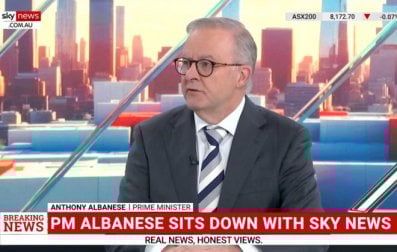
Every day on the trail, Anthony Albanese and his senior ministers field multiple questions about the status of Australia’s relationship with its most powerful ally. Their effort is to shift the narrative of the failure to secure an exemption from the 10 per cent tariffs to a focus on sound foreign policy and economic management. The main issue, the government knows, is not the levy itself but the rapidly escalating global dispute, which has seen the US and China push their reciprocal tariffs up to 145 per cent and 84 per cent, respectively, and counting.
For now, Albanese continues to maintain that the unpredictable nature of Washington’s decision-making underscores the value of a deliberate and coordinated approach. Treasurer Jim Chalmers has marshalled the country’s top financial authorities in a display of preparedness that also complements his campaign pitch.
“While we’re working through the implications of this global uncertainty responsibly and methodically, Peter Dutton is ramping up talk of a recession in a desperate attempt to deflect from his failure to come up with costed and coherent policies in his flailing campaign,” the treasurer said this week.
The prime minister has emphasised the unpredictability of the US administration’s position. “We need to be considered in how we go forward,” he told reporters on Thursday. “You do not dial it up to 11 at every opportunity, which is what Peter Dutton’s plan is: say the first thing that comes into your head, pretend you didn’t say it, and move on.”
One senior government official describes a profound challenge underlying the US tariffs. “This isn’t just an economic slight – it’s strategic,” they tell The Saturday Paper. “We’re being tested – not just in trade but in how far we’re willing to defend our sovereignty. Trump is probing for weakness and how we respond now will shape our standing for the next four years.”
A Department of Foreign Affairs and Trade official emphasised Australia’s relevance, and hence its potential leverage, on Capitol Hill.
“What I keep seeing in Washington is President Trump and other senior members of the administration, Republican and Democratic lawmakers, all talking about Australia, whether it’s trade, defence or critical minerals, and that tells you something important,” the official said. “We matter. Maybe more than we realised. That’s reassuring, but the flip side is that with visibility comes risk. When you’re on Trump’s radar, you’re also in the firing line, so think very carefully before you say anything.”
With parliament prorogued and the government in caretaker mode, Australia has paused direct negotiations until after the May 3 election.
Meanwhile, government ministers are working on a range of alternative offers that can be used as bargaining chips if Labor wins. They are emphasising a two-pronged strategy of steady diplomacy abroad and economic reassurance at home.
On the latter, Treasurer Jim Chalmers has met with the heads of the Big Four banks, Macquarie Group and key superannuation funds, and convened the Council of Financial Regulators – including Reserve Bank of Australia Governor Michele Bullock and Joe Longo, chair of the Australian Securities and Investments Commission – as well as Gina Cass-Gottlieb, chair of the Australian Competition and Consumer Commission. Chalmers also held separate talks with Future Fund chair Greg Combet and Australian Securities Exchange chair David Clarke, then capped the week by hosting the board of the Business Council of Australia.
The mobilisation isn’t simply performative, given the rising risk of a global downturn that could push many countries into recession. While the direct impact of the tariffs on Australia is modest, says Dr Vladimir Tyazhelnikov, senior trade economist at the University of Sydney, “the bigger threat is systemic. If the trade war weakens China or Europe, that hits demand for our commodities – iron ore, coal, base metals.”
Within hours of Trump’s “Liberation Day” tariff announcement on April 2, the prime minister announced a five-point plan, starting with the establishment of a strategic reserve of critical minerals, designed to enhance Australia’s leverage in global supply chains.
Alongside this is a $50 million relief package that has been allocated to industries hit hardest by the tariffs, particularly beef producers. The plan also includes stricter anti-dumping protections and new procurement rules to prioritise Australian-made goods that is part of a broader shift toward economic self-reliance.
Albanese, Trade Minister Don Farrell and Foreign Affairs Minister Penny Wong have all ruled out concessions on areas such as the Pharmaceutical Benefits Scheme, which the US has cited as detrimental to its drugs industry, and biosecurity, as the basis for Australia’s restrictions on US beef imports.
Dr Daniel Kiely, senior research fellow at the Bankwest Curtin Economics Centre, welcomed the targeted support measures and cautioned against kneejerk responses.
“We shouldn’t be reactionary,” Kiely tells The Saturday Paper. “Retaliatory tariffs would only hurt Australian households. The goal should be to preserve open trade, which gives consumers greater choice and lower prices.”
Kiely said the support package would be especially vital for small to medium enterprises, many of which lack the capacity to switch markets quickly.
“They need help navigating that transition. With the right backing, they can adapt – but it’s not automatic,” says Kiely.
Overall, he says, while a levy on Australian goods is not ideal, there may be opportunities for Australia, and policymakers should look at the longer-term potential.
“We’ve seen massive growth in our exports to Asian economies over the last decade, and that will continue to be the case,” says Kiely. “So again, continuing to work with other trading partners that we have well-established FTAs [free trade agreements] with and making sure that we look out for and position ourselves for additional benefits that may arise from that.”
Beyond economic management lies a deeper ideological disruption, because what makes Trump’s actions uniquely destabilising is not just the tariffs themselves but also the world view they signal.
Trump is the first US president since Ronald Reagan to prioritise economic transformation over immediate growth, says Professor Wesley Widmaier, an international relations scholar at the Australian National University.
Unlike his predecessor Joe Biden’s forward-looking industrial strategy, Widmaier says, Trump’s vision is nostalgic.
“This is not Alexander Hamilton saying, you know, we’re going to build canals and we’re going to get to the next level. This is kind of a conservative use of tariffs to bring back something that has already gone. It would be like Albanese saying, ‘Let’s bring back Holden.’ ”
Australia’s vulnerability, Widmaier argues, isn’t just material.
“There’s always this push-pull between aligning with the hegemon and hedging through regional institutions or global rules-based norms,” he says. “Trump’s return is shifting that balance again.”
Viewed through this lens, says Widmaier, Prime Minister Albanese’s observation that the US imposing a 10 per cent tariff on Australian exports is not the act of a friend may signal a broader recalibration away from reliance on the US as a “great and powerful friend” and towards a more regionally enmeshed strategy that emphasises upholding shared international standards, rules and principles, rather than simply pursuing narrow self-interest or power-based goals.
“To the extent that Australia tacks between foreign policy priorities of: one, aligning with great and powerful friends; two, acting as a middle power; and three, engaging with Asia and the region, I think we will see a bit less of one and a bit more of two and three,” says Widmaier. “This may be more a shift in emphasis than a turning point, but I agree with the general direction as likely.
“It’s also worth noting that the best PMs didn’t drink the British or American Kool-Aid. We should not have great and powerful friends … we should be appropriately transactional with partners,” adds Widmaier. “One gets the sense that Turnbull was great at managing both Obama, on PBS disputes, and Trump, on migrant agreements and tariff exemptions. I get the sense that Albanese is similarly hard-headed.”
That shift is already evident in Australia’s trade policy.
Over the past decade DFAT has deepened ties with India, the United Kingdom, the European Union and Indo-Pacific nations. Since the UK deal took effect in 2023, beef exports to Britain have risen more than 400 per cent. Under the Australia–India agreement, exports of oats, citrus and timber have also surged, pushing two-way trade up 120 per cent year-on-year.
Diversification alone won’t be enough. Officials say the next frontier will require deeper integration, including common regulatory standards, mutual recognition of qualifications and infrastructure investment in freight and supply chains.
While back-channel negotiations with Washington will continue, expectations are low. “Even Turnbull’s steel exemption took months,” says one Labor backbencher. “This will be a grind.”
According to the same backbencher, Australia may be starting from a favourable position – given its trade deficit with the US and robust defence ties – but exemptions will be rare and likely dependent on the make-up of the next US congress after next year’s mid-term elections, as much as on Trump himself.
Emeritus professor Richard Pomfret, an international trade expert at the University of Adelaide, agrees that the tariff fallout must be kept in perspective.
“We got off relatively lightly. But the real concern is the precedent – Trump’s tariffs undermine the very principles the WTO [World Trade Organization] was built on.”
Pomfret also argues that Australia should move to preserve the multilateral system by “doubling down” on its partnerships within other trading blocs such as the 12-nation Comprehensive and Progressive Agreement for Trans-Pacific Partnership, and the Regional Comprehensive Economic Partnership, the world’s largest trade agreement, covering 15 Asia-Pacific nations including Australia, China, Japan, South Korea and all 10 members of the Association of Southeast Asian Nations, as well as a potential trade agreement with the European Union.
“This is a good time for the final push on an EU deal. The US accounts for just one-eighth of world trade – less than China or the EU. There’s a lot to work with elsewhere.”
Yet even the best diplomacy won’t help Australian businesses that rely on the US if they can’t adjust to the change in circumstances.
Despite Australia maintaining dozens of FTAs, many firms still struggle to make use of them. The Australian Chamber of Commerce and Industry warned last year that the “noodle bowl” of overlapping trade deals is confusing and off-putting.
“For small exporters, tangled rules of origin and endless paperwork can be the end of the line,” ACCI said in a submission to parliament. “In a crisis, trade deals must be not only comprehensive – but usable.”
That’s why Canberra’s response to Trump’s tariffs, policymakers argue, must include domestic reform, such as simplifying paperwork, resolving non-tariff barriers and helping small to medium enterprises plug into global markets.
Ultimately, Australia’s economic resilience won’t be measured in tariff rates – but rather in how quickly and confidently it can pivot when the next shock comes.
This article was first published in the print edition of The Saturday Paper on April 12, 2025 as "‘We are being tested’: Inside Labor’s trade war strategy".
For almost a decade, The Saturday Paper has published Australia’s leading writers and thinkers. We have pursued stories that are ignored elsewhere, covering them with sensitivity and depth. We have done this on refugee policy, on government integrity, on robo-debt, on aged care, on climate change, on the pandemic.
All our journalism is fiercely independent. It relies on the support of readers. By subscribing to The Saturday Paper, you are ensuring that we can continue to produce essential, issue-defining coverage, to dig out stories that take time, to doggedly hold to account politicians and the political class.
There are very few titles that have the freedom and the space to produce journalism like this. In a country with a concentration of media ownership unlike anything else in the world, it is vitally important. Your subscription helps make it possible.
Subscriber exclusive
Send this article to a friend for free.
Share this subscriber exclusive article with a friend or family member using share credits.