Profile
Hugo Weaving’s acting career has brought him international acclaim, but his latest film – an adaptation of Paul Kelly’s song “How to Make Gravy” – reflects his devotion to Australian stories. By Stephen A. Russell.
He’s a global star, but Hugo Weaving’s heart belongs to Australian stories
Beyond the glare of Hollywood blockbuster turns as elven lord Elrond and the villainous Agent Smith, Hugo Weaving has carved an illustrious career depicting Australian men pushed to the edge.
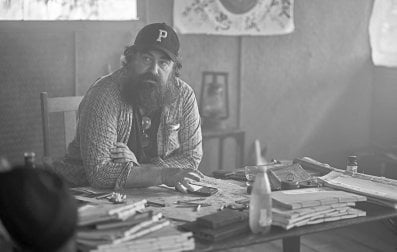
He’s played people such as Martin, the reclusive blind photographer in Jocelyn Moorhouse’s Proof (1991), drag queen Mitzi in Stephan Elliott’s The Adventures of Priscilla, Queen of the Desert (1994), the snarling cop Johnno in Ivan Sen’s Mystery Road (2013) and a grizzled hermit in Mark Leonard Winter’s The Rooster, which debuted at last year’s Melbourne International Film Festival.
During MIFF, we sat down together one sunny morning in a corner bar of the Next Hotel on Little Collins Street to discuss the breadth of his career. Despite Weaving’s towering stature – he’s 189 centimetres as well as a massive star – he exudes an approachable warmth.
Several phone calls follow – Weaving is abundantly generous with his time – bringing us to Binge’s Christmas film, How to Make Gravy. Marking Nick Waterman’s debut feature and co-written with ARIA Award-winning musician Meg Washington, it stirs the lyrics of Paul Kelly’s iconic 1996 song into a seasonal feast. “There’s something very true about the characters Paul writes and the worlds he creates that everyone can attach themselves to,” Weaving says. “He’s an authentic, quintessentially Australian poet.”
Sharing a prison setting with Craig Monahan’s Healing (2014), in which Weaving played a corrections officer guiding inmates towards their release from prison via falconry, Gravy places the actor on the other side of the bars. He plays Noel, a man who is respected by guards and inmates alike and runs the kitchen.
“Noel’s taken responsibility for who he is, accepted his faults and has completely reconstructed himself,” Weaving says. “There’s so much warmth and love that sits in him. He’s not shying away from his weaknesses and is helping other guys to be better human beings. To say sorry to the people they love for the things they’ve done, owning up to who they are.”
Weaving says Gravy is an accomplished first feature. “[Waterman’s] got a great eye, and I was in floods of tears at Megan’s music,” he says. “It’s very moving and funny, a kind of musical and Christmas movie all in one, with a great deal of beauty.”
The film fields an impressive cast. Daniel Henshall plays the recently imprisoned Joe, with Titane star Agathe Rousselle as Noel’s long-suffering wife, Rita, impatiently waiting for his release with their kids, Angus (Jonah Wren Phillips), Frank (Rose Statham) and Dolly (Izzy Westlake). Kate Mulvany plays Joe’s sister, Stella, and Brenton Thwaites is his little brother, Dan.
Joe hopes to keep his head down in Noel’s kitchen, but the older man won’t allow him to unless he joins his support group circle. “Dan [Henshall] is one of my all-time favourite actors and I’m so privileged to work with him again after his dead-eyed menace, Dolly, in The Royal Hotel,” Weaving says. “Just look at his amazing performances in Snowtown or Acute Misfortune. I’ve got so much admiration for him.”
Weaving has just returned from filming season five of the scintillating spy drama Slow Horses in London, performing with Gary Oldman, Kristin Scott Thomas and Jack Lowden. The series is adapted from the Mick Herron novels, and the writing room includes Weaving’s cousin, Will Smith. “Not that one,” Weaving says, laughing. “It’s such a good team and a wonderful cast.”
London is one of many cities he knows well. Born in Ibadan six months before Nigeria won independence from British colonial rule, he lived an itinerant life driven by the work of his father, Wallace, a seismologist. Predominantly schooled in Britain, Weaving’s love of cinema was awoken at prep school in Bristol by Lindsay Anderson’s 1968 private school-set film If…, in which Malcolm McDowell’s student Mick Travis foments an uprising.
“The headmaster would screen films every Saturday night in the dining hall,” Weaving recalls. “I was about 13 when I saw If… and it’s all about hierarchy, the prison of school and rebelling against that system. Surreal and funny and full of stalwarts of British cinema like Arthur Lowe, it turned the way in which films were made on their head.”
During the ’60s, working-class artists started hammering at cinema’s lofty towers. “You no longer needed to be an Oxbridge graduate to be a lead, with Terence Stamp, Michael Caine and all those North Country actors coming through,” Weaving says.
Ken Loach’s harrowing but beautiful Kes (1969), a coming-of-age drama in which David Bradley’s Billy escapes his dysfunctional family life by hand-rearing a kestrel – surely an influence on Healing – was another inspiration. “The accents were so thick that it was mind-blowingly powerful for terribly posh schoolboys like us,” Weaving says.
The family eventually settled in Sydney in 1976, where Weaving attended Knox Grammar School and then the National Institute of Dramatic Art, graduating in 1981. “I literally left [Britain] on the cusp of punk, when the Sex Pistols and The Clash were emerging, later raging against Thatcherism,” Weaving says. “Having been at various ends of the tentacles of the British Empire, I recognise that class system and all its history, but I don’t feel locked into it, thank God.”
Weaving has enjoyed a prolific career since popping up as “Student 2” in Chris McGill’s 1980 Canberra-set film ...Maybe This Time. Television gigs followed in cricket drama Bodyline, with Gary Sweet and Heather Mitchell, and Bangkok Hilton with Nicole Kidman, before his big breakthrough in Proof.
“It was the first film I read out of drama school that I was really excited about,” Weaving says of Proof. “It had a European, arthouse sensibility but was very much set in Melbourne with a strong sense of place. It was about our city life. We don’t really live in the country. We’re the most urbanised nation in the world, hugging the coast, so it was a thrilling film that felt like the beginning of something new.”
Almost 15 years later, Weaving rejoined Moorhouse and his Proof co-star Russell Crowe on an adaptation of Murray Bail’s Miles Franklin-winning novel Eucalyptus. Kidman was attached but ferocious infighting saw the shoot scrapped three days in. Moorhouse swore off the industry. “That was a really difficult time,” Weaving recalls.
Moorhouse returned and reunited with Weaving on another literary adaptation, The Dressmaker, the Kate Winslet-led revenge fantasy adapted from Rosalie Ham’s bestseller. “It was fuelled by that particular trauma for Joss [Moorhouse],” Weaving says. “Let’s revisit history and change it, à la Inglourious Basterds. And who doesn’t love a spaghetti Western?” There are echoes of Priscilla’s Mitzi in his character, Sergeant Farrat, a cop who conceals his love for cross-dressing. “That was a joy, to revisit some of that Priscilla history in him, though for Farrat, it’s buried. It’s not out and proud.”
Weaving, Stamp and Guy Pearce enthusiastically embraced the art of drag in public when they filmed Elliott’s opus. “We had an infamous night on Oxford Street in Sydney,” Weaving recalls. “We had just had make-up and costume tests for Priscilla, and they’d literally shaved every hair off my body, so we frocked up and went to one of the big clubs, DCM, which was pumping every night. Billy Hunter said, ‘I’ll come with you girls’, because he wanted to protect us. That was a great adventure. It was empowering, understanding the effect a drag queen has on people, and as we got progressively drunk, our characters emerged.”
Meeting Stamp, his childhood hero, didn’t quite go to plan. “I put my foot in it,” Weaving says. “I tend not to gush, but he’s an icon who’s worked with Fellini! Meeting him was thrilling, but I realised afterwards that I’d complimented him on The Charge of the Light Brigade, which was a David Hemmings performance.”
Stamp took the faux pas on the chin. Meanwhile, the promise of a Priscilla sequel edges closer. “It’s not a done deal, but we’re moving in the right direction,” Weaving says. “If you’re revisiting a much-loved piece many years later, you’ve got to have a good reason to do it. I’ve been reading various drafts and it’s really exciting and incredibly daunting. That’s a good mix, because it makes you work hard.”
James McTeigue’s 2005 film V for Vendetta features an explosive strike at the heart of the violent class system. Adapted from Alan Moore’s graphic novel by The Matrix directors Lilly and Lana Wachowski, it cast Weaving as the masked vigilante of the title, who radicalises Natalie Portman’s Evey Hammond. “It’s fantastically dystopian, which I love, with retro sensibilities in similar territory to Brazil,” he says. “It was fantastic fun, shooting in London and Berlin with iconic actors like John Hurt and Stephen Fry, Sinéad Cusack and Stephen Rea, the most fabulous human being who’s a wonderfully grumpy but lovely thespian.”
Weaving said no to the Wachowski-directed The Matrix three times while he was shooting Bedrooms and Hallways (1998) in London with director Rose Troche. “Then I read the scene where Smith interrogates Neo and thought it was really funny, so I put down a test and they loved it. When we met, I really dug them.”
The decision not to return for The Matrix Resurrections was fraught. “Lilly and Lana didn’t want to do a fourth one, but there was studio pressure because Keanu is very hot right now, again,” Weaving recalls. “We had misgivings, but Lana was eventually persuaded and was trying to persuade me.”
He had an offer to play Alfred in a new adaptation of Friedrich Dürrenmatt’s tragicomedy The Visit, directed by Angels in America playwright Tony Kushner, for the National Theatre in London. It starred Lesley Manville as Claire, an immensely wealthy woman who returns to her home town to drive a terrible bargain: kill the cad who jilted her (Weaving) and she’ll rejuvenate the joint.
“It was a pretty thrilling offer, and Lana said I could do both, then she pulled the plug.” Weaving sighs. “She wasn’t sure my heart was in it, and that ultimately wore her down. I wasn’t disappointed not to be doing it, but on the other hand, I kind of think it would have been better if I had, in many ways. But it just felt like the wrong way to go about it. It’s a complicated thing.”
He hadn’t read The Lord of the Rings when Peter Jackson called. “It wasn’t my cup of tea, but there was something about the choice that felt like the right time and place,” he says. He found the character of Elrond interesting. “If you’ve read Gulliver’s Travels, you know the immortals were so depressed and tired of living because most of the people they’ve met, they’ve lost.”
Ultimately, Weaving’s heart lies with local stories. Beyond an enticing return to Mitzi and co’s misadventures, he would like to finish writing a screenplay and perhaps even to direct, but making space isn’t easy. “Owning what you have to say and the story you want to explore and then allowing that to happen in an organic way is time-consuming.”
It’s hard not to believe that Sydney-based Weaving’s bobbing around the globe helped to forge the kind-hearted man he is. “I saw Johannesburg at the height of apartheid,” he says. “What does that do to a young brain? We’re all human beings, but the rules are disturbingly different. You see these pretensions and the hopes, fears and depressions within these systems, understanding it’s a reality created by humans, a construct like The Matrix. And if that’s your only reality, you have no perspective on the world. You don’t recognise it as a mask.”
Perhaps this is why Weaving wears so many masks, treading the boards in shows such as the Sydney Theatre Company’s The President, alongside Olwen Fouéré, or illuminating our screens.
“Even going to a new school as a 13-year-old, you’re manufacturing your own persona consciously. So you’re acting. We all are. I don’t think there’s anything inherently different in me. My situation just afforded me the ability to see these things clearly, and it was great education for an actor.”
This article was first published in the print edition of The Saturday Paper on December 18, 2024 as "Hugo Weaving. ".
For almost a decade, The Saturday Paper has published Australia’s leading writers and thinkers. We have pursued stories that are ignored elsewhere, covering them with sensitivity and depth. We have done this on refugee policy, on government integrity, on robo-debt, on aged care, on climate change, on the pandemic.
All our journalism is fiercely independent. It relies on the support of readers. By subscribing to The Saturday Paper, you are ensuring that we can continue to produce essential, issue-defining coverage, to dig out stories that take time, to doggedly hold to account politicians and the political class.
There are very few titles that have the freedom and the space to produce journalism like this. In a country with a concentration of media ownership unlike anything else in the world, it is vitally important. Your subscription helps make it possible.
Subscriber exclusive
Send this article to a friend for free.
Share this subscriber exclusive article with a friend or family member using share credits.