Life
In a week of climate-driven bushfires and flooding, the author finds solace in explorations of both human ingenuity and the science of existence. By Mark E. Dean, KC.
Contemplating destiny and disaster in Australia
In August 2024, I listened to a two-part interview on Radio National with Paul Ham, the author of The Soul: A History of the Human Mind. The interview was captivating, exploring the depth of human imagination and ingenuity. Ham discussed the development of humanity’s beliefs in gods and their purpose in the order of civilisations. I decided to buy the book and dedicate the time to read it.
As I thumbed through a signed copy in Readings Carlton, an academic-looking man approached me and asked if I thought it worth a read. The man was H. Chris Ransford, an Australian physicist and mathematician. We briefly discussed The Soul, he introduced me to his family and explained, as he bought his copy, that they were heading to the airport to return home to Brussels. He handed me his card telling me to stay in touch, adding that he had just finished writing a book himself, about destiny.
From that day we corresponded from time to time and we recently met in Melbourne, where he was visiting from Washington, DC. He told me his book, The Science of Destiny, was now published and he would forward a copy from the United States.
Christmas and the New Year arrived and like many of us I headed to the coast and the lifelong routines of the sea, flathead tails, barbecues and cold chardonnay. There was a sense of foreboding, though, as the weather reports of an extreme heatwave in Victoria rolled in. The Science of Destiny arrived at the post office.
My small farm is located in the Macedon Ranges in Victoria, an enchanting region and bushfire zone. I left the coast to the news of the fires in Harcourt, a wine and apple region 30 kilometres to our north. It was 40 degrees with extreme winds as I arrived home. Our place had weathered the destruction. Some trees were down, but the livestock were alive and the recently planted produce had survived. We were spared the devastation suffered by many others in our district, including the wine, fruit and vegetable producers who lost their stock in the fire that destroyed the Harcourt co-op storage facility.
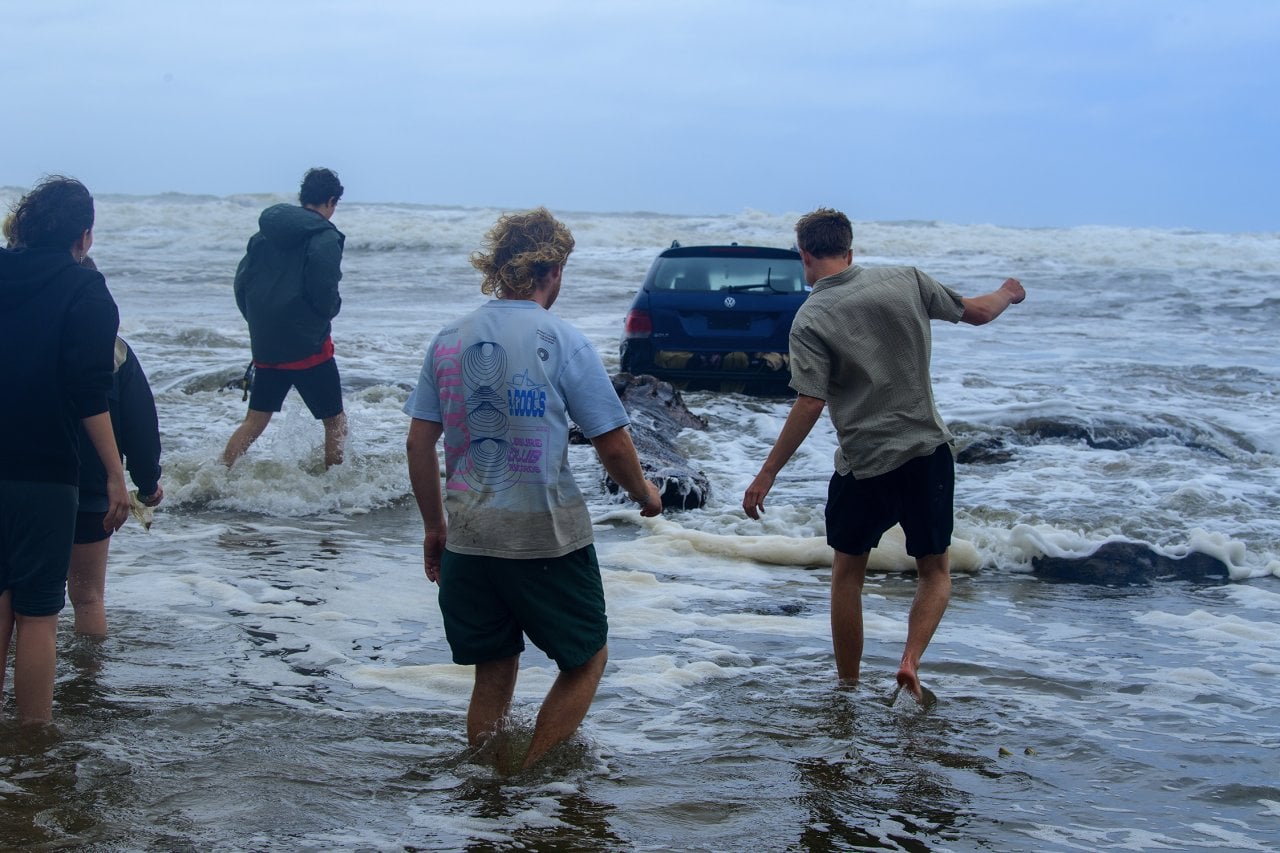
As I went about cleaning up the trees and other damage caused at the farm, I felt as if I was somehow on borrowed time. A few days later, my son messaged to say that the rivers flowing into the sea from the Otway Ranges had suddenly and unexpectedly flooded. Wye River and Lorne, towns we have visited and lived in, were inundated. The devastation was revealed as I drove into Lorne that week. The languid summer holidays of the past were washed into the sea. Cars floated into the Southern Ocean. The campsites were a tangled mess of barbecues, chairs and mud.
I walked to the beach, where the Erskine River meets the sea. It was empty. Neat piles of debris lined the high tide mark. To my great surprise two hooded plovers came into view, running as they do across the sand. They are an endangered species and we all do our bit over summer to care for these birds that unwisely choose to breed on the beach. Further along lay a nautilus shell, in the sand and in perfect condition. It was a rare find that brought, with the plovers, some joy to an otherwise dark week.
I sat in the sun that evening reading The Science of Destiny. I am not a mathematician or physicist and some of the language and sources Ransford relies on are new to me, but as I delved into his thesis a unifying principle of the order that governs our lives emerged. The science or principles are, in his opinion, the rules of mathematics.
Ransford argues that these principles are not labels or language created by humanity but rather have an independent life. They explain the origin of the existence of the universe and they govern our lives. For example, in the absence of two objects, such as the plovers on the beach, the rule that one plus one equals two will still exist. The rules are immutable pieces of information, which exist independently of what we observe.
Ransford goes on to state that this fundamental truth is variously called by humanity God, the source, the one, universal consciousness and numerous other terms and beliefs. These beliefs are the gods detailed in Paul Ham’s history of the mind and are the spiritual foundation of human existence.
Ransford argues that from the standpoint of the universe that created us, our individual purpose in life is to keep growing in knowledge and wisdom. He states that wisdom is endless and knowledge may continuously expand as destined by the universe we occupy. He describes this as the spiritual purpose of life. He further argues that for some there is what he calls the materialistic purpose of life, whose origins reside in life’s fundamental need to replicate itself. Plainly enough, these two purposes play out in the conflicts we see in our lives today and in climate change.
Ransford goes on to ask, why, if there is a universal consciousness, does the universe not intervene to address the destinies of tragedy and destruction, such as we have witnessed this summer, both in the natural and human world. One explanation he offers is that the universe has a use-by date far beyond our imaginations and, further, that
the answer to this question may never be ours to know.
Despite the lack of an answer, Ransford explains that individuals may arrive at an “Omega Point”: the place where individual consciousness has perfected itself by less reliance on the world of materiality, striving for an evermore spiritual state of being. A person grows in wisdom in the material world by understanding that no issue will be resolved from the environment in which the issue arose.
It seems clear that the challenges this summer has revealed require a wisdom that engages with human destiny beyond the simplistic debates of mainstream politics. The horrific murders at Bondi and the extremes of the climate we now continually experience have profoundly changed Australia. The irreconcilable purposes of human life, identified by Ransford, have again brought us to a fork in the road.
I returned to the farm and prepared for the next wave of fire. We attended a crowded CFA meeting at the local pub, dealing with the ongoing risk. The discussion concerned the capacity of emergency services to respond to the catastrophic fires with which we all now live.
We left the meeting contemplating all that has happened this summer and what destiny holds for these lands.
This article was first published in the print edition of The Saturday Paper on January 31, 2026 as "Destiny and disaster".
For almost a decade, The Saturday Paper has published Australia’s leading writers and thinkers. We have pursued stories that are ignored elsewhere, covering them with sensitivity and depth. We have done this on refugee policy, on government integrity, on robo-debt, on aged care, on climate change, on the pandemic.
All our journalism is fiercely independent. It relies on the support of readers. By subscribing to The Saturday Paper, you are ensuring that we can continue to produce essential, issue-defining coverage, to dig out stories that take time, to doggedly hold to account politicians and the political class.
There are very few titles that have the freedom and the space to produce journalism like this. In a country with a concentration of media ownership unlike anything else in the world, it is vitally important. Your subscription helps make it possible.
Subscriber exclusive
Send this article to a friend for free.
Share this subscriber exclusive article with a friend or family member using share credits.