Film
Josh Safdie’s kinetic sports odyssey, Marty Supreme, is both distinguished and slightly undone by its monumental lead. By Keva York.
Timothée Chalamet brings swagger to Marty Supreme
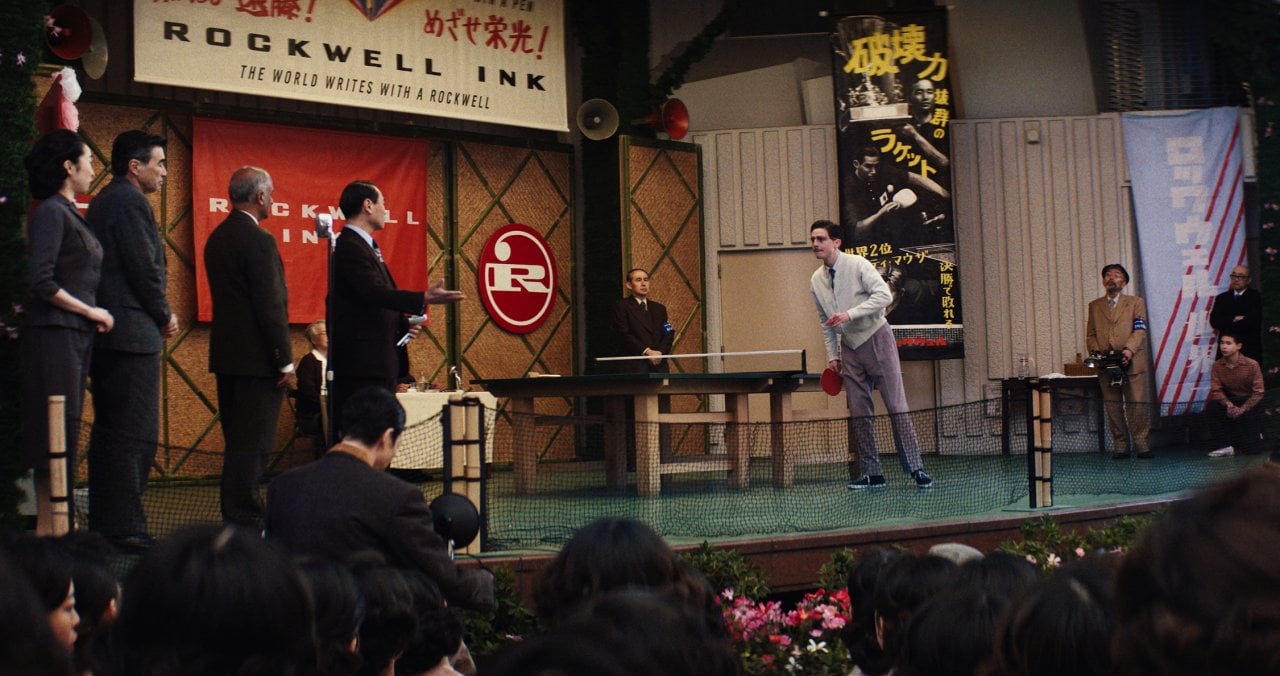
“I have a rule I always follow,” wrote Marty Reisman, table tennis prodigy and inveterate hustler, at the outset of his rollicking 1974 autobiography, The Money Player. “I bet only on myself.”
It’s perhaps a sounder ideology than it is a financial strategy – not to mention, extra-legal. Reisman recounts an incident at the 1945 United States Championships, when prior to his quarter-finals appearance he approached the man he believed to be his bookie, clutching a $500 wad.
“Here’s some more money I want to put on myself,” he said. “Young man,” came the aghast reply. “I happen to be the president of the United States Table Tennis Association.”
Reisman would still play in the quarter-finals – but not before he’d located the real bookie and, unfazed by his blunder, put his money down. Post-match, he was marched off the premises by the police. He was not suspended, because he was only 15 years old at the time.
Via The Money Player, the so-called “bad boy of ping-pong” provided the blueprint for Marty Supreme. Josh Safdie’s adrenalised sports odyssey riffs on Reisman’s international exploits and the sport’s ragtag mid-century milieu – headquartered at Lawrence’s, the dingy but hallowed hall in midtown Manhattan that served as a de facto national proving ground.
For all its many moving parts and famous faces, the film is in effect a monument to Timothée Chalamet’s Marty Mauser. The freshly Golden Globe-anointed star imbues this Reisman-esque ping-pong wizard with an irascible, skinny NYC kid swagger. His performance hits a synergistic sweet spot somewhere between the DiCaprio of Catch Me If You Can and the De Niro of Mean Streets. Yet the film, while frequently dazzling, suffers a little for this surfeit of self-possession. A monument cannot permit vulnerability, but a drama must.
Like Howard Ratner of Uncut Gems or Good Time’s Connie Nikas, Marty is a quicksilver monomaniac in what’s become an identifiable Safdie-verse – a reckless opportunist who at any given moment knows his goal and his next move and nothing of the in-between. Marty’s mandate is global table tennis domination, and he’s got the chops. It’s everything else that’s against him. For starters, the world championships are in London and he’s stuck hawking shoes at his uncle’s store on the Lower East Side, without a plane ticket nor the means to buy one, thanks to his uncle holding out on his wages. But neither family bonds nor legal ones can deter Marty, who proceeds to stick up his workplace.
Call it “one paddle after another”. Safdie’s first directorial venture without brother Benny in 18 years extends the model of kinetic, serio-comic urban picaresque that put the duo up there with present-day America’s most exciting filmmakers – more so than Benny’s solo debut last year, The Smashing Machine, also a sports drama about a man who thinks he was born to win, but in a markedly lower gear.
This likely has a good deal to do with the elder Safdie getting most of the key collaborators in the fraternal divorce: not only Ronald Bronstein, their co-writer and editor since their 2009 joint directorial debut, Daddy Longlegs (in which Bronstein also starred), but also renowned cinematographer Darius Khondji, who shot Gems, and Daniel Lopatin, aka Oneohtrix Point Never, whose coruscating ’80s-flavoured synth score works to warp Marty’s supremely rich evocation of the early 1950s. (The music tells us that Mauser is ahead of his time, like another notable Marty. Recall Michael J. Fox’s rockin’ rendition of “Johnny B. Goode” in Back to the Future: “I guess you guys aren’t ready for that yet… But your kids are gonna love it.”)
In comparison to Good Time and Uncut Gems, however, Marty Supreme is a veritable blowout, unfurling over the course of several years and between many countries. Working his way towards an inevitable showdown with his rival, Koto Endo (played by real-life pro Koto Kawaguchi), Marty ricochets from the lowly tenement he shares with his mother (Fran Drescher) to the Ritz in London, and on to Paris, Giza and Tokyo by way of a couple hair-raising jaunts to New Jersey.
In his wake trail kvetching family members and appalled table tennis officials, plus a devoted hometown lover (Odessa A’zion) whose pregnancy is no fault of her husband. There’s also another married paramour, a restless retired movie star (Gwyneth Paltrow, coldly luminous), along with her husband, a mercenary ink magnate (Kevin O’Leary), and a vengeful, canine-loving gangster, played with relish by none other than the lumpen don of independent New York cinema, Abel Ferrara.
Undoubtedly the most ambitious project in the Safdies’ combined catalogue, Marty Supreme is also the most expensive film produced by A24 to date, with a reported budget of between US$60 million and US$70 million. Add to this a marketing kitty capacious enough to keep a Marty-branded hot-orange blimp airborne in American skies – a gaseous augur of awards season – and to support Chalamet’s ascension to the top of the Las Vegas Sphere, from which he extols the film’s tagline “DREAM BIG”.
Is Marty’s dream big? Though he pursues it in grand style, it renders him totally tunnel-visioned – all he can do is follow the bouncing ball. To the extent that the film belongs to Chalamet, it can feel frustratingly narrow in its scope. Almost every member of the incredible cast – a Rolodex of notable names and/or faces, plucked from the streets and the worlds of sports, fashion and music as well as film and television – feels underused or, in the case of A’zion’s Rachel, underwritten, despite her winningly spunky performance. The great Sandra Bernhard has perhaps two lines. Ferrara admittedly has more to do but to less effect than in his cameo as a crook in Daddy Longlegs. And Marty, for all his range at the ping-pong table, isn’t the most dynamic character – after all, he’s always going to bet on himself.
When in the film’s final act Marty does come undone, bending to some kind of redemptive arc – more of a swerve, really – I found myself thinking about the ending of Stanley Kubrick’s A Clockwork Orange, another film about a charismatic young sociopath, also marketed with a Pantone shade of pumpkin.
Much to author Anthony Burgess’s displeasure, Kubrick famously snubbed the book’s final chapter, closing his adaptation with the renewal of Alex DeLarge’s lurid fantasies rather than his novelistic counterpart’s transcendence of them. With apologies to Burgess, Kubrick was right: to punctuate the barrage of ultraviolence with a burst of sentimentality is actually the more cynical move. In the case of Marty Supreme, the knowledge that both character and star are consummate salesmen should make anyone wary of buying in.
This article was first published in the print edition of The Saturday Paper on January 31, 2026 as "One paddle after another".
For almost a decade, The Saturday Paper has published Australia’s leading writers and thinkers. We have pursued stories that are ignored elsewhere, covering them with sensitivity and depth. We have done this on refugee policy, on government integrity, on robo-debt, on aged care, on climate change, on the pandemic.
All our journalism is fiercely independent. It relies on the support of readers. By subscribing to The Saturday Paper, you are ensuring that we can continue to produce essential, issue-defining coverage, to dig out stories that take time, to doggedly hold to account politicians and the political class.
There are very few titles that have the freedom and the space to produce journalism like this. In a country with a concentration of media ownership unlike anything else in the world, it is vitally important. Your subscription helps make it possible.
Subscriber exclusive
Send this article to a friend for free.
Share this subscriber exclusive article with a friend or family member using share credits.