News
One Nation was the first Australian political party to register a website. Now, the party is poised to exploit AI ‘slopaganda’ in the 2028 election campaign. By Anna Broinowski.
Pauline Hanson and the AI ‘slopaganda’ election
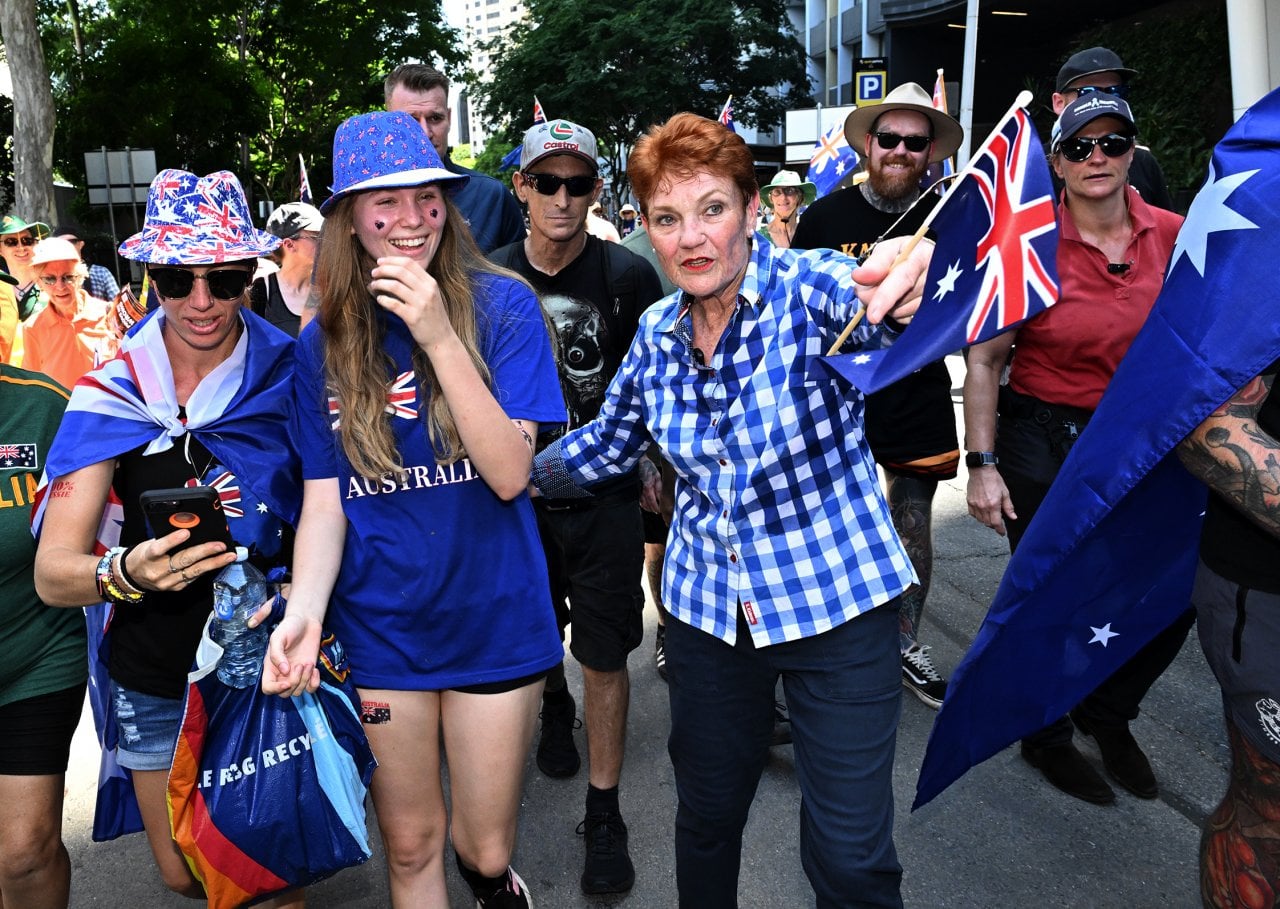
Pauline Hanson may be feeling a certain schadenfreude over the Coalition’s spectacular implosion. For decades, the Liberal and National parties have worked to keep the One Nation leader on the margins while co-opting her policies and rhetoric.
In 1996, Hanson, a disgruntled Ipswich fish and chip shop owner and independent MP, divided the nation with her first speech to parliament, in which she claimed Australia was “in danger of being swamped by Asians”. The Coalition was quick to harness her populist appeal with white, working-class voters angry about multiculturalism, privatisation and Indigenous reforms, using the conversation to advance its own agenda on race, immigration and the culture wars.
John Howard, who shares Hanson’s ideological allegiance to the pre-woke, Anglo Australian values of the 1950s, won four federal elections by skilfully capitalising on One Nation policies and preferences, while publicly distancing himself from Hanson’s incendiary politics.
Hanson first became a major political force when One Nation won 11 seats in the 1998 Queensland election. With Hanson threatening the LNP’s national base, a group of conservative powerbrokers led by Liberal MP Tony Abbott bankrolled a case that saw her jailed for electoral fraud in 2003. Hanson, who prides herself on her honesty, spent the first night in her cell on suicide watch. When she emerged for a meal, the inmates served her fish and chips.
Her electoral fraud conviction was overturned on appeal.
Now, two decades later, One Nation is polling ahead of the Coalition on primary votes for the first time. The Liberals are paralysed by an existential crisis, with intractable, Abbott-era strongmen seemingly unable to address 21st century voter concerns – climate action and socioeconomic equity among them. The Nationals’ hackneyed “party of the bush” brand is rupturing under a push to ape Hanson’s hard-right policies and the conflicting interests of global mining corporations and domestic farmers.
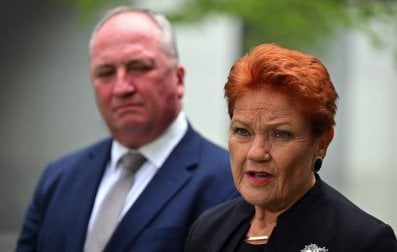
One Nation, unsurprisingly, is filling the void left by the LNP’s self-immolation. To rural and regional voters unconvinced by the progressive, pro-environment values of predominantly urban teals and Greens, Hanson and her new, anti-net zero lieutenant, Barnaby Joyce, present a clear and unambiguous choice. Some pundits are already predicting One Nation, bolstered by the straight-talking charisma of its renegade leaders, could be in federal opposition after the 2028 election.
Hanson must be relishing the irony. She is not a feminist but maintains a righteous anger against what she calls the “boys’ club” that banished her from power from 1998 to 2016.
Hanson’s “Fed Up” 2016 election campaign was mostly ignored by the major parties and political media, who dismissed her as a serial candidate. It delivered her to the Senate the same year another anti-establishment populist became president of the United States. Hanson toasted Donald Trump’s victory on Parliament House’s forecourt with her chief of staff, James Ashby. Confounded by Hanson’s shock resurgence, commentators labelled her “the Australian Trump”. She pushed back, insisting Trump “is like me”.
Hanson had a point. A self-styled political outsider, she was ending “left-wing elites” on behalf of her underdog battlers long before Trump left reality television to “drain the swamp” in Washington. She pre-dates the US president’s voracious use of social media as a political tool by three decades. One Nation was the first Australian party to own a website and Hanson the first Australian politician to bypass “biased” mainstream media with online blogs. Pre-empting Trump, she has consistently harnessed new digital platforms to weaponise her rejection by the status quo and attract more followers.
During One Nation’s 2016 election campaign, Hanson and Ashby expanded their online army through impassioned YouTube interactions with Far North Queensland’s “forgotten people”. For the 2025 election, the party upgraded its politics-as-entertainment strategy with South Park-style animations, racking up 485,000 Facebook views for satirical clips of bird-killing wind turbines, non-binary lefties and evil Greens.
This week, on Australia Day, One Nation launched its first feature film, A Super Progressive Movie – a Rabelaisian fever dream about a “white, cis-gendered male” battling diversity, equity and inclusion forces hell-bent on destroying him and everything sensible Australians apparently hold dear.
Right-wing AI “slopaganda” is already normalised in the 24/7 news cycle under Trump. The possibility that One Nation’s similarly pernicious persuasion tactics could win votes in 2028 is increasingly real. Prime Minister Anthony Albanese recently cautioned against the chaos and division generated by a Hanson-led resurgence. Joyce, before abandoning the Nationals, declared “there’s no votes in the centre”. The race to the middle that typifies Australia’s two-party campaigns could look very different in a Labor versus One Nation election.
With One Nation as its opponent, Labor may be forced to align more closely with the teals and Greens. Voters, perhaps for the first time since Gough Whitlam’s 1972 campaign, would face starkly opposing choices: between net zero on one side and One Nation’s push for more coal on the other; between pro-immigration, pro-diversity policies, and a Trump-style ban on Muslims and other migrants Hanson views as “incompatible”.
This would be a contest between fighting domestic violence and resurrecting laws traditionally favouring men; between reducing guns and increasing them; between reproductive autonomy and an anti-abortion, heteronormative ideology; between environmental protection and a red tape-free rollout for developers, miners and nuclear power.
In this new normal, the few policies Labor and One Nation potentially share include restricting foreign ownership, maintaining public healthcare and schools, and strengthening multinational taxes. Both parties currently support the US alliance. Whether Labor can move to distance Australia from its unreliable, globally polarising ally is now a pressing concern.
With democratic and international systems under daily assault by Trump’s move-fast-and-break-things leadership style, perhaps a more urgent question is not if One Nation can win opposition in 2028 but how easily the algorithmic alliance between Big Tech and social media could make this happen – and what this could mean for Australia more broadly.
In his seminal speech at Davos last week, Canadian Prime Minister Mark Carney urged middle powers to divest from the US, warning “if you’re not at the table, you’re on the menu”. Hanson, who addressed Trump’s CPAC conference last year, may be happy continuing Australia’s loyalty to an autocratic rogue president who bombs, infiltrates and annexes sovereign nations for resources and land, but the Albanese government would be wise to take note. The $368 billion AUKUS deal severs Australia’s hard fought-for nuclear ban and locks the country into potential future conflicts led by the world’s biggest military superpower.
Trump’s political and military ambitions are supported by the Big Tech broligarchy, who circulate right-wing deepfakes, surveillance data and AI abuse tools with impunity, protected by the US Communications Decency Act, which exempts digital platforms from the criminal liabilities accorded to legacy publishers. Now, thanks to the escalating power of generative AI, the algorithmically targeted political advertising that helped swing the 2016 Brexit vote and turbocharged Trump’s three presidential campaigns is about to go nuclear.
New research predicts the 2028 US election – and by extension, Australia’s – could be deluged by AI “bot swarms”. These agentic AIs create undetectable, synthetic social media accounts that generate thousands of personally tailored political messages instantaneously, interacting with voters in
real time.
Hanson, an early technology adopter who understands digital media elections are often won on “feels” rather than “facts”, is perfectly positioned to exploit this looming info apocalypse. One Nation could wage a campaign straight out of the Trumpian playbook, deploying AI swarms to attack opponents, polarise voters, chill free speech, weaponise division and swing Australia massively to the right.
Given what’s at stake, it would be a national tragedy if One Nation is the only party to capitalise on the Coalition’s demise. Hanson, like any populist, appeals to voters disenfranchised by the status quo. While her early political instincts skewed more to old-school Labor egalitarianism than the neoliberalism of the LNP, she has evolved into a seasoned hard-right warrior, using race-baiting and hate speech to exploit the reductive social media binaries that now dominate political discourse.
The void is there to be filled – by a different kind of populist, who can beat Hanson at her own game. Perhaps in 2028 Australia will see the rise of a homegrown Zohran Mamdani, Alexandria Ocasio-Cortez or Bernie Sanders, a leader charismatic enough to persuade voters that net zero is good for farmers, that fossil fuels serve only corporate and military interests and that Australia is mature enough to hold its own as a middle power. Hanson is banking on a digital campaign that persuades voters of the exact opposite.
This article was first published in the print edition of The Saturday Paper on January 31, 2026 as "Racist to the bottom".
For almost a decade, The Saturday Paper has published Australia’s leading writers and thinkers. We have pursued stories that are ignored elsewhere, covering them with sensitivity and depth. We have done this on refugee policy, on government integrity, on robo-debt, on aged care, on climate change, on the pandemic.
All our journalism is fiercely independent. It relies on the support of readers. By subscribing to The Saturday Paper, you are ensuring that we can continue to produce essential, issue-defining coverage, to dig out stories that take time, to doggedly hold to account politicians and the political class.
There are very few titles that have the freedom and the space to produce journalism like this. In a country with a concentration of media ownership unlike anything else in the world, it is vitally important. Your subscription helps make it possible.
Subscriber exclusive
Send this article to a friend for free.
Share this subscriber exclusive article with a friend or family member using share credits.