Theatre
Sydney Theatre Company’s adaptation of The Talented Mr. Ripley is an entertaining two hours that comes with a geniunely unexpected twist. By Cassie Tongue.
Joanna Murray-Smith’s adaptation of The Talented Mr. Ripley
Ever since Patricia Highsmith wrote The Talented Mr. Ripley in 1955, audiences have been fascinated by his exploits. From a low-level New York scam artist – bored and despairing over his lot in life – to a wealthy and highly cultured European expat, Tom Ripley slowly improves his station with a little bit of murder. Perhaps he’s so compelling because, at heart, Ripley is engaged in a high-stakes and uncompromising pursuit of pleasure and privilege: his capers are drenched in fine art, classical music and expensive wine.
It helps that Highsmith folds tension into her Ripley plots like a love letter to the emotion: as the pressure of a scheme ramps up, Ripley’s heart pounds, his cheeks flush and sometimes he even breaks into sudden giddy laughter. Killing makes him more alive.
No wonder his adventures – five Ripley novels were published between 1955 and 1991 – have been told and retold, including the 1999 Academy Award-nominated film adaptation starring Matt Damon as Tom Ripley and a buzzy 2024 Netflix series where Andrew Scott took on the role of the killer.
Ripley is also no stranger to Australian stages. In 2014, Joanna Murray-Smith’s electric play Switzerland followed author Highsmith as her European seclusion is interrupted by a charming young stranger – or is it her beloved Ripley come to life? Like Highsmith, Murray-Smith can’t say goodbye to her favourite murderer. A decade later, she’s back with The Talented Mr. Ripley: a more straightforward adaptation, this time focused on the first and most famous Ripley novel.
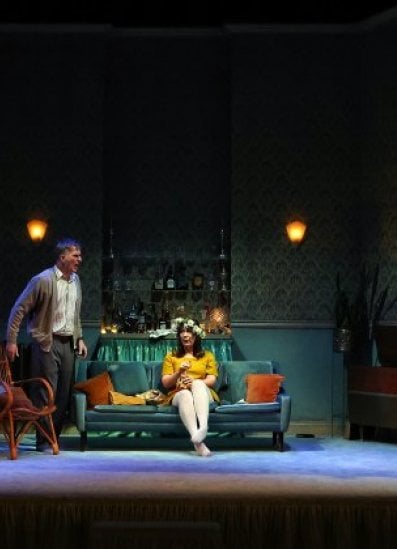
Paired again with director Sarah Goodes, who made a taut and tantalising thrill-ride out of Switzerland (the pair also collaborated on Julia, the successful and widely toured play about former prime minister Julia Gillard), this production plays on a sense of artifice. When we first meet Tom (Will McDonald), the Roslyn Packer stage is grey and nearly empty. But when he crosses paths with Herbert Greenleaf (Andrew McFarlane), the rich and powerful father of Dickie (Raj Labade), a vague acquaintance of Tom’s, the story begins to be rounded out with flown-in set pieces and props – bar stools, glasses, even spotlights – that illustrate how Ripley remakes reality.
Herbert has come to ask Tom, who he believes is a real friend of Dickie’s, to return his prodigal son from his life of leisure in Italy to take over the family business. Time is of the essence, he explains: Dickie’s mother is sick and it’s time for the boy to grow up. Tom is more interested in the all-expenses-paid escape to Europe from his crummy apartment than he is in the mission, but he accepts.
Tom is also interested in Dickie. Highsmith, who also wrote The Price of Salt (retitled as Carol, the name of Todd Haynes’s 2015 film adaptation), had a complicated relationship with her own sexuality and loaded the Ripley stories with homoerotic subtext. In 2025, it makes sense to turn this implicit suggestion into explicit expression. Goodes, Ripley and lighting designer Damien Cooper all linger on Dickie – his shirtless physique, how he seems to glow in the Italian sun, how he stands and sits just so, a study of attractive shapes. Ripley points out that you can’t help but fall for Dickie Greenleaf, and he has fallen hard. Never mind that Dickie has something going on with Marge (Claude Scott-Mitchell), a writer who is in Ripley’s way from the start. Ripley is determined to get what he wants.
When he doesn’t get it, the solution is death. It’s a turning point in the novel and the play. Although it runs for two hours without an interval, this is the event that pulls us distinctly into a new act. From here, it’s all about the agony and ecstasy of what it means to get away with murder. Murray-Smith’s witty, conspiratorial tone has already made us accomplices, so it’s easy to lean in and get invested. Will Ripley – will we – make it out in one piece?
Murray-Smith is a talented craftsperson: her scripts are generally well-constructed and efficient and her characters experience clear arcs. The shape and structure of the play is confident and solid and, up until the final moments, a faithful interpretation of the source material. She and Ripley are building this world for us before our eyes – he breaks the fourth wall repeatedly, celebrating his wins with us – and with McDonald as Ripley, it’s a delight.
He’s particularly captivating in opposition: we spend much of the runtime painfully aware, through McDonald’s posture, phrasing and patterns of speech, that he does not and cannot fit in with Dickie’s casual luxury; he is too eager and effortful on this moneyed Italian playground. It stings when he’s rejected and we can’t help but feel triumphant when he begins to relax into himself – or rather, into his new identity as Dickie Greenleaf.
Hard sacrifices are made to keep the story fast-paced, action-packed and interval-free, and this lessens the intensity of the ride. We rarely see Marge as anything other than the stick-in-the-mud Ripley perceives her to be, though it’s clear and interesting that she sees right through him immediately. Some key character transformations in the latter half of the play are also rushed.
The production is not as strong as the script at its best. It’s so obsessed with assembling and dismantling scenes to prove their flimsiness that it ends up feeling like a flimsy world. The actors are all we have to keep the story grounded and, with such heightened stakes, that’s a near-impossible task. It’s hard not to long for a fuller, more detailed production, packed with all the things Ripley craves so we can crave them too – the sights, the beautiful clothes, the food and wine, the cultured conversations.
It feels almost like a relief when a late set-change fills in a hotel room and keeps it in place long enough for us to feel its personality and how its class indicators change the behaviours of its guests. Ripley loves things: he makes sense among them. It’s as if we’re stranded without them. Still, the minimal set, by Elizabeth Gadsby, has a couple of sudden delights – the space Ripley occupies expands or contracts according to his mental state and the slide of a wall closing in when Ripley’s peace is threatened is neatly effective.
It’s an entertaining two hours – there are plenty of easy laughs, chatty scenes that feel like overhearing gossip, and pleasingly confident performances. We don’t often get to spend time enjoying Highsmith’s favourite mood – that lingering, horrible, lovely tension. In the play, it tends to ramp up in a heady haze, only to diffuse just as quickly. But then, when we’ve almost made it out alive, Murray-Smith invents a new ending.
This twist shouldn’t be spoiled – it’s a big swing that doesn’t quite work but is genuinely surprising and provides the most successful and spine-tingling moment of tension in the whole production. There’s a winking audacity to it: it’s as if Murray-Smith and Ripley are telling us to be careful what we wish for – if we want tension, we’ll have to pay for it in blood.
The Talented Mr. Ripley is playing at the Roslyn Packer Theatre until September 28, then Art Centre Melbourne from October 28.
This article was first published in the print edition of The Saturday Paper on August 30, 2025 as "Deadly obsession".
For almost a decade, The Saturday Paper has published Australia’s leading writers and thinkers. We have pursued stories that are ignored elsewhere, covering them with sensitivity and depth. We have done this on refugee policy, on government integrity, on robo-debt, on aged care, on climate change, on the pandemic.
All our journalism is fiercely independent. It relies on the support of readers. By subscribing to The Saturday Paper, you are ensuring that we can continue to produce essential, issue-defining coverage, to dig out stories that take time, to doggedly hold to account politicians and the political class.
There are very few titles that have the freedom and the space to produce journalism like this. In a country with a concentration of media ownership unlike anything else in the world, it is vitally important. Your subscription helps make it possible.
Subscriber exclusive
Send this article to a friend for free.
Share this subscriber exclusive article with a friend or family member using share credits.