Music
Audrey Hobert’s debut album, Who’s the Clown?, is an unlikely hit full of mundane yet surreal detail that’s weirdly endearing. By Shaad D’Souza.
Audrey Hobert’s bizarre and discomforting debut album
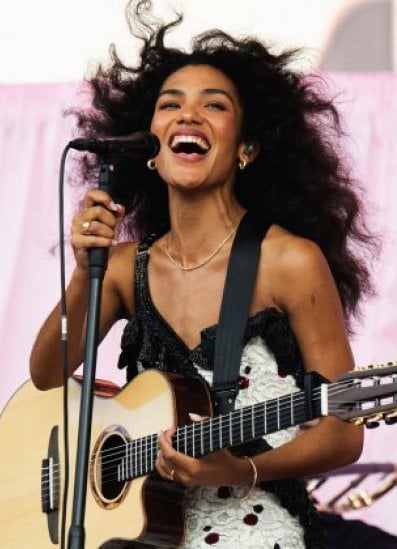
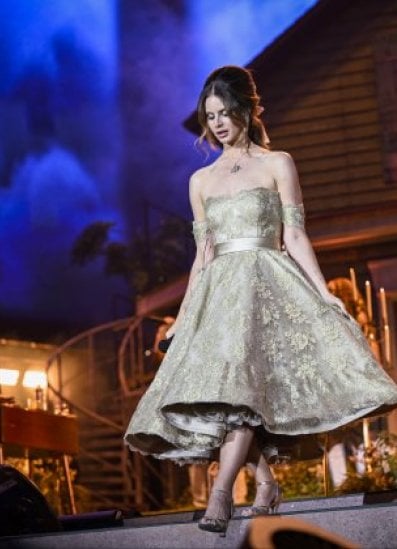
Who’s the Clown?, the debut album by Los Angeles-born and raised singer-songwriter Audrey Hobert, is bizarre and discomforting and all the better for it – a hybrid of mercenary songwriting instinct, unfiltered emotion and banal detail that gelatinises in its own strange way into one of the year’s most surprisingly delightful records. It’s difficult to explain what makes the 26-year-old so unique and exciting without quoting her lyrics, which often smash together examples of the quotidian and the totally batshit in a way that recalls a toddler smashing together two trucks.
Her single “Bowling alley”, for example, is a narrative about deciding to spend the night at home because she – the narrator in these songs, even when fictitious, is always implicitly some version of Hobert – had a shitty day at work. She’s wallowing at home when, “through the trees” outside her window she sees a party at a bowling alley, which she was invited to and forgot about. She goes to the party, hits a strike, is celebrated by the patrons at the alley and then, looking back through the trees into her room, she sees she left a candle burning. So she goes home to blow it out.
There is a loose emotional thread to the song – it ends with Hobert musing that “it doesn’t need to be about me all the time” – but mostly it is about bowling. Most mainstream pop songs aren’t this specific, this strange and this laissez-faire in terms of their willingness to be free-form and esoteric. Who’s the Clown? is often in this exact zone – loose, experimental-ish and totally, madly catchy. And it is mainstream: Hobert is clearly one of 2025’s breakout stars, with her single “Sue me” finding traction on TikTok. Anecdotally, it feels like a lot of people I know, including those usually uninterested in pop, have actually taken the time to listen to Who’s the Clown?
Hobert charted an interesting path to her debut album. The daughter of a Los Angeles television writer, she was on track to become a scriptwriter herself until she co-wrote a handful of songs with Gracie Abrams, the daughter of director J. J. Abrams and her childhood best friend. One of those songs, “That’s So True”, took off, becoming an international chart hit in 2024, and Hobert began performing songs with Abrams on occasional stops of her arena tour in 2024 and 2025. Her brother, Malcolm Todd, is also a musician who has appeared on the American charts. So, is she a nepo baby, nepo sister, nepo bestie? The current climate is geared against giving Hobert full credit for her record deal with RCA, a subsidiary of Sony, and to be fair, her connections in life have given her a clear advantage.
It is hard for me to really feel anything other than grateful for that, given what a joyful and entertaining experience it is listening to Who’s the Clown?
Full disclosure: it takes a moment to adjust to Hobert’s songwriting style, which can be arch and twee in equal measure. Take, for example, the opening lines of the album: “I had a thought / What if somebody asked me / What do you like to do? / Well, I’d pretend to think, then I’d say / I like to touch people.” The whole thing is delivered in a very American accent over an easy, extremely hi-fi guitar groove – almost like a Wheatus song or something – but it never feels as if Hobert is trying to make a joke or singing with any real sense of irony. Later, on the chorus of “Thirst Trap” – about, you guessed it, trying to take a good thirst trap – she sings: “I’m taking thirst traps in the mirror in my room / I think I look bad, so I change the lighting.”
It’s a level of detail that is both infuriating and endearing – if all our lives are basically out in public now, because of social media and high-density housing and overcrowded roads and constant surveillance and so on, then why not write songs about the most boring but weirdly real parts of them? Hobert’s lyrics scan as slightly simplistic, but I think they might be more self-aware and thought-out than a lot of other contemporary pop music.
I’ve written before about the ways in which hyperspecificity and literalism have sucked the fun out of pop – specifically when I reviewed boygenius’s The Record a couple of years back – and when I heard Hobert’s debut single “Sue me”, I initially thought that she fits into that paradigm. I was wrong. Who’s the Clown? actually fixes that form: Hobert writes with such minute detail that her music begins to feel surreal and, unlike Phoebe Bridgers, who popularised this new strain of lyric writing, she doesn’t fill her songs with ham-fisted attempts at metaphor or overwrought images. By keeping her writing totally ground-level – and often confined to a single location or scene – Hobert creates the image of herself as a true diarist, someone free-associating humiliations and funny anecdotes and setting them to slick, tightly written melodies.
This tightness is a key element of Hobert’s style – she did work, after all, as a songwriter for hire and you can really hear it. “Shooting star” may feature one of the album’s most inscrutable narratives, but she makes it work with a chorus that’s rhythmic and ingratiating. “Sue me” is slightly unsavoury in its desperation, but Hobert makes its story of cajoling an ex into one more fling sound anthemic and euphoric. The best song here, “Silver Jubilee”, wouldn’t work in most scenarios: it’s an electro-pop song that uses rap convention (“I’ma pour one out”) to tell a story about getting drunk at home with your friends and siblings. It’s awkward and silly, but Hobert has a knack for making total-mouthful lyrics sound absolutely natural and for making you want to sing them yourself. (Which, trust me, is actually much harder than it seems.)
Is Who’s the Clown? a bellwether for where pop is going to go next? I doubt it – what Hobert does is too specific and too oddly skilled for anyone to seriously emulate it in a way that would feel natural.
With any luck this album will find a foothold in some mainstream zone, if only to make the charts feel less homogenous and more idiosyncratic. But that might be a far-fetched dream – maybe even the kind of boring fantasy Hobert would write a song about.
This article was first published in the print edition of The Saturday Paper on August 30, 2025 as "Everyday fantasies".
For almost a decade, The Saturday Paper has published Australia’s leading writers and thinkers. We have pursued stories that are ignored elsewhere, covering them with sensitivity and depth. We have done this on refugee policy, on government integrity, on robo-debt, on aged care, on climate change, on the pandemic.
All our journalism is fiercely independent. It relies on the support of readers. By subscribing to The Saturday Paper, you are ensuring that we can continue to produce essential, issue-defining coverage, to dig out stories that take time, to doggedly hold to account politicians and the political class.
There are very few titles that have the freedom and the space to produce journalism like this. In a country with a concentration of media ownership unlike anything else in the world, it is vitally important. Your subscription helps make it possible.
Subscriber exclusive
Send this article to a friend for free.
Share this subscriber exclusive article with a friend or family member using share credits.