News
The government has given ‘unprecedented’ time to Barnaby Joyce’s net zero bill weeks before it must deliver a new midterm emissions reduction target. By Karen Barlow.
Labor ‘playing politics’ with Joyce’s net zero bill
On July 31, the Labor-led committee that decides the order of the proceedings in the House chamber, and the time allotted for bills, met in a private session to insert 20 minutes of debate into this week’s parliamentary session.
The time was set aside for a specific bill, one Labor believed would create a significant distraction and stoke division within the Coalition: Barnaby Joyce’s self-descriptive Repeal Net Zero bill 2025. The change allowed for a minimum of four speakers at five minutes each.
Three other crossbench private member’s bills, including Zali Steggall’s proposed legislation to establish a national climate change adaptation framework, would now follow the Joyce bill. Each was given half the time and presenters were allowed only one other speaker to second their effort.
“They’re giving up their time to allow Barnaby Joyce to speak about net zero. That is pretty much, far as I know, very unprecedented,” a Liberal MP who supports net zero tells The Saturday Paper.
“When every chance to speak on behalf of your community is valuable, they’re choosing to take away the opportunity for their members to talk about things that matter to them, to allow Barnaby Joyce to talk about what matters to him.
“They’re just playing political games. The government talks about the need for certainty for investors. They’re deliberately driving uncertainty in the conversation.”
Private member’s bills are rarely debated beyond a brief introduction and very rarely pass into law.
The Saturday Paper has analysed the 298 private member’s bills presented to the House of Representatives since the start of the Abbott government in the 44th Parliament.
Only 18 of the bills were allowed to be debated further in a second reading debate and just two, on marriage equality and territory rights, passed into law.
There have been 33 climate-related private member’s bills since the start of the 44th Parliament. None were given time to debate beyond the introduction. There was no debate on various bills by former Greens leader Adam Bandt to either ban coal or place a moratorium on new coal, gas and oil.
Efforts by Indi independent Helen Haines and her predecessor, Cathy McGowan, to create more community energy projects through the Australian Renewable Energy Agency, introduce cheaper home batteries and establish an Australian Local Power Agency to support the development of community energy projects also went undebated.
Some Coalition figures say Labor is motivated by cynicism in giving so much time and prominence to Joyce’s bill.
“Labor are playing politics brilliantly,” the member for Cook, Simon Kennedy, tells The Saturday Paper. “Energy prices are skyrocketing, emissions are flat and they’re failing on renewables targets – but somehow Labor has distracted the public from this. They know how to distract the public with one hand while the other completely fails to deliver anything. It’s smoke and mirrors – all slogans, no substance.”
Climate Change and Energy Minister Chris Bowen said the debate was “very legitimate”. The leader of the House, Tony Burke, said he was “surprised we’re still having this debate, but I don’t intend to censor it”.
“It’s clear from the first week that there are plenty of members wanting to participate in this debate,” he told The Saturday Paper.
Steggall says precious time in the chamber is being wasted by the government’s decision to allow the debate.
“What this is about is Barnaby Joyce is trying to be leader of the Nats again, and so he’s trying to give himself as much prominence,” she says. “The reason why the government is giving him airplay is because it’s great to watch your opponent self-implode and show publicly just how out of touch and dysfunctional [they are]. Unfortunately, the net result for the Australian people is you end up with a sideshow debate.
“His speech is just bluster. That’s why I’ve called it a clown show. There’s no policy. This is purely Barnaby. I mean, I think he’s a mouthpiece for Gina Rinehart. I think if there’s anyone that’s being overtly her mouthpiece, it’s Barnaby.”
Joyce’s private member’s bill is designed to remove Australia’s net zero emissions target, a move more retrograde than previous Coalition governments that had signed the Paris climate agreement and set net zero emissions targets.
While it is not Coalition policy, Joyce found support from Queensland LNP MPs Llew O’Brien and Garth Hamilton.
“We have a government in Australia that is engaging in one of the greatest acts of economic self-sabotage in the history of the nation, pursuing 82 per cent wind and solar targets that are destroying rural and regional Australia,” O’Brien told parliament. “They are tearing our communities apart.
“This is a nightmare that needs to stop … this blind obsession with net zero.”
The bill’s backers were interspersed with two government MPs, Susan Templeman and Ali France, who ridiculed the doomed effort.
“By endorsing Labor’s plan in May, Aussies have made a very clear statement to the world that Australia is the place to do business if you’re looking to use clean energy to create prosperity,” said France, who defeated former opposition leader Peter Dutton in the seat of Dickson. “That is why this bill ... is so bizarre. It goes against the will of the people, and it is anti-business.”
In parliament, Prime Minister Anthony Albanese relished the division highlighted by the bill and the debate that accompanied it. “It’s hard to follow the plot over there,” he said on Tuesday. “The Liberals fighting each other, the Nats fighting each other, the Liberals then fighting the Nats, and when they go to their party conferences it’s everyone fighting the leadership of the Liberal Party and the National Party.”
The Coalition’s post-election position on net zero is that the commitment is, like most other opposition policies, under review and there is an internal process under way.
At the opposition’s joint partyroom meeting, Sussan Ley took questions from seven MPs on the lack of an opposition position on net zero. These exchanges were leaked to the media before the meeting was even over.
“It’s not division. It’s literally people with different opinions, and we can ventilate those, right? That’s just something they don’t do, but we do,” a Liberal moderate tells The Saturday Paper.
“Most people are respectful of that process and understand that actually going through that policy development process is going to bring us the best possible outcome and the best possible decisions in relation to our broader energy policy. The people that are agitating on net zero are agitating on it for their own purposes, and that’s it.”
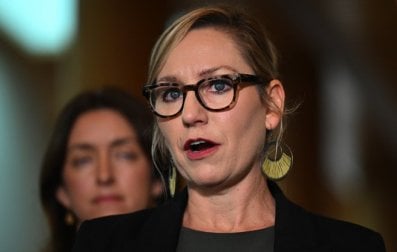
There is division in the Albanese government, too, on climate policy, according to Steggall, the independent member for Warringah. She is waiting to see how it will play out. Steggall says Bowen and assistant minister Josh Wilson are “genuinely doing their best”, but an appreciation of the urgency of climate action is “still not embedded” across the government.
“I think there’s a real tussle happening within Labor,” she says. “I think there’s a generational shift that you have the old guard, like the PM, who is maybe battle-scarred from previous fights over climate, but also where you do have some members [who] I don’t think are completely sold and convinced on what needs to be done to mitigate climate change and how that needs to be done.”
Steggall points to the significant number of first-term MPs in the Labor Party, many of whom she describes as “young, progressive, aware of the challenges and have been elected on a platform that they are going to act on climate change”.
“So, I think the real question is going to be, what is their sway in the party room? Can they move the old guard that still has a foot in each camp.”
The Albanese government is weeks away from announcing a 2035 emissions reduction target. The Climate Change Authority has been consulting on a potential target range of 65 to 75 per cent on 2005 levels. The authority’s chair, Matt Kean, says the recommendation for government is based on a “technically conservative” posture.
“We have commissioned best-in-class economic modelling and performed a line-by-line analysis of emissions reduction potential across all major Australian sectors, informed and tested against submissions and consultations with experts and stakeholders,” Kean tells The Saturday Paper.
“I have approached this task in the same way I approached my role as treasurer in devising the NSW budget. It has been a rigorous, sensible and pragmatic approach to arriving at the target.”
The need for the Albanese government to announce a midterm target comes as pressure is mounting from United States President Donald Trump to relax climate targets and “get back” to fossil fuels.
Trump has moved to wind back significant federal climate action in the US and has threatened tariffs and levies on nations to encourage fossil fuels use. The EU–US trade deal struck last month sees the European bloc agreeing to buy US$750 billion in American energy products, including oil and gas, over three years in return for reduced US tariffs.
The international context is not lost on Kean. He has “taken extra time to consider the appropriateness of this range in light of the election of Donald Trump and a changing geopolitical landscape”.
The Climate Change Authority advice and the government’s response, which will go to cabinet under the Climate Change Act, is expected ahead of the leaders’ week at the UN in New York, which starts on September 22.
Anthony Albanese, expected also to make a declaration at UN headquarters about Australia recognising Palestinian statehood, will be bearing Australia’s update to meet net zero commitments and keep as close as possible to 1.5 degrees of warming agreed to under the 2015 Paris Agreement.
The National Climate Risk Assessment second pass report, a purportedly grim and frightening assessment of what is coming for Australia, will be released in mid-September alongside the target. Climate Change Minister Bowen has confirmed that the National Adaptation Plan will be published at the same time. Climate groups and some crossbenchers are calling for the risk assessment to be released now, to help inform and explain the target.
This pressure comes as quarterly emissions data from the National Greenhouse Gas Inventory shows Australian emissions fell by 1.4 per cent in the year to March, putting Australia on track to achieve its 2030 goal of 43 per cent below 2005 levels.
Kean says the curve is already being bent on emissions, but more needs to be done. He backs the government’s expectation that the target will be ambitious and achievable.
“This stance mirrors how Australia’s federal and state Treasury departments approach budget assumptions and projections,” he says. “They must be robust, well-informed and defensible. And surprises should generally be happy ones.”
There are calls ahead of the announcement for greater ambition to avert the worst of global warming, including a push from some in the scientific community for net zero by 2040 or even 2035. There’s also encouragement to send a strong signal to the business community to drive investment and accelerate the transition.
“We recognise that there are tensions between these different objectives and a diversity of views on these issues across the Australian community on the trade-offs between them,” Kean says. “We have drawn on deep consultation, rigorous analysis, and taken into account the legislative requirements to arrive at the recommended target.”
This article was first published in the print edition of The Saturday Paper on August 30, 2025 as "Sideshow Barnaby".
For almost a decade, The Saturday Paper has published Australia’s leading writers and thinkers. We have pursued stories that are ignored elsewhere, covering them with sensitivity and depth. We have done this on refugee policy, on government integrity, on robo-debt, on aged care, on climate change, on the pandemic.
All our journalism is fiercely independent. It relies on the support of readers. By subscribing to The Saturday Paper, you are ensuring that we can continue to produce essential, issue-defining coverage, to dig out stories that take time, to doggedly hold to account politicians and the political class.
There are very few titles that have the freedom and the space to produce journalism like this. In a country with a concentration of media ownership unlike anything else in the world, it is vitally important. Your subscription helps make it possible.
Subscriber exclusive
Send this article to a friend for free.
Share this subscriber exclusive article with a friend or family member using share credits.