News
An investigation by ASIO, the AFP and foreign partners steadily pieced together financial trails and communications that led to the Islamic Revolutionary Guard Corps. By Jason Koutsoukis.
‘Extraordinary and dangerous acts’: Inside Iran’s domestic terror campaign
Five hours after a firebomb tore through the Adass Israel Synagogue in Melbourne at 4am on December 6, Prime Minister Anthony Albanese was on the line to local ABC Radio host Raf Epstein.
“It’s a terrible morning to awake to this news, which all Australians should unequivocally condemn. This is an outrage,” Albanese said. “By definition, this is an act of hate and it’s something that should not occur in Australia, or anywhere else for that matter. People must be allowed to conduct their faith as they see fit in a peaceful way.”
Five months out from a general election, with the government behind in the polls and bookmakers giving the Coalition an even chance of winning, the politics were febrile.
That same morning, The Australian led with a front-page blast from the office of Israeli Prime Minister Benjamin Netanyahu, excoriating the Albanese government for backing a United Nations resolution demanding Israel end its “unlawful presence in the Occupied Palestinian Territory as rapidly as possible”.
Less than 24 hours later, Netanyahu took to social media to again condemn the Albanese government, directly linking its actions at the UN to the attack on the Adass Israel Synagogue.
“Unfortunately, it is impossible to separate this reprehensible act from the extreme anti-Israeli position of the Labor government in Australia,” Netanyahu wrote. “Anti-Israel sentiment is antisemitism.”
Albanese and Netanyahu had framed the same fire in radically different ways: one as a test of Australia’s social cohesion, the other as proof of Labor’s hostility to Israel.
Eight months later, the revelation that Iran’s Islamic Revolutionary Guard Corps (IRGC) had orchestrated the synagogue attack has vindicated Albanese’s caution and culminated in the most dramatic diplomatic expulsion in Australia’s postwar history.
The first arson attack linked to Iran came at 1am on October 17 last year, when two men set fire to the Curly Lewis brewery in Sydney’s Bondi. According to intelligence, they were paid $4000 upfront for the crime.
The attack failed on two fronts, however: the brewery’s automatic sprinklers quickly doused the flames, and the brewery had no connection to Sydney’s Jewish community.
The actual target was Lewis’ Continental Kitchen, a beloved kosher cafe that had served generations of North Bondi locals. Three days later, in the early hours of Sunday, October 20, the same attackers torched it.
When police later laid out the case in court, the details bordered on farce: a promised $12,000 payout, a handler calling himself “James Bond”, and money laundered through offshore channels before reaching what Australian Security Intelligence Organisation director-general Mike Burgess described this week as local “cut-outs”.
Two months after the Bondi attacks, the Adass Israel Synagogue in Melbourne’s Ripponlea was torched. CCTV footage of the attack showed two men moving with mechanical purpose, accelerant in hand, intent on inflicting maximum damage.
About seven weeks later, on January 19, New South Wales Police Force was alerted to a caravan in Dural that was loaded with a cache of Powergel industrial explosives and a note listing several “Jewish entities” as targets, including a Sydney synagogue.
Investigators quickly concluded the caravan posed no direct threat and began treating it as a fabricated terror plot, but the frenzied media coverage surrounding the discovery prompted Burgess to make a rare public statement on January 30.
“ASIO is monitoring and, in conjunction with our law enforcement partners, investigating multiple anti-Semitic incidents in Australia,” Burgess said. “We have seen a disturbing escalation in the targeting of Jewish interests, and a disturbing escalation in the severity and recklessness of the targeting, with general harassment and intimidation moving to the targeting of people and places.”
While Burgess said the national terrorism threat level remained at “probable” – meaning there was a greater than 50 per cent chance of an attack in the next 12 months – his language had shifted. These were no longer isolated incidents.
Three weeks later, Burgess walked onto the stage inside the auditorium at ASIO headquarters in Canberra to deliver ASIO’s annual threat assessment, a gathering Burgess has turned into the marquee event on Australia’s national security calendar.
Calling this year’s speech “the most significant, serious and sober address so far”, Burgess said Australia had entered “a period of strategic surprise and security fragility”, with espionage, foreign interference and politically motivated violence all flashing red.
Then Burgess added a line that jolted the audience of public servants, law enforcement officials, foreign ambassadors and journalists.
“We are not immune to hostile nation states, such as Iran, undertaking acts of security concern on our shores,” Burgess said, before posing a rhetorical question. “Is an attack on a synagogue terrorism, communal violence, politically motivated violence or foreign interference? Depending on circumstances and motivations, it could be all of those things, or none of those things.”
This was the first official hint that there might be more to the arson attacks on Jewish targets in Sydney and Melbourne. Still, as far as the public knew, the investigations proceeded like any other police investigation through the first half of this year.
In Sydney, terrorism charges were added to the arson counts, signalling that police no longer saw the Bondi cafe fire as merely a hate crime. In Melbourne, Operation Hilfield recovered a stolen Volkswagen Golf that was used in the Adass Israel Synagogue attack and a separate nightclub fire.
By July, a 20-year-old man was charged with theft and terrorism offences. Earlier this month another man was charged with entering the synagogue and helping to set the blaze.
In the background, ASIO was tightening its net, with investigators steadily piecing together financial trails and communications that pointed to the involvement of offshore actors.
On Monday, Mike Burgess was ready to brief Albanese and Home Affairs Minister Tony Burke, who has ministerial oversight of ASIO. The evidence he relayed showed the attacks were not the work of local thugs alone but had been orchestrated by Iran’s Revolutionary Guard, the IRGC.
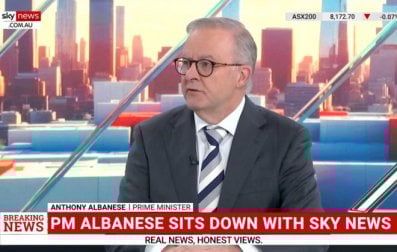
At 1pm on Tuesday, Albanese, Burke, Foreign Affairs Minister Penny Wong and Australian Federal Police Commissioner Reece Kershaw fronted the cameras in the prime minister’s courtyard at Parliament House.
“We informed the government yesterday of our assessment,” Burgess said. “Our investigations have been ongoing since October last year and involves ASIO’s own collected intelligence, the great work of the Australian Federal Police and liaison with foreign partners.”
Both the Bondi and Ripponlea fires had been orchestrated by Iran’s Islamic Revolutionary Guard Corps, Burgess said. The money had come through offshore channels, was laundered into Australia, and then passed to local cut-outs. The arsonists themselves likely had no idea they were acting for Iran, or even a foreign country.
“These were extraordinary and dangerous acts of aggression orchestrated by a foreign nation on Australian soil,” Albanese said. “They were attempts to undermine social cohesion and sow discord in our community. It is totally unacceptable and the Australian government is taking strong and decisive action in response.
“A short time ago we informed the Iranian ambassador to Australia that he would be expelled. We have suspended operations at our embassy in Tehran, and all our diplomats are now safe in a third country. I can also announce the government will legislate to list Iran’s Islamic Revolutionary Guard Corps, the IRGC, as a terrorist organisation.”
For the first time since World War II, an Australian government had expelled an ambassador. Ahmad Sadeghi, Iran’s envoy in Canberra, was given seven days to leave the country.
Later, during Question Time in the House of Representatives, Opposition Leader Sussan Ley offered bipartisan support for the government’s actions, with Albanese telling parliament that the government had informed Jewish community leaders prior to the 1pm press conference so they could watch what ASIO director-general Burgess had to say.
“People can have different views about the Middle East, and it’s absolutely legitimate for people to put forward those views,” Albanese said. “What is not legitimate is to blame Jewish Australians if they disagree with the policy of the Israeli government or to blame Arab or Muslim Australians for the actions of Hamas or other people. What we need to do is to make sure that we advance peace and security for people in Israel and Palestine.”
Ley opened Question Time on Wednesday by asking why Albanese hadn’t acted against Iran sooner.
“We called on the government to expel the ambassador last year and demanded the IRGC be listed as a terrorist organisation more than two years ago,” Ley said. “Since then, the Iranian regime has sponsored attacks on Australian soil. Prime Minister, why didn’t you act sooner when the warnings were so clear and the risks so grave?”
Albanese countered by quoting the Coalition’s home affairs spokesman, Andrew Hastie, the Coalition’s own former intelligence committee chair, who had admitted in a radio interview earlier on Wednesday that the Coalition too had failed to list the IRGC.
“The member for Canning did an interview this morning where he was asked, ‘Why didn’t the Coalition list it during its time in government?’ The member for Canning responded, ‘That’s a good question. I was the chair of the intelligence committee. I was always keen to list it. That’s for whoever was in government then to explain.’ ”
Albanese continued: “To be very clear, he’s talking about the then attorney-general, the then leadership and the various ministers that were then in office. That interview was today. He did another interview yesterday. Yesterday he said, ‘I think we should have listed the IRGC sooner, but I understand that our intelligence agencies had to stack it all up and do so in a forensic manner.’ ”
As to why the government hadn’t acted sooner, Albanese was unequivocal: “We listen to intelligence agencies. We don’t try to second-guess them. We got the advice on Monday morning and acted as soon as possible, given the need to get Australian personnel out of Tehran safely.”
While answering a follow-up question from Liberal MP Julian Leeser on why the government had ignored warnings from the Persian community, the Jewish community and the Coalition about Iran, and appeared to be playing catch-up, Albanese accepted a Coalition offer that he be given extra time to list everything the government had done in response to the wave of attacks on Australia’s Jewish community.
He listed the appointment of Jillian Segal as Australia’s first envoy on anti-Semitism, the creation of Special Operation Avalite to trace the arson attacks back to the IRGC, the implementation of sanctions, a ban on Nazi salutes and hate symbols, anti-doxxing laws, millions of dollars in funding for synagogue restoration and school security, and a Holocaust education centre to be established in Canberra.
“The withdrawal of an ambassador is a very serious step, indeed, to take,” Albanese said. “That is the step that we have taken.”
The context for the government’s actions this week have been building for more than two years.
A Senate inquiry into the human rights implications of violence in Iran had gathered evidence from Iranian Australians, academics and community groups about Tehran’s reach into Australia. Its report described credible accounts of surveillance, harassment and intimidation of diaspora activists, and called for stronger measures against foreign interference.
Tasmanian Liberal senator Claire Chandler, who chaired that inquiry, told The Saturday Paper this week she still believed the government should have acted sooner.
“The prime minister’s decision to finally list Iran’s Islamic Revolutionary Guard Corps as a terrorist organisation is a long-overdue step that should have been taken years ago,” Chandler says.
“The Senate inquiry I chaired in early 2023 made a clear recommendation to list the IRGC as a terrorist organisation, yet the government chose to do nothing. While I welcome the listing, it must serve as a lesson: when foreign threats are clear, our response must be swift, principled and unwavering.”
She added: “The IRGC’s designation, overdue as it is, should mark a turning point in how we respond to foreign interference and state-sponsored terrorism. We must ensure that government is equipped and willing to act decisively when the evidence demands it. Anything short of a proactive, clear-eyed approach risks undermining public confidence and compromising national safety.”
This article was first published in the print edition of The Saturday Paper on August 30, 2025 as "‘Extraordinary and dangerous acts’: Inside Iran’s domestic terror campaign".
For almost a decade, The Saturday Paper has published Australia’s leading writers and thinkers. We have pursued stories that are ignored elsewhere, covering them with sensitivity and depth. We have done this on refugee policy, on government integrity, on robo-debt, on aged care, on climate change, on the pandemic.
All our journalism is fiercely independent. It relies on the support of readers. By subscribing to The Saturday Paper, you are ensuring that we can continue to produce essential, issue-defining coverage, to dig out stories that take time, to doggedly hold to account politicians and the political class.
There are very few titles that have the freedom and the space to produce journalism like this. In a country with a concentration of media ownership unlike anything else in the world, it is vitally important. Your subscription helps make it possible.
Subscriber exclusive
Send this article to a friend for free.
Share this subscriber exclusive article with a friend or family member using share credits.