News
The timeline from the discovery to the exposure of the fake terrorist plot reveals how political exploitation served to stoke fears and erode public confidence. By Jason Koutsoukis.
Inside the Dural caravan terrorism hoax
The abandoned caravan had sat idle for weeks on Derriwong Road in Dural, a quiet suburb north-west of Sydney, until early December when one local resident decided it was becoming a road hazard and towed it onto his property.
About seven weeks later, on January 19, a mixture of curiosity and concern prompted the same man to force the caravan open. Discovering a cache of Powergel industrial explosives and a note listing a number of “Jewish entities” as targets – including a Sydney synagogue – the resident immediately alerted police.
Within hours, the state and federal police had launched a covert joint counterterrorism investigation under the NSW Joint Counter Terrorism Team, which includes ASIO and the NSW Crime Commission.
Quickly concluding that the caravan and its contents posed no direct threat, the Joint Counter Terrorism Team began investigating its origins under “Operation Kissinger”, noting how easily the caravan was found, as well as the lack of a detonator. Right from the start, investigators were treating the caravan as a possibly fabricated terror plot.
How this became, over the following two months, a politically charged debacle that risked both diminishing the seriousness of the rising wave of hate crimes and vastly overstating the imminent danger is only just becoming clear. The episode has highlighted the ways in which such issues are quickly weaponised, in the media and in the heat of an imminent election campaign, vaulting over the appropriate investigation process.
Dr John Coyne, director of national security programs at the Australian Strategic Policy Institute, describes that process as one of careful coordination: “Law enforcement and intelligence agencies must first confirm the credibility and specifics of a threat before making it public, ensuring that premature disclosures do not inadvertently amplify the threat, compromise ongoing investigations, or create unnecessary panic.
“Authorities must ensure timely and transparent communication that neither underplays nor sensationalises threats,” says Coyne. “Trust in government communications is key; therefore, messaging must be clear, fact-based and resistant to political manipulation.”
This is not how things unfolded from January 20. On that day, Premier Chris Minns and other senior NSW officials were briefed about the caravan’s discovery. The following day, police launched coordinated raids across multiple properties.
One raid targeted a property in Dural, adjacent to where the caravan was discovered, while another focused on a home in Sydney’s west. Both operations were conducted under Strike Force Pearl, the recently established NSW Police Force investigation into anti-Semitic incidents.
That same day, January 21, Prime Minister Anthony Albanese convened an urgent meeting of national cabinet, the intergovernmental forum comprising the prime minister and state and territory leaders, to respond to the alarming surge in anti-Semitic hate crimes.
In a statement later that day, Albanese said the Australian Federal Police (AFP)commissioner, Reece Kershaw, had briefed national cabinet on the latest police intelligence about anti-Semitic hate crimes. But it later emerged that Kershaw informed neither national cabinet nor the prime minister about the discovery of the caravan.
For the next eight days, Operation Kissinger remained covert, until January 29, when details of the investigation were leaked to Sydney newspaper The Daily Telegraph. Soon after the story went online, Premier Minns convened a press conference alongside the NSW deputy police commissioner, David Hudson, confirming the discovery of the explosives-laden caravan.
Hudson made it clear police harboured suspicions that the caravan could be part of a carefully staged hoax, with police investigating “whether someone was looking for some assistance at court, whether someone was going to disclose the existence of those explosives to us prior to it being recovered by a member of the community and towed to a safe place”.
While Hudson said NSW Police Force had not declared the discovery of the caravan a terrorist incident, Minns chose instead to focus on the explosives’ potential blast radius of up to 40 metres.
“This is the discovery of a potential mass casualty event,” Minns said. “There’s only one way of calling it out and that is terrorism.”
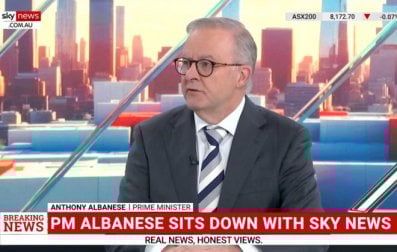
Asked on Sydney radio the next morning by the ABC’s Craig Reucassel whether he also classified the discovery of the caravan as terrorism, Albanese replied: “I certainly do.”
“I agree with Chris Minns,” Albanese added. “It’s clearly designed to harm people, but it’s also designed to create fear in the community. And that is the very definition. As it comes in, it hasn’t been designated yet by the NSW police, but certainly is being investigated, including by the Joint Counter Terrorism Team.”
When Albanese refused to say when he was first briefed on the caravan, the federal opposition went on the attack.
“The prime minister refused to say on ABC Radio this morning when he was briefed,” opposition home affairs spokesman James Paterson told ABC Radio’s Hamish Macdonald later that day.
“There is no good operational reason why the prime minister should refuse to say when he was briefed about this and he must be up-front today,” he said.
“Was he briefed on the 20th of January like the premier was? Was he briefed later? And what actions did he take after he was briefed, did he convene the National Security Committee of cabinet or not?”
At a press conference in Melbourne on January 30 at Boronia Heights Primary School, Albanese, standing alongside the Victorian premier, Jacinta Allan, and the federal education minister, Jason Clare, faced further questions about when he was first briefed.
“There are two issues that are my priority,” Albanese said. “The first is making sure that people are kept safe. The second, which is related to that, is making sure that any investigations aren’t undermined and that the police and national security agencies are able to do their work. I get ongoing briefings. Every day I get a national security briefing.”
A few days later Opposition Leader Peter Dutton called for an independent inquiry into the government’s handling of the caravan investigation.
“I think the prime minister should appoint an eminent Australian from the law enforcement and intelligence community to have a transparent look at what has failed here, because we can’t have what could have been the most catastrophic terrorist event in our country’s history and the prime minister doesn’t know about it until the public does,” said Dutton.
Appearing on the ABC’s Insiders program on February 2, Dutton revealed that he had spoken with the director-general of ASIO, Mike Burgess, about the caravan incident and had received AFP briefings.
“We’ve had James Paterson and our people have had briefings in relation to it. I’ve spoken – and I’m not going to go into the private details of text messages I’ve had with Mike Burgess – but I know this space very well … and I can’t believe that the prime minister hasn’t been informed,” Dutton said.
When Albanese was asked about the caravan in parliament two days later, the discovery of the caravan had morphed into “a planned mass casualty terror attack against Sydney’s Jewish community”.
“The leader of the opposition always has briefings made available when they’re requested,” Albanese told parliament. “He has not requested a briefing at this time.”
The reason, one Labor adviser tells The Saturday Paper, was that it was already becoming quite clear to people close to the investigation that the caravan was not part of a planned terror attack.
“The opposition did not request a briefing because they wanted to keep stoking this issue, and not have to own up to the fact that it was by then pretty obvious to everyone investigating the caravan that it had nothing to do with an actual terrorist incident,” says the Labor adviser.
By the end of the following week, the caravan had largely disappeared from daily headlines – until Saturday, February 15, when David Crowe, political editor for The Age and The Sydney Morning Herald, reported that police had turned their attention to organised crime gangs as the likely source of the explosives.
Police also confirmed to Crowe that Powergel explosives found inside the caravan were up to 40 years old, and that underworld crime figures had “offered to reveal plans about the caravan weeks before its discovery by police, hoping to use it as leverage for a reduced prison term.”
After which the caravan, which had been described as a “potential mass casualty event” by Minns and “a planned mass casualty terror attack against Sydney’s Jewish community” by Dutton, largely faded from public consciousness.
Until March 10, when, in a joint announcement, NSW Police Force and the AFP revealed their investigation had concluded that the Dural caravan incident was not a genuine terrorist plot but a fabricated scheme orchestrated by organised crime, with investigators labelling it a “criminal con job” rather than an ideologically driven attack.
According to police, the apparent motive was for the orchestrator – described as “the person pulling the strings” – to benefit from the resulting chaos, such as by trading information to authorities or influencing their own criminal prosecutions.
In total, 14 people have been arrested in relation to the broader string of staged anti-Semitic incidents across Sydney, including the caravan incident, and more than 140 charges have been laid for offences including arson, weapons and property damage.
With the full results of the joint police investigation now out in the open, it was the Albanese government’s turn to go on the attack, with Home Affairs Minister Tony Burke leading the charge.
“What we had was a situation where, quite deliberately, Peter Dutton made a decision to not find out the facts from the Australian Federal Police, to ignore the advice from ASIO in lowering the temperature, simply because it suited his self-promotion ambitions,” Burke told the ABC’s Sally Sara on Tuesday. “Now that is the very definition of being reckless with national security, but it’s precisely, precisely what he did.”
Neil Fergus, a private-sector consultant who specialises in counterterrorism risk management with more than 20 years’ experience in Australia’s federal security community, tells The Saturday Paper the Powergel explosives appeared to have been “repeatedly stolen in small quantities over a period of time to build up a cache of stock comprising a variety of production batch numbers”.
“Police will presumably be tracking to whom and when the various batches were sold and transported to investigate and try and identify the persons involved in the multiple thefts,” says Fergus. “Incidentally, Powergel is a detonator sensitive emulsion explosive and should not be transported nor stored with detonators.”
While Fergus believes current controls are fairly robust and effective, the perennial problem confronting authorities is when an “insider” involved in legitimate blasting operations pilfers small amounts while they are working.
“It is very difficult to detect,” says Fergus. “And, as demonstrated by the caravan’s contents, repeat thefts of the type believed to have occurred can result in a substantial cache eventually being built up.”
Still, says Fergus, cases of deception by organised crime elements, as described by the AFP and NSW Police Force, remain relatively rare.
“Obviously, it would have required some detailed long-term planning and the active participation of a number of people in related activities and anti-Semitic actions,” says Fergus. “Notwithstanding the strong likelihood a number of the anti-Semitic attacks in Sydney were not perpetrated by
this group.”
The Australian Strategic Policy Institute’s John Coyne also emphasised that even though police have concluded the caravan incident was a hoax, it has still resulted in increased anxiety among targeted communities.
“Fake terror threats, when effectively executed, can achieve the very objective of actual terrorism: sowing fear, distrust and social fragmentation. If left unchecked, such incidents can erode public confidence in government institutions and law enforcement’s ability to protect citizens,” Coyne said.
From a national security perspective, adds Coyne, repeated exposure to false alarms risks desensitising the public, making them either overly reactive or dismissive in the face of real threats.
“Additionally, adversaries, whether state or non-state actors, can exploit these fears to undermine Australia’s social cohesion and democratic resilience,” he says. “The challenge for security agencies is not just countering threats but also managing their secondary effects, ensuring that fear does not drive division or lead to overreach in policy responses.”
This article was first published in the print edition of The Saturday Paper on March 15, 2025 as "A caravan of no competence".
For almost a decade, The Saturday Paper has published Australia’s leading writers and thinkers. We have pursued stories that are ignored elsewhere, covering them with sensitivity and depth. We have done this on refugee policy, on government integrity, on robo-debt, on aged care, on climate change, on the pandemic.
All our journalism is fiercely independent. It relies on the support of readers. By subscribing to The Saturday Paper, you are ensuring that we can continue to produce essential, issue-defining coverage, to dig out stories that take time, to doggedly hold to account politicians and the political class.
There are very few titles that have the freedom and the space to produce journalism like this. In a country with a concentration of media ownership unlike anything else in the world, it is vitally important. Your subscription helps make it possible.
Subscriber exclusive
Send this article to a friend for free.
Share this subscriber exclusive article with a friend or family member using share credits.