News
The government invited only the progressive independents – excluding the Greens, the Coalition and the relevant parliamentary committee – to a briefing on the still-unpublished Climate Risk Assessment report. By Karen Barlow.
Your subscription makes these exclusive articles possible
Subscriptions make these exclusives possible SUBSCRIBE NOW
Exclusive: Secret briefings on climate national security risk
“Frankly terrifying” is how independent Senator David Pocock sees the external national security threat of climate change to Australia.
He’s seen the unreleased report on the risks, and he and progressive independents in the house say it is “recklessly negligent” not to let Australians know as well. The Saturday Paper can reveal that on December 9, a non-sitting day of parliament, the crossbenchers dialled in to a secure meeting to be briefed on the Office of National Intelligence’s (ONI) long-awaited Climate Risk Assessment report. The report was delivered to the government in early 2023.
The Coalition and the Greens were not briefed, nor was the usually bipartisan Joint Parliamentary Committee on Intelligence and Security.
The Greens say the independents are now gagged as to the report’s contents, but it is an issue that will weigh heavily in any negotiations with the cross bench in the event of a hung parliament. This leaves the Greens less informed than the independents on an issue core to the party’s campaign, heading into an election that most reputable polls point to delivering a hung parliament.
“We’re woefully underprepared for what’s coming,” Pocock tells The Saturday Paper. “It’s no surprise that the government has been sitting on this report from the Office of National Intelligence.
“After hustling the government for the last few years, they gave crossbenchers a private briefing on it and it’s frankly terrifying, what our national security agencies are telling us is coming, and government is not acting,” the senator says. “I think it is actually negligence from both of them.”
Pocock is referring to both Labor and the Coalition as Australia inches closer to a federal election that must be held by May 17, but which has been delayed by Tropical Cyclone Alfred hitting Australia’s east coast far further south than usual.
Nevertheless, climate change is largely being framed in the pre-campaign as a debate about energy prices in a cost-of-living crisis.
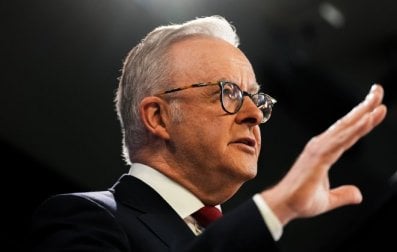
Anthony Albanese says he listens to science and recognises the impact of climate change on Australia’s weather patterns. “I take climate change seriously and my government takes climate change seriously,” the prime minister told reporters as Alfred approached the coast.
Yet an update to the separate, more domestically focused National Climate Risk Assessment is also well overdue.
The national security risks associated with climate change should be shared with Australians, says Zali Steggall, who would not confirm whether she had been briefed on the report.
“No one is officially telling Australian people that we have officially passed 1.5 degrees,” says the independent member for Warringah. “The question now is, how much below two degrees can we stay?
“Most experts are saying we’re actually on track for 2.6 to three degrees. Now, that is catastrophic in some areas. So, I think it’s recklessly negligent of either major party to fail to properly inform the Australian people of the risk ahead.”
The independents – including Andrew Wilkie and Helen Haines – are not talking about the contents of the ONI report, which was ordered by Labor soon after taking office and led by Australia’s most senior intelligence chief, ONI Director-General Andrew Shearer, with input from the Department of Defence.
Albanese, the minister responsible for the ONI, has been adamant in the past that “considerable material” on climate risk is already publicly available, including the warning in the declassified version of the “2023 Defence Strategic Review” that climate change may “significantly increase the risk of conflict in the region”.
When Richard Marles, the deputy prime minister and defence minister, took questions on Cyclone Alfred in a press conference last week, reporters raised the increasing use of the Australian Defence Force for disaster response as natural disasters become more frequent and more intense – a key concern in the strategic review.
“In a macro sense, we needed to be thinking about how we supported all of our governmental efforts in terms of responding to natural disasters and ensuring that Defence was the last port of call,” Marles told reporters.
“It is obviously going to be the case and will always be the case while we are here, that Defence will be there ready to provide support when they have unique assets that can be provided.”
The ONI assessment offers a different perspective on the effect of climate change, however: that of Australia looking out to the world.
While the member for Goldstein, Zoe Daniel, says the report – now a couple of years old – is already in need of updating, she agrees that “there’s a really strong case for a declassified version of this kind of information being released”.
The independents were not allowed to bring any staff into the December 9 briefing, which took place after federal parliament rose for 2024. Daniel said the briefing was the result of the cross bench’s persistence, and the deputy prime minister agreeing to one.
“I don’t think any of us would have been particularly surprised by what we heard, given how engaged we are with this particular range of issues and impacts on climate. But still, it’s important to get the actual facts.”
Over almost two years, the independents, along with Greens Senator David Shoebridge, have argued reports similar to that from the ONI in the United States and Britain are publicly available. Those reports talk of sea-level rise impacting naval bases, increased risk of global unrest, global supply breakdowns, the growing concern over climate refugees, and the opening of sea routes previously covered by sea ice.
They warn that the reduction in sea ice “already is amplifying strategic competition in the Arctic over access to its natural resources” and there will be strain on global energy and food systems.
Germany last month published its own National Interdisciplinary Climate Risk Assessment warning the climate crisis is the “biggest security challenge of our time” and that a “mix of violence and climate crisis is forcing more and more people around the world to leave their homes”.
Shoebridge is not happy the ONI climate risk report is still classified and he sees selective briefings as a gag.
“Both Labor and Coalition are notorious for offering confidential briefings to their opponents as a way of silencing public criticism,” he tells The Saturday Paper.
“In this case, credible security experts have made it clear this ONI report has likely made very strong statements linking climate change with national security. However, once you are told that in a confidential briefing, this effectively gags you from saying that again because you had that reinforced in secret.”
The Saturday Paper sought an interview with Marles on the reasoning behind the selective briefings, but he declined.
In response to questions sent to both the prime minister and the deputy prime minister, a spokesperson for Albanese sent a statement saying the “Albanese government is committed to action on climate change”.
“We engage constructively with the crossbench, and that engagement includes regular briefings,” the statement read. “Some briefings are confidential, and we trust that confidentiality is respected.”
The former chief of the ADF, retired Admiral Chris Barrie, has not seen the report but wants it in the public sphere after he encouraged Labor to commission it as part of the Australian Security Leaders Climate Group.
“They grabbed hold of the idea, put it in the Powering Australia platform for election in 2022 and it’s sort of fizzled out,” Barrie tells The Saturday Paper.
He has an idea about the contents.
“I think the thing that would be most terrifying was the concept that displaced people from other countries would want to come here,” Barrie says. He cites the case of Bangladesh, which faces losing close to a fifth of its territory to rising sea levels by 2050, including a third of its agricultural land.
Years ago, he says, he estimated that as many as 40 million displaced Bangladeshis may be unable to find homes in overcrowded neighbouring countries and, over time, would be seeking refuge in places like Australia.
The climate risk report by the US National Intelligence Council, one of a number of published government and non-government security assessments, shows the superpower assessing high risks to US interests of cross-border migration by 2030, and water tension and conflict by 2040. It expects increasing geopolitical tensions as countries argue over these issues and how to pay for the world’s decarbonisation. It expects countries to compete to control resources and dominate new clean energy technologies.
Former US special envoy for climate change Jonathan Pershing, who has been in Australia for Climate Action Week Sydney, says the sheer cost of addressing these challenges has been a motivating factor for making such information public in the US.
“I think that you’ve got some sense that there’s going to be a financial cost to mitigating that risk,” the program director of environment at the William and Flora Hewlett Foundation tells The Saturday Paper. “And in order for congress to be aware, they can always get a confidential report, but often those things do have a public dimension as well, and congress is interested in public reactions when they have to spend money.
“I don’t think it tends to reveal the kind of confidential preparedness information. That’s material that I’m sure is being done that could be fully classified and you would not see it in the public domain.”
But the Climate Risk Assessment report is not the full picture of risks to Australia from climate change. There is also the separate commission of a domestic National Climate Risk Assessment, the first pass of which came out in March last year, with the government’s assistant minister for climate change, Josh Wilson, identifying that “basically everything” is at significant risk because of climate change.
Minister for Climate Change Chris Bowen describes the risk assessments as the “foundation for our climate response for years to come”. The government said in November that the second-pass assessment was under way and will be a “deeper quantitative analysis of the top 11 priority risks”.
Barrie wants to know where it is.
“The second pass report from that domestic risk assessment was supposed to be delivered in December last. Guess what? We haven’t seen it, and we haven’t heard of it, and as far as I’m aware, it’s been buried,” he says.
The Saturday Paper understands that the work on the second pass assessment has apparently proved more complex than expected, and it is nearing finalisation with a view to being released soon.
These criticisms come as the Coalition accuses the Albanese government of sitting on a review of Australia’s spy agencies by senior public servants Heather Smith and Richard Maude.
The 2023 commissioned report was delivered to government eight months ago, and officially the government is still considering its response. The last review, the 2017 L’Estrange–Merchant review, led to the creation of the ONI.
The 2017 report mentions “climate change pressures” among resource security concerns, and irregular migration of people as contributing to “heightened tensions and instabilities that are affecting nations’ perceptions of their security”.
Albanese came to power promising to end the climate wars. The fight between the major parties on climate action continues, and importantly, while renewable energy is being rolled out at a determined pace, Australia remains heavily reliant on coal and gas, with more fossil-fuel project approvals pending.
Looking beyond this election, Zali Steggall has proposed a private member’s bill that would legislate regular, independent and public National Climate Risk Assessments, force the government of the day to have detailed adaptation plans, and the Climate Change Authority to do yearly implementation reports around that planning.
“It’s like having a security assessment that tells us our armed forces are 50 per cent too small but not having any kind of plan in play for the next five to 10 years to increase our capacity. It’s the same thing.
“We have to start investing in that preparation and adaptation.”
This article was first published in the print edition of The Saturday Paper on March 15, 2025 as "Exclusive: Secret briefings on climate national security risk".
For almost a decade, The Saturday Paper has published Australia’s leading writers and thinkers. We have pursued stories that are ignored elsewhere, covering them with sensitivity and depth. We have done this on refugee policy, on government integrity, on robo-debt, on aged care, on climate change, on the pandemic.
All our journalism is fiercely independent. It relies on the support of readers. By subscribing to The Saturday Paper, you are ensuring that we can continue to produce essential, issue-defining coverage, to dig out stories that take time, to doggedly hold to account politicians and the political class.
There are very few titles that have the freedom and the space to produce journalism like this. In a country with a concentration of media ownership unlike anything else in the world, it is vitally important. Your subscription helps make it possible.
Subscriber exclusive
Send this article to a friend for free.
Share this subscriber exclusive article with a friend or family member using share credits.