Books
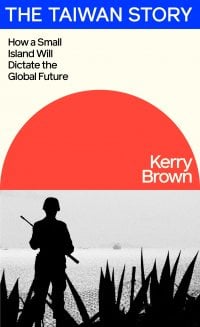
Kerry Brown
The Taiwan Story
As the focus of our collective anxiety moves between the horrors of Gaza, the political circus in the United States and other crises, few of us pay enough attention to what’s happening in the Taiwan Strait.
Kerry Brown wants to change that. Of all the actual and potential conflicts in the world, he argues, this could be the big one. If Beijing makes good on its threat to “reunify” the island militarily, and the US gets involved, we may be staring down the barrel of world war. At the very least, given Taiwan’s key role in the world’s supply chains, military action by China would “aim a dagger at the heart of the global economy”, triggering worldwide economic depression.
The world could “sleepwalk” into disaster, he warns, if we don’t give the China–Taiwan issue our commitment and attention. Brown does not mention Australia, but given AUKUS and US military creep here, if there is conflict, we will be drawn in, with predictably catastrophic results.
The Taiwan Story: How a Small Island Will Dictate the Global Future is both less and more than the promise of its title. Brown provides a big-picture account of Taiwan’s history, centring on its relationship with China, which is neither as eternal nor solid as Beijing would have it. But it is not really the story of Taiwan, or at least as richly detailed or precise an account of the island’s story as given, for example, in Jonathan Clements’ Rebel Island, also published this year.
Brown’s purpose is elsewhere: to address what he calls “the Taiwan–China challenge”. His focus is on how Taiwan’s unique history and relationship to the mainland has led to the current, fraught situation – and how the rest of the world might act to mitigate the chance of disaster.
The evolution of Washington’s China policy has played an outsized role in the island’s fate, and it is still evolving. Brown notes that in his term in office, US President Joe Biden has provocatively promised to come to Taiwan’s aid in a crisis. In doing so he has abandoned the longstanding and eminently useful policy of “strategic ambiguity”. American politicians of all stripes, from Nancy Pelosi to Newt Gingrich, are increasingly prone to self-serving, irresponsible grandstanding on the Taiwan question. All bets are off if Trump gets a second term: in a crisis, he could do anything or nothing at all.
Xi Jinping, like other Communist Party leaders before him, insists loudly and frequently that Taiwan has always been part of China. This assertion is 30 per cent doctored history, 30 per cent ideology and 40 per cent wilfulness. For the Taiwanese themselves, Brown observes, “Being called Chinese … is like summoning up a shadow self, a part of identity that is hostage to forces and assertions that are beyond one’s control.”
In fact, “as an example of excluding those affected by decisions from the actual process of decision-making itself”, the Taiwan situation is “unparalleled”.
Austronesian tribes were the island’s original inhabitants. Then came the odd uninvited Chinese and Japanese pirate or trader, followed by Spanish and Dutch colonialists. After the Ming dynasty fell to the Qing in 1644, a bunch of Ming loyalists decamped there. The Qing couldn’t have that, so they soon claimed the island but then lost it to Japan in 1895. Fifty years later, at the end of World War II, the Japanese left. The Nationalist government of Chiang Kai-shek, busy fighting the Communists, sent a handful of corrupt and brutal henchmen across the Strait to run the place. They managed to infuriate the local population to the point of insurrection, prompting the imposition of martial law. After Chiang Kai-shek lost the civil war in 1949, he fled there with a million or so supporters, soldiers and officials, planning, like the Ming loyalists before him, to use it as a base for retaking the mainland. Didn’t happen. Martial law only wound up in 1987 and Taiwan began to democratise.
As democracy took off, the Communists began to worry. The Nationalist old guard, once reliably committed to reunification despite wanting themselves to be in charge, had given way to a newer generation less interested in reunification than simple contact and cooperation. Some leaders of the newer parties, such as the incumbent Democratic Progressive Party (DPP), even mumbled things that sounded, alarmingly to mainland ears, like calls for independence.
One of the most valuable aspects of this book is its close survey of Taiwan politics over the past several decades. Brown notes how Taiwan politics reflect changing social and economic conditions as well as rising nativist sentiment, with fewer and fewer Taiwanese willing to identify in any way as “Chinese”.
Brown’s hypothetical about a populist US senator who proactively recognises Taiwan’s independence and triggers a war is unnecessarily long-winded, although the point that this scenario is “no longer so far-fetched” is a valid one. As he stresses, China, normally a “rational actor” , does not act like one when it comes to Taiwan: “nationalism in Xi’s China works increasingly like a state religion”, and the recovery of Taiwan is its first commandment. Indeed, while I write this, China is conducting war games around the island.
Brown passionately – and, to my mind, rationally – defends ambiguity as the best stance for other countries to adopt. In essence, Beijing should not know how or how strongly they might react if it invaded Taiwan. Hope for global security may well depend, he says, on “hedging with clarity and focus as never before”.
Viking, 272pp, $42.99
This article was first published in the print edition of The Saturday Paper on October 26, 2024 as "The Taiwan Story".
For almost a decade, The Saturday Paper has published Australia’s leading writers and thinkers. We have pursued stories that are ignored elsewhere, covering them with sensitivity and depth. We have done this on refugee policy, on government integrity, on robo-debt, on aged care, on climate change, on the pandemic.
All our journalism is fiercely independent. It relies on the support of readers. By subscribing to The Saturday Paper, you are ensuring that we can continue to produce essential, issue-defining coverage, to dig out stories that take time, to doggedly hold to account politicians and the political class.
There are very few titles that have the freedom and the space to produce journalism like this. In a country with a concentration of media ownership unlike anything else in the world, it is vitally important. Your subscription helps make it possible.
Purchase this book
The Taiwan Story
BUY NOW
When you purchase a book through this link, Schwartz Media earns a commission. This commission does not influence our criticism, which is entirely independent.
Subscriber exclusive
Send this article to a friend for free.
Share this subscriber exclusive article with a friend or family member using share credits.