News
Following a mixed reception to the latest piece of the Coalition’s policy, the shadow minister reveals further measures to come on deregulation and access to finance. By Karen Barlow.
The Sukkar interview: How the Coalition plans to fix housing
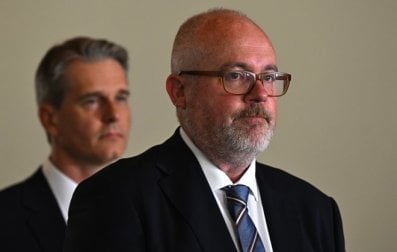
The opposition’s housing spokesman, Michael Sukkar, has defended his party’s focus on deregulation in the property sector as a way to tackle cost-of-living pressures. He says that more is to come, alongside an update to the Coalition policy allowing home buyers to access more of their super to pay for a deposit.
The opposition’s new proposal is a program to “unlock” backlogs in the delivery of homes by spending $5 billion over five years on “critical enabling infrastructure” such as roads, roundabouts, power, communications, footpaths, water and sewerage. The announcement comes just days after revelations of Prime Minister Anthony Albanese’s purchase of a $4.3 million New South Wales Central Coast property stirred accusations that Labor is out of touch with struggling voters.
To distinguish itself from the government, the Coalition says it is fixing on those aspiring to own a house with a backyard out in the new greenfield suburbs, and accuses the government and the Labor states and territories of concentrating on inner-city infill developments of high-rise apartments.
“I think it’s a bit of a fad amongst policymakers at the moment that Australians should only have the choice, in the future, of purchasing an apartment, and we think Australians should have a range of options, including detached homes with backyards,” Sukkar says.
“We don’t make any apologies that there’s a focus of this fund on greenfield, because in the end, the focus of the fund is getting [as many] houses unlocked as humanly possible.”
Sukkar’s comments come as a major housing group distances itself from the opposition’s latest offering.
The housing infrastructure policy sits alongside a plan for a 10-year freeze on further changes to the National Construction Code, which relates to the safety and amenity standards of builds, and a pledge to review it. Since 2022, the code has required all new houses and apartments to meet a minimum energy efficiency rating of 7 stars, and it has been blamed for inflating property prices.
Days after standing with Dutton and Sukkar as the policy was unveiled, the Property Council of Australia chief executive Mike Zorbas has made it clear he does not actually support a freeze on changes to the code. “The Property Council has long supported the regular review and interstate coordination benefits of the National Construction Code,” he said in a statement.
Sukkar defends the Coalition’s focus on cutting red tape and rejects the suggestion that the Property Council has walked back support for the new policy.
“The Property Council’s had a very longstanding position on the NCC, so he’s never walked back on that at all, as far as I’m aware,” he said. “The Property Council is very supportive of the housing infrastructure program.
“They’ve always reserved that they think that regular changes to the NCC are necessary. They are most definitely in the minority in the industry.
“That additional $30,000 [to meet the 7-star rating] is the difference between owning a home or not,” Sukkar says. “Gold-plating these sorts of homes will be right for some people, and we encourage them to do so, but for first-time buyers, who are the most price sensitive, we want them to have the greatest opportunity to own a home at some point in their lives, and that doesn’t happen by imposing more and more regulatory requirements that just push up the cost of building a new home.
“In the end, every dollar of regulation and tax finds its way into the end product for a consumer, it’s not borne by the terrible, evil property developers, in inverted commas.”
Groups like National Shelter are protective of the code, saying it has been responsible for phasing out older-style “hovels and hotboxes”.
“We’re wanting to have housing that is responsive to the changing environment so that people can have their energy bills going down, and that it’s comfortable in terms of those really hot days,” says National Shelter chief executive Emma Greenhalgh.
“How do you incentivise property investors to make the homes for renters much more energy efficient with things like solar and insulation and potentially double-glazing and the removal of gas and increasing electrification?”
Independent Senator David Pocock is more blunt. “I think it sends a terrible signal about what the Coalition actually thinks about climate change and mitigation and adaptation,” he tells The Saturday Paper.
There’s no going backwards, according to the Housing Industry Association, but managing director Jocelyn Martin says the code has added to the cost of a home and that a “good, strong conversation” is needed.
“Builders now have been through those changes. They have adapted their plans. They are back on track in terms of that,” she says. “A repeal of any of those changes would probably just be very challenging. We wouldn’t support that. But certainly, looking ahead and looking at how we make those changes to the National Construction Code is something that we very much support.”
The Coalition has come under criticism for failing to address a mounting housing crisis under its decade of continuous leadership. Until this month, the newest element of the opposition’s housing proposal was Peter Dutton’s pledge to slash immigration as a way of reducing demand – the details of which are yet to become clear. Sukkar is now flagging some possible amendments to the policy his party took to the last election, which would allow first-home buyers to use up to 40 per cent of their super to a maximum of $50,000 on a home deposit.
“It’s a policy that we’ve carried over from the last election and so that inevitably means it’s three years old now, three years old by the time of the next election. So, we’ll look at it,” Sukkar says. “If there are any tweaks, they won’t be significant.”
The Coalition is also running a Senate inquiry chaired by Liberal Senator Andrew Bragg to look at home loan lending standards. “It’s an indictment that the CEO of a Big Four bank basically comes out and says finance is the province of rich people,” Sukkar says.
Bragg, the Coalition’s housing affordability spokesman, says it is time to get creative. “I think we need a massive national effort to get the houses built,” he tells The Saturday Paper. “And this is what Menzies did when he came in [to office] in 1949 and he inherited a very similar situation where you had high immigration and low housing construction.”
The Coalition’s latest policy is an attempt to address the supply shortages that many blame for the affordability crisis. It claims its proposal will support the construction of 100,000 houses a year, or 500,000 over the program’s lifetime. The policy is based on advice from developer group the Urban Development Institute of Australia, which drew on research conducted in the NSW Lower Hunter and Central Coast and provided to both the government and the opposition.
“We believe it is credible to suggest a national average of $10,000 per dwelling as a shortfall in enabling infrastructure,” an institute spokesperson said. “Therefore, it is acceptable policy to suggest that for every additional $1 billion invested in enabling infrastructure, up to 100,000 additional dwellings could be developed across the country.”
The new infrastructure policy, for connections that make homes liveable, including roads, roundabout and sewerage, is an as-yet-unknown mixture of “use it or lose it within 12 months” grants, loans and equity to the private sector – that is, construction companies and property developers.
“The precise composition of the two will be pretty well informed by what we believe the best mix is,” Sukkar says. “There’s no point having a composition of the fund that means that it goes unused.”
“We’ll announce what the precise breakdown will be, with a view that we want every dollar out the door.”
He says the federal infrastructure department would oversee the program.
The office of Housing Minister Clare O’Neil characterised the Coalition’s plan as supporting “developers to build homes out on a city’s urban fringes”.
“We don’t know how much of their announcement is loans or grants, and there’s no plan for supporting infrastructure like public transport, schools or healthcare,” the office said in a statement.
Judging by their housing proposals so far, the Coalition still aims to spend less on housing than the government, which announced an overall $32 billion housing plan, but it is not clear about how much less. Both sides are promising more to come. The government’s $10 billion oversubscribed – and still getting under way – financing vehicle for social and affordable houses, the Housing Australia Future Fund, is in the opposition’s sights to cut.
Labor has a bold but significantly delayed pledge with the states and territories to build 1.2 million new homes over five years under the National Housing Accord. About 64,000 extra new homes need to be built each year to achieve the accord’s target, according to the Business Council of Australia.
The government also has a housing infrastructure program worth $1.5 billion over two years, $1 billion of which is earmarked for social housing.
With just over half a year left till the last possible date of the next federal poll, however, the government’s housing bills, Help to Buy and Build to Rent, are still stalled in the Senate. And Labor, the Coalition and the Greens could hardly be further apart. While Labor champions social housing and infill in cities, the Coalition is standing out in the outer suburbs’ greenfield, and the Greens have a big focus on renting and young first-home buyers.
The adversarial nature of the political debate is deeply concerning to many observers.
“There’s a frustration around the absolute politicisation of housing,” says National Shelter’s Emma Greenhalgh. “This isn’t just some sort of existential threat. You really actually want to see parties coming together. To be working on it.”
National Shelter is urging the formation of a wartime cabinet or an effort akin to the pandemic response, focused on solving Australia’s housing affordability crisis.
“For people who are on the ground experiencing this housing crisis, we can’t afford to continue to wait to get them into housing,” Greenhalgh says.
RedBridge Group pollster Kos Samaras says naked politicking is being noticed by voters. His group has been tracking housing sentiment in individual electorates to find fundamental pessimism.
Only 15 per cent of people polled thought a person could buy their first home without family assistance.
“They fundamentally don’t think anything’s going to be done to fix it,” he tells The Saturday Paper. “So, there’s no confidence in the electorate that whatever the major parties in particular are offering right now is ever going to be delivered, or they’ll see the actual tangible outcomes of it.
“The pessimism isn’t just about the attainability, it’s also about the political class actually having the capacity to make changes.”
While the current policy offerings can be seen as doing something about the crisis, Samaras says it is coming off as bickering.
“When we test some ideas, and say, ‘What do you think? Should there be a housing summit where we get all the stakeholders and all the political parties in the one conference, and everyone thrash out a unified plan?’ That’s what they want,” the Redbridge Group director says.
“They don’t want this politicised. That’s where the Greens are getting a bit of blowback from their constituency as well on this.
“They’ve seen what happens when all governments get together and work together at the beginning of the pandemic. They know that in times of crisis, things can gel, that they expect that pandemic-type response to the housing crisis.”
Sukkar says the government should look at itself. “I think there’s no doubt about that frustration, and a frustration that the government’s been unable to deliver on many of the things that they’ve committed,” he says.
“Things have seemingly got worse, whether it’s rents up by 25 per cent, whether it’s first-home buyers down, whether it’s fewer homes being built, whether it’s approvals down at 158,000 at last count.”
And the housing minister says the opposition should look back at what it did or did not do while in government.
“We have a broken housing system, but also broken housing politics. Housing has become incredibly politicised, and weaponised, by both the Coalition and the Greens. The reality is that we are in the midst of a housing crisis that has been 30 years in the making – for 20 of those years the Coalition has been in office,” a spokesperson said.
“We are trying to work outside of the hyper-political housing debate in parliament and work directly with states, territories and industry to get more homes built.”
Pocock, who has a private senator’s bill to legislate objectives and targets for a national housing and homelessness plan, says he is not seeing the housing crunch being treated like the crisis it is.
“This is much bigger than just about housing. This is about our future as a country,” the ACT representative tells The Saturday Paper.
“If we cannot get housing right, we’re really seeing people starting to buckle under the pressure, and what that means for individuals and families and communities and the knock-on effects. There’s no one thing that’s going to solve it, but we need sensible tax reform. That’s something that’s not on the table for the major parties.”
This article was first published in the print edition of The Saturday Paper on October 26, 2024 as "The Sukkar interview: How the Coalition plans to fix housing".
For almost a decade, The Saturday Paper has published Australia’s leading writers and thinkers. We have pursued stories that are ignored elsewhere, covering them with sensitivity and depth. We have done this on refugee policy, on government integrity, on robo-debt, on aged care, on climate change, on the pandemic.
All our journalism is fiercely independent. It relies on the support of readers. By subscribing to The Saturday Paper, you are ensuring that we can continue to produce essential, issue-defining coverage, to dig out stories that take time, to doggedly hold to account politicians and the political class.
There are very few titles that have the freedom and the space to produce journalism like this. In a country with a concentration of media ownership unlike anything else in the world, it is vitally important. Your subscription helps make it possible.
Subscriber exclusive
Send this article to a friend for free.
Share this subscriber exclusive article with a friend or family member using share credits.